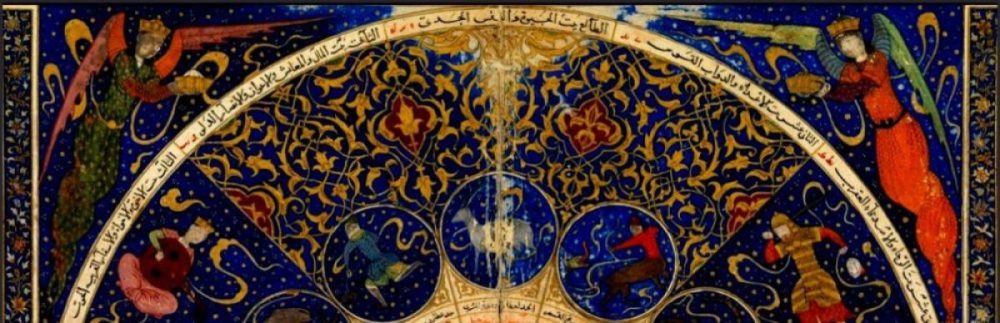
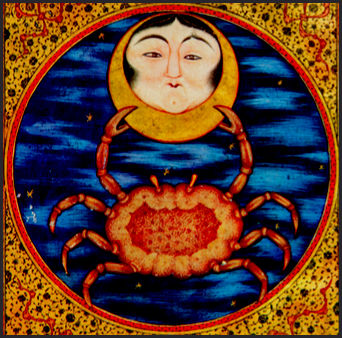
Detail of The Moon in Cancer from the Book of Felicity (1582), an illuminated manuscript commissioned by Sultan Murad III, who ruled the empire from 1574 to 1595, its text was translated from Arabic and all its miniatures were apparently directed by the famous master Nakkaş Osman
This a simple heads up to a rather significant lunation as the Sun is about to leave Cancer. For many people, a New Moon refers to when it becomes visible again. However, with the Sun conjoining with the Moon, this is also the Dark of the Moon because it cannot be seen.
This conjunction is also referred to as a syzygy and is one of the causes of crucial consideration of the Pre-Natal syzygy, usually referred to as a Prenatal lunation or the most recent first New Moon or Full Moon prior to the nativity. The Solar and Lunar forces are mingling and setting the stage for the next lunation. So, the two states are a conjunction of the Moon with the Sun and an opposition of the same.
The Moon in Cancer is very much at home, highly reflective, intuitive and nurturing. It is also highly protective of itself, as the image of the Crab suggests. It is a good moment to explore emotional reactions.
The Moon is the Great Mother. However, she doesn’t do well when badly aspected by Mars or Saturn or indeed in their signs. The Moon is in her only domicile in Cancer and Capricorn is the sign of her detriment. She Falls in martian Scorpio. Importantly, the opposition is precise and in Capricorn.
In a previous article, I discussed the opposition to the Capricon planets. At that time the Moon was with Jupiter and Saturn on the other end of the opposition. Here we have a new beginning.
The house placement will, of course, change depending on the location and time zone. This chart is drawn for Greenwich. The following applies specifically to London, England. In this chart, the opposition is on the Gates of Hade’s axis. There is more than one reason that this axis is considered as unfortunate.
The primary reason is that neither house aspects the Ascendant – the place of the life force and the means by which we navigate our lives. The second reason is likely to be because of the emphasis on the material and specifically, money, which has been associated with the “root of all evil” for millennia. The real danger is that we may lose our way, not connected to the compass of the Ascendant, as it were. The emphasis on the material provides a further sign of how else we may lose our way.
The 8th house is also indicative of death. With both luminaries in this house and on this axis will logically cause alarm. But Venus is in the 7th house and in the Exaltation of the accompanying Node. This is a welcome relief in an otherwise troubled chart

New Moon in Cancer. 20 Jul 2020 AD GC. 6:32:49 PM. Greenwich, England. 0w00’00. 51n29 00. BST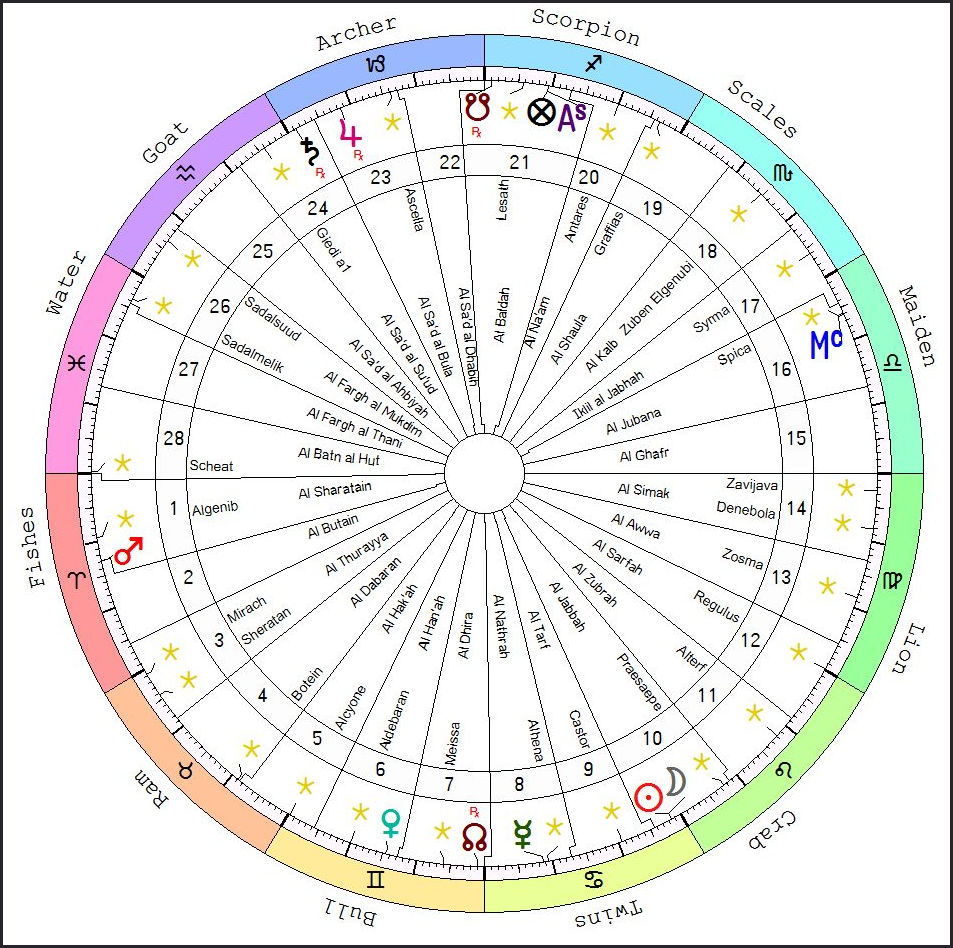
The syzygy is in found in the 19th Lunar Mansion. The Arabic name is Al Jabhah. The English translation is Lion’s Forehead watched over by the Angel Ardefiel. It is noteworthy that the constellation originally associated with this mansion is Leo, with the principal stars associated with this mansion being Regulus (alpha Leo), Algieba (gamma Leo), Adhafera (zeta Leo), and Al Jabhah (eta Leo).
For this reason, the use of Lunar Mansions must never lose the connection to the Sidereal zodiac, while reading the mansion in the context of the Tropical.
According to Ptolemy, the nature of Regulus is Mars and Jupiter, and the nature of Adhafera and Al Jabhah is Mercury and Saturn. Dorotheos tells us that this a good Mansion for buildings, which will last, and for partnerships, benefiting all parties.
According to Ibn ‘Arabi (1200 AD), the attribution is “The Sky of the Fixed Stars, the Sphere of the Stations, the Sun of Paradise, the Roof of Hell.” and suggests the Divine Attribute is “The Powerful.”
This lunation is a time to reflect on a dire moment without delusions and to act in accordance with noble intent. This is a place of great strength in a time of adversity.






 The Classical Astrologer