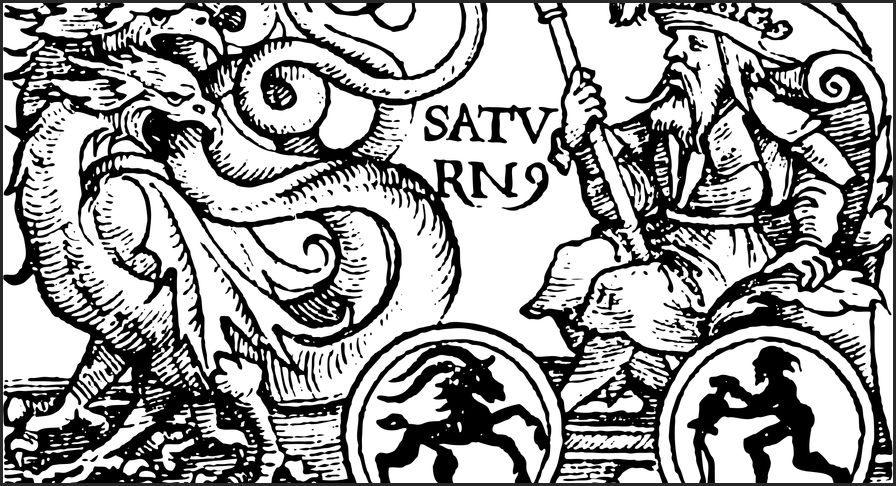
De Magnis Coniunctionibus: Tropical Aquarius – Sidereal Capricorn

Saturn, from Guido Bonatti Liber Astronomiae – Nicolaus Pruknerus,

The Winter Solstice this year is like no other that any of us have experienced,  I would like to begin by stating in simple terms what the attending Grand Conjunction is and isn’t. One of the central questions explored here is how the conjunction may be interpreted depending on which method is used.

Be advised that I have previously written articles, readily accessible on this blog, on the conjunction itself and merely wish to add some thoughts on the larger picture of the conjunctions in a wider context of interpretation.  First off, here is the chart for the exact moment of the Conjunction.

You will notice that this occurs within a few minutes of arc after the precise moment of the Winter Solstice. We cannot read the chart for the Grand Conjunction without considering its timing on the Solstice and we should not attempt to interpret the Solstice without regarding the integral element of the Conjunction.

What it is:

The Grand Conjunctions occur on average every 19.6 years, as Jupiter joins Saturn, due to the combined effect of Jupiter’s approximately 11.9-year orbital period and Saturn’s 29.5-year orbital period.

Since antiquity, these events were held to be of the utmost importance. As the two social chronocrators,  they signal the nature of the ensuing two decades and beyond. However, this Grand Conjunction represents a change from the triplicity of Earth to the triplicity of Air when employing the tropical zodiac.

However, it cannot and should not be ignored that great historical astrologers used a sidereal zodiac and chose mean conjunctions. The essential difference between the mean and true conjunction is as follows:

“A mean conjunction in Ptolemaic astronomy happens at precise, regular intervals. It is based on the average length of each planet’s cycle in the zodiac, which is nothing more than the cycles we are familiar with today: the 12-year cycle of Jupiter is actually a rounding-up of the more accurate cycle of 11.86 years. Likewise, the period of the “Saturn return” is 29.4 years. But in Ptolemaic astronomy this period has a technical meaning: it is the length of time it takes for the center of a planet’s epicycle to revolve exactly once around the zodiac. The position of the center of the epicycle is its “mean” position as it revolves at a constant or mean rate.” See Dykes.

So, when we say the current conjunction occurs in Aquarius, we are being true to the tropical zodiac, using ‘true’ conjunctions. With this in mind, let’s examine what the tropical zodiac and ‘true’ conjunctions illustrate.

When the trigons shift to another element, the event is referred to as a Mutation. With the exception of one Grand Conjunction in the airy element of Libra, the Exaltation of Saturn, all others have been in the element of the earth continuously since 1842 when calculated using a tropical zodiac.
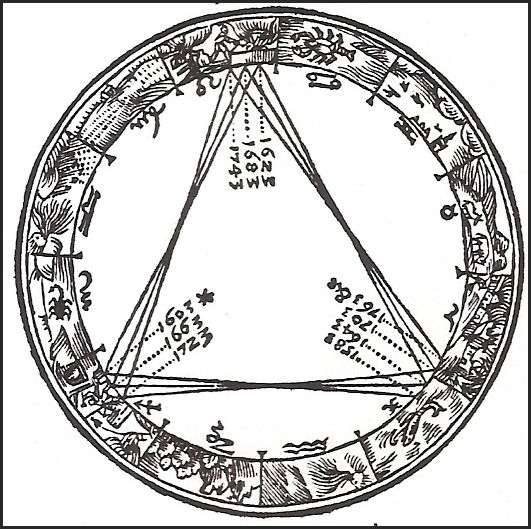
The progression of the Firey Trigons which commenced 8 Dec 1603 as illustrated by Johannes Kepler.

The significance is not so much that the triplicity has shifted, but that subsequent Grand Conjunctions will remain it that element until 29 Mar 2199, with the sole exception of a Grand Conjunction in Scorpio. entering 8 Dec 2159. We will be in the Airy triplicity for 199 years. The last time we experienced this spanned 3 Nov 1186 to17 Jan 1405 25 Jan 1405. During this time, there were three deviations – one in Taurus and two in Scorpio.

See the attached  calculations of the Great Conjunctions: 5,000 B.C. – 2,500 A.D. Geocentric, Gregorian Calendar. Time Frame: From 1 Jan 5000 BC GC, 12:00:00 AM, PDT +07:00:00 to 1 Jan 2500, 12:00:00 AM, PDT +07:00:00 Location: Greenwich, England, 0w00 00, 51n29 00

The meaning of the Grand Conjunction is integral to core elements in Mundane astrology. It would be ultimately futile to navigate the many cycles within cycles without an understanding of the GCs In simple terms, these events are like the hands of a cosmic clock, demonstrating the nature of the coming epoch. Clearly, a shift from Earth to Air has a myriad of significances. Most essentially, Earth is tangible and material. Air is intellect. But Aquarius is a Fixed Air Sign and contrary to New Age thinking cannot by its very nature be revolutionary. It is after all under Saturn. It can and is, however, adept at innovation – of expressing the traditional qualities of Saturn in novel ways. One such manifestation is the crystallizing of powers in technology and what are now referred to as “tech giants.”

Released from an Epoch of Earth, there will be (and already is) a renewal of the modern version of the Inquisition, which began in earnest in 1231 during the last Saturn-Jupiter conjunction in Aquarius. We are already well into the Aquarian Age in my estimation and this Great Conjunction merely accentuates what I will call the Aquarian agenda.

The Monarchies of Europe are unlikely to survive in their current form. Aquarius is the sign that opposes the Sun. The other Saturn sign, Capricorn, opposes the Moon. This opposition to the lights is largely what defines Saturn. Note also that Capricorn is in aversion to the Sun and Aquarius is in aversion to the Moon. 

How much of this would also be true if we were considering Capricorn rather than Aquarius?

What it is not.

There has been a multitude of claims that this GC is a clear signal that the Age of Aquarius has arrived. To make such a statement is to reveal a fundamental ignorance of the clear distinction between an Age and an epoch. If the current GC indicates the Age of Aquarius, then so would any period that began in Tropical (or sidereal) Aquarius. I have at written length elsewhere on this blog regarding the nature and calculations of the Ages and will not rehearse that content here.

The conjunction is only in Aquarius using a tropical zodiac and ‘true’ conjunctions,

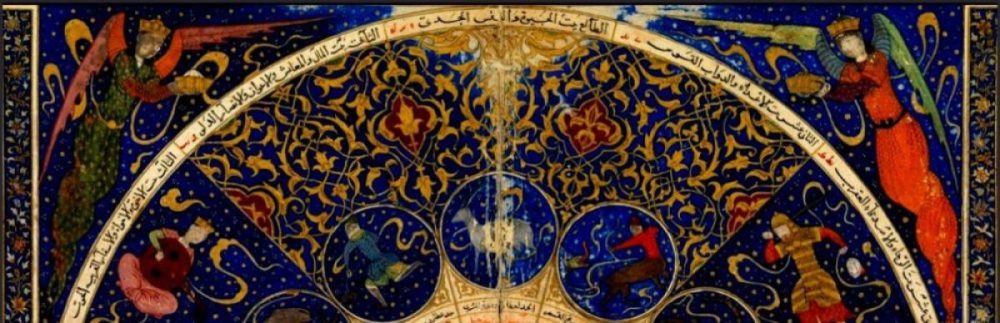
Bear in mind also that in Vedic and all other Sideral schools of astrology, the conjunction is in Capricorn and not Aquarius. It behoves us to remember that the masterful Masha’allah and Abu Masha used a sidereal zodiac, at least with respect to all manner of Mundane astrology. De Magnis Coniunctionibus is the Latinized title of a book written by Abu Ma’shar himself, sub-titled “Historical Astrology: The Book of Religions and Dynasties.”

As Benjamin Dyke pointed out, “it is important to know that only a sidereal system will yield 12 conjunctions per triplicity.”

From a sidereal perspective, the current GC is in Capricorn and therefore the element of Earth. Still, the sign remains a domicile of Saturn. Below is a chart for the same date and time, using the Persian Sassanian ayanamsa.
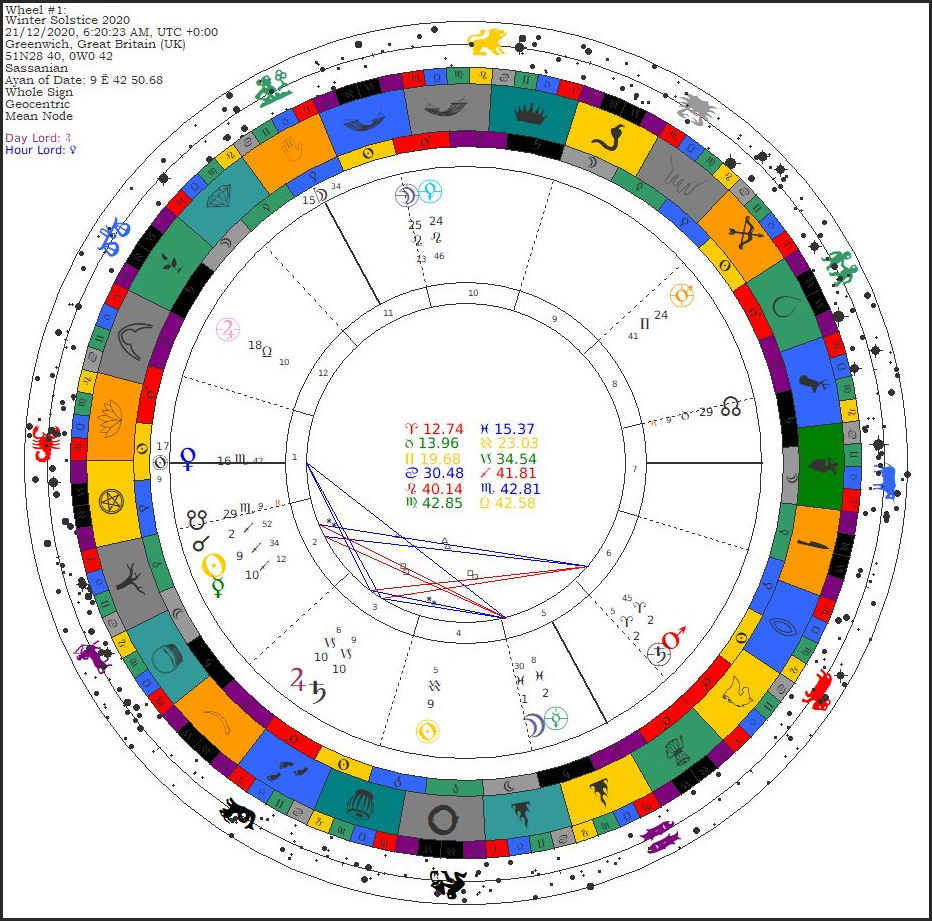
Dyke provides a visual image of Abu Ma’shar’s own parameters.  Masha’allah’s are also given in §6 of his  Introduction to Astrology of the World II: Revolutions & History.

There is another consideration to be made. For most of astrological history, astronomers and astrologers relied on the system of Mean Conjunctions I don’t think it wise to ignore this fact. Dykes fully explains the situation on Skyscript. According to the Mean Conjunctions, we left the Fiery triplicity on 26 December 1980 and will not experience the conjunction in the Ayrey triplicity for 200 years when it will commence in Aquarius on 9 June 2199.  Considering this massive discrepancy and the extraordinary success achieved using the Mean system, this ought to give us pause.

To find a useful table of sideral mean Saturn-Jupiter conjunctions from 185 BC to 2219 AD, consult Appendix A in Benjamin N. Dykes. Astrology of the World II

Summary:

This GC does not herald the beginning of the Age of Aquarius. Ages are not determined by single conjunctions. From a sidereal perspective, we would view the current GC as occurring in Capricorn. The Mean & sidereal system used by Masha’allah and Abu Masha have us in the first forty years of an Earth triplicity and we won’t shift to an air triplicity for almost 200 years.

It is interesting to note that the 2000 mean conjunction was in Gemini and not Taurus, as we read it using the ‘true’ system.

What we can be sure of is that using either system, we are now solidly in a Saturnine epoch. The element of the trigons will be understood depending on the ayanamsa we employ and whether we use the mean or true conjunctions.

It is clear that early Hellenistic astrologers such as Vettius Valens used both zodiacs, on at least some occasions. There is a prevalent view that the two systems cannot be reconciled, but the fact is they are measuring related but different things. The tropical zodiac is indispensable because it relates to the seasons on Earth. Sidereal ayanamsa maintains the connection to the firmament – the actual position of stars in the constellations so that we can never have a case where a star is projected onto a tropical backdrop, in a sign outside of the constellation in which it participates.

The sidereal zodiac works seamlessly with the 13 Lunar months of Vedic astrology, which expresses itself through the Nakshatras. When it comes to describing a seasonal event, such as the Equinox or solstices, the Tropical system is adjusted to be forever in synch with the pivotal points of the annual wheel.

There are solid historical reasons why one would use a tropical or sidereal zodiac, a mean or true understanding of conjunctions. However,  the discrepancy is of the greatest significance when it alters the elemental quality of a 200 year series in a given triplicity.
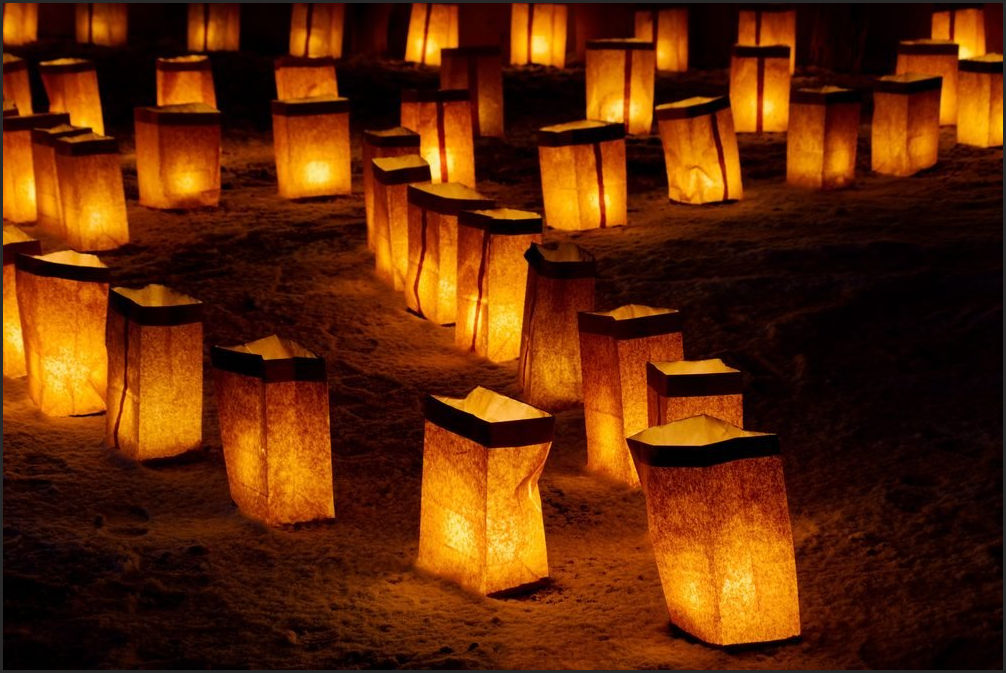
Yuletide 2020

Image courtesy of Vancouver’s Winter Solstice Lantern Festival 2020

Marsilio Ficino wrote in a letter to Rinaldo Orsini: “… I recalled what the ancient sages say, not without very good reason, in their fables about Saturn and Jupiter, Mars and Venus; they say that Mars is bound by Venus, and Saturn by Jupiter. Thus simply means that the benignity of Jupiter and Venus holds in check the malignity of Saturn and Mars “ (Letters Vol. 2. p.16.) Be of good cheer!

This brief article is written is to acknowledge and celebrate the turning of the tropical wheel, as we anticipate the return of the light when the Holly King reaches the zenith of his reign from the Autumnal Equinox to the Spring Equinox when the crown will be passed to the Oak King.

I have written much regarding the Grand Conjunction of Jupiter and Saturn which coincides with this Winter Solstice.  This is a momentous event and I will further address this moment when we say that the triplicity mutates into the element of Air after a centuries-long sojourn through the Earthy triplicity While this cannot be extricated from the Winter Solstice itself, the Solstice is of immense significance in and of itself, as the darkest night to be followed by the waxing light and warmth of the Sun. This is forever a cause for celebration and is marked in many different, but related ways throughout the world.

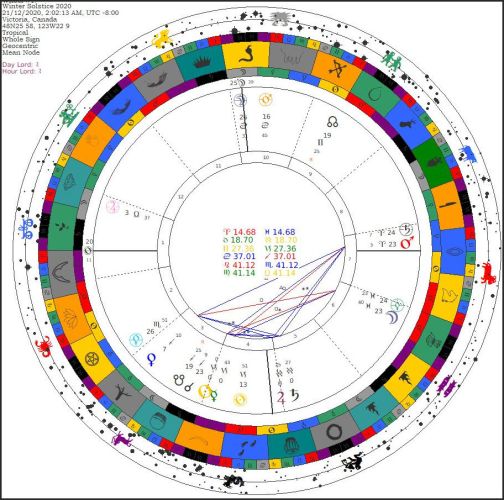
The chart which appears here is set for Victoria, BC Canada. The header image is taken from the Vancouver Lantern Festival celebrated on the other side of the Straight of Georgia. I write this in thoughtful contemplation and good cheer on Vancouver Island, on the Eve of the Solstice and the day before the perfection of the Jupiter/Saturn Grand Conjunction.

The Planetary Day for the precise moment of the Solstice: the ingress of the Sun into Tropical Capricorn. The chart is for the Day of the Sun. The Hour belongs to Jupiter. The Moon is in the Sign of the Exaltation of Jupiter and she disposits the Part of Fortune in Cancer, placed precisely on the MC. The Moon is the Sect ruler and in the 28th Lunar Mansion known as the Belly of the Fish.  The constellation originally associated with this Mansion is Andromeda. The principal star associated with this Mansion is Mirach (beta Andromeda). According to Ptolemy, the nature of Mirach is Venus. According to Ibn ‘Arabi the attribution: is “The Hierarchy of the Degrees of Existence, not their manifestation. The Divine Attribute is the “One Who Elevates by Degrees.” This is, of course, the final Lunar Mansion and represents preparation for a renewed cycle of becoming.

Importantly, in virtually all known cultures this moment in the year holds a similar hallowed position as the point of re-birth for the light. Unsurprisingly, the Pagan celebration of Winter Solstice (Yule) is among the oldest winter celebrations in the world. The nature of the season as experienced in Northern Europe provides additional impetus to mark the beginning of the return of the light during the darkness of the season. This is the essence of the spirit celebrated at the time of boreal Winter Solstice – the first day of winter and the darkest night.

In Northern Europe, the Sun was seen as a wheel that turned seasons.  The Norse word for this wheel was l, houl and this is thought to be the origin of the word Yule. Bonfires were li; storytelling, feasting and revelries were an integral part of the celebration.

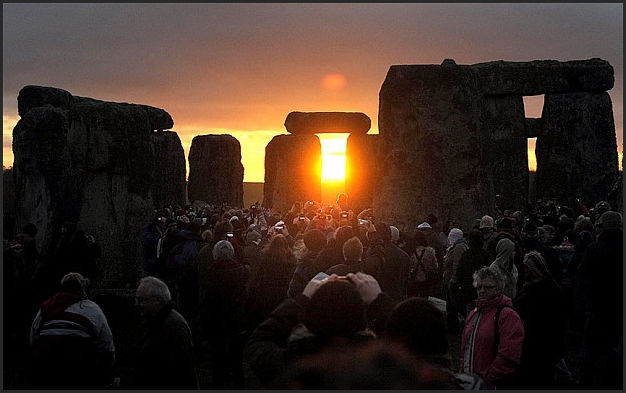
Sunrise at Stonehenge – Winter Solstice

The Winter Solstice was celebrated in Britain well before the arrival of Christianity and continues to this day. The Druids cut mistletoe. which grows on the sacred oak trees and gave it as a blessing.  The mistletoe symbolized life in the dark winter months.

It is said that it was the Druids who began the tradition of the Yule log and that the Celts thought that the sun stood still for twelve days in the middle of winter and during this time a log was lit to counter the darkness and banish dark spirits, bringing good fortune and prosperity for the coming year.  The mistletoe that grows on the sacred oak was a symbol of life in the dark winter months. Many traditions of Yule have been embraced in Christian and secular celebrations of Christmas.

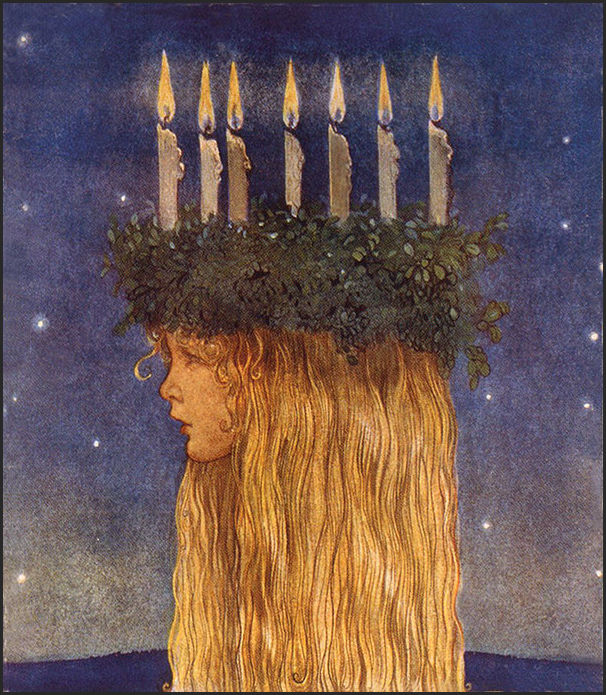
In Scandinavian tradition, the Night of St. Lucia (light) was celebrated as the longest night of the year, Winter Solstice, in the Northern hemisphere. on 13 December before the Gregorian calendar gave us the current date of 21 December. Bonfires were lit, tp offer warmth and light, while banishing troublesome spirits. This festival became conflated with Saint Lucy’s Day circa 1000 AD wit the advent of Christianity.

The Christian feast commemorates Lucia of Syracuse, a virgin martyr who suffered under the  Diocletianic Persecution. According to the legend, Lucia brought nourishment and assistance to Christians hiding in the Roman catacombs. She wore a candle-lit wreath on her head to guide her in the darkness and to allow her to carry as much food as possible. Like so many Christian feasts, it is clear that of Saint Lucy’s Day is viewed by Christians as a precursor of Christmastide, anticipating the Light of Christ on Christmas Day

A Blessed Solstice to all!

Lucia by Swedish artist John Bauer, 1913

Posted in Uncategorized | 1 Reply

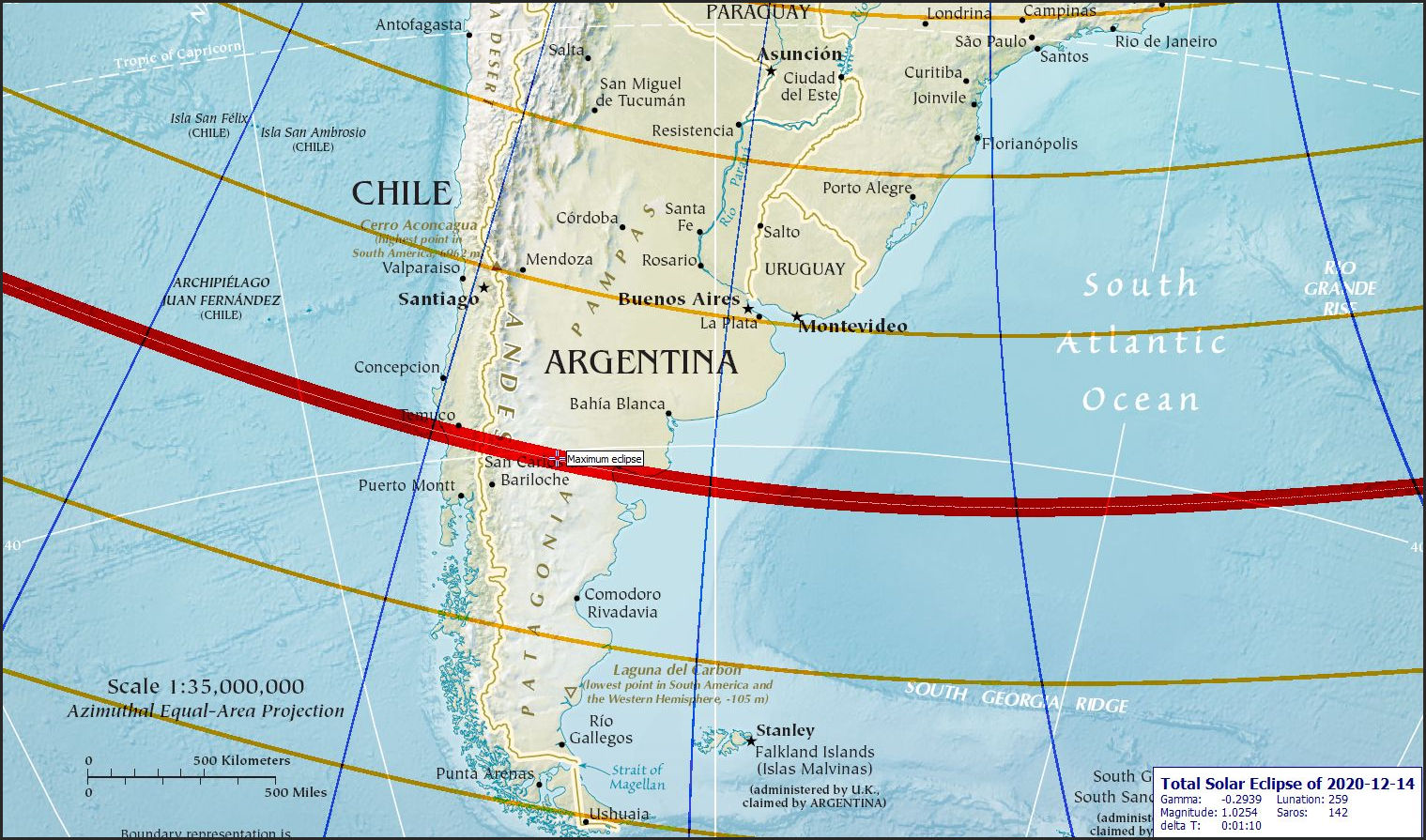
Total Solar Eclipse 14 December 2020

The only total Solar Eclipse of 2020 occurs on 14 December.  It will commence at 1 p.m. local time on the west coast of Chile and end at 1:24 p.m. local time on the east coast of Argentina. The point of maximum eclipse corresponds to St Carlos de Bariloche, Argentina.

The tradition is clear that the potential visibility of an eclipse – that is to say whether one actually observes it or not –  is the area of influence.  If the eclipse cannot be seen in a given part of the world, then the ‘effect’ is not applicable. This eclipse is therefore of particular and primary interest as an augury for events in South America, but not elsewhere, except as a secondary of tertiary indication, involving other celestial and/or terrestrial events. For example, if we were considering an earthquake for the region, that event may well have further implications for other parts of the world. If there were to be a serious financial crisis, that too may affect other parts of the world.

According to tradition, every hour of a Solar eclipse is equal to one year of influence See for example Dorotheus of Sidon: Carmen Astrologicum. Trans. Umar al-Tabari Ed B.N. Dykes. p.62  Presumably, Dorotheus is referring to the period of the entire process of the eclipse, which in this case lasts for 3 and 1/3 hours, starting at sunrise over the Pacific Ocean and ending at sunset over the Atlantic Ocean, close to the west coast of Africa. However,  at any given point on the total eclipse path, the maximum duration for totality is just shy of 2 minutes and 10 seconds in duration.

Three and half years of influence is indeed considerable and we look to the chart for the maximum eclipse in San Carlos de Barchloche, Argentina.

It is impossible to ignore the close and applying conjunction of Jupiter and Saturn, which will perfect on the boreal Winter Solstice and the Summer Solstice in the Southern Hemisphere.  Planetary Day ☽︎ Planetary Hour ♀︎ & Chart Almutem ♃︎.

The Moon is in the 21st Lunar Mansion, Al-Baldah. The Picatrix refers to this Mansion as Albelda and abruptly claims it to be “for destruction.” (Trans. Greer & Warnock 2010-11 p. 293) Ibn ‘Arabi (1200 AD) starkly refers to this Mansion as The Death-Giver.

Christopher Warnock writes of this Mansion: “It is a sign of enmity and anger, argument and conflict. It might literally signal that someone is being two-faced, saying one thing to us and doing another. If the question concerns the progress of an activity, this Mansion generally suggests a negative answer. This is the time to accept that the path we have travelled has reached its end. We are playing an end game. It is time to cut our losses.” See Lunarium.

This then is at the heart of the eclipse. Jupiter is in his House of Joy, but in his Detriment and conjunct Saturn in his own Domicile. The Moon, associated politically as the common people is eclipsing the Lord of the 6th House which is also associated with the common people, including servants. This may be one of those rare occasions when an ill wind actually does nobody any good. The Sun is further rendered weak due to the condition of Jupiter. Moreover, Jupiter’s sextile to the Part of Fortune is a weak and essentially ineffectual financial significator, particularly since the Moon squares the PF.

Mars is powerful, in Sect, in Domicile and Exalted in Capricorn, the sign of the current Conjunction. He is the Lord of the 2nd and 9th House – the purse and the judiciary. Venus in Scorpio. is Oriental and in her Detriment. This is Venus in warrior mode. She is however, with Toliman, listed as Bungula in Robson.  According to Ptolemy it is of the nature of Venus and Jupiter, which imparts beneficence, friends, refinement and a position of honor. [Robson*, p.148.] The 9th House informs the 10th, placing this robust and elegant Venus ‘close to the throne,’ as it were.

The President of Argentina, Alberto Fernández, came into office on 10 December 2019  and this eclipse occurs only a few days after his first year in office. Argentina is facing a plethora of serious problems. According to a recent report in the Financial Times (9 September 2020):

“Covid-19 is proving a mightier opponent than difficult political factions: Argentina’s ongoing lockdown, the longest and toughest in Latin America, has failed to prevent some of the highest daily deaths from coronavirus while dealing a blow to the economy. Argentina is suffering the worst of both worlds: according to the country’s industrial union, production at 63 per cent of companies has either fallen by more than half or ceased altogether.”

The financial situation in the region will continue to be dire and heightened social unrest is indicated. This is indeed a highly significant pivot and the changes occurring in Argentina and beyond are likely to be devastating to the current status quo, for good or ill.

The government of Alberto Fernández as indicated by the 10th House eclipse configuration is under extreme pressure and is unlikely to survive.

Solar Eclipse in Sagittarius