What I have to say here is not limited to Judaism by any means, but there are key concepts and beliefs within the religion that are helpful in explaining the often awkward relationship between astrology and particularly monotheistic religions.
The term mazel tov is usually regarded as a Jewish phrase expressing congratulations or wishing someone good luck. It’s more complex than that, though. Mazel is fate, in the sense of G_d working through the constellations. This the essence of the doctrine that the stars impel, they do not compel.In this respect the Jewish and Islamic view is the same.
There are of course many forms of astrology and they are not all viewed in the same way. Some off the main forms of astrology are Mundane and all forms off Predictive Astrology, including Horary. These seek to see into the future, in one way or another : to predict a political win, a war, the establishment of a new kind of order and so on. in Horary, the question isn’t always about the future. It could be a question such as ‘where are my keys’? or ‘does that girl like me?’ Since the means of prognostication have to do with the interactions of energies. Is this really so different rom a doctor listening to your pulse? I don’t say there are no differences. I only suggest that the line is more difficult to draw than is often assumed.
The second group consists of Nativities, Medical Astrology and Electional Astrology. The first is what everyone calls a birth chart that describes the nature o the person, showing strength, weaknesses with an aim to help the person or her parents to help create the best environment and tools. This is actually less predictive than a weather forecast. The goal is to understand and help.
Medical Astrology is perhaps the most useful of all forms. It not only provides us with what we need to know about the person’s humours and temperament. We will find out what kinds of healing are likely to work best for this person and also gives us reliable information as to which kinds of diseases the native will most likely encounter. Hippocrates said “He who does not understand astrology is not a doctor but a fool.”
Electional astrology in essence is not a great deal different from consulting the Farmer’s Almanac, although considerably more refined.. To find the best time to do something, we choose a moment that is most propitious for the given purpose. This actually the same in spirit as planting by the Moon. It will of course be specialized for the person who asks when something might be done. Again, this is a means of helping others and doesn’t contradict the Jewish and Islamic prohibitions, or would not if understood.
So in reality, there are few out and out predictions made by anyone, not because it’s wrong or doesn’t work, but because it’s only used when needed, It is a false idea turned dogma that the stars are the means by which Divine Will, or Great Spirit, speak to us. There are dozens, perhaps hundreds.of kinds of divination but astrology has stood the test of time for several millennia
It’s a rare event to find a Rabbi discussing these issues and I commend him for doing so.
A blog post on someone of the stature of al-Kindi can scarcely do him justice, but it can serve as an introduction to this extraordinary man as well as the transmission and absorption of Greek texts into Islamic theology. It is also my hope that al-Kindi will regain his former prominence among the many other Islamic contributors to human knowledge and to astrology in particular. His cosmology is essentially simple and I believe answers to many of the on-going discussion on the nature of fate and free-will.
To understand how al-Kindi’s mind works, his study of The religion, philosophy, literature, geography, a chronology of India is a good place to start. He’s is infinitely curious and readily absorbs the philosophy and weighs the values of other very different nations. I have placed the complete work in two volumes in the file section. Familiarity with al-Kindi breeds content. He stands as an essential figure of the Islamic Golden Age. It was tolerance, acceptance and inclusiveness that created the Age – not rigid xenophobia. It came about via respect of other cultures and a willingness to work with them.
Abu Yusuf Ya‘qub ibn Ishaq Al-Kindi (ca. 800–870 CE) was the first self-identified philosopher in the Islamic and specifically Arabic tradition. His work with a group of scholars and translators, in what became known as the House of Wisdom in Baghdad, gave to the Arab world the works of Aristotle, the Neo-Platonists, and Greek mathematicians and scientists. He did not appear to demonstrate the rigid distinctions between Platonic and Aristotelian philosophy that became the bugbear of later European philosophers. This in itself was no mean feat, but Al Kindi seemed to instinctively know what was of a similar nature and what was not. Al-Kindi’s own thought was suffused with Neo-Platonism, though his main authority in philosophical matters was Aristotle.
The Semitic or Abrahamic religions are less replete with metaphysical codes but have what is more properly called cosmological ones, when compared for example, with the seemingly endless metaphysical systems of Hinduism. This is also true when those same texts are compared to the Platonic tradition, including the sophisticated and exquisite vision written down by Plotinus. It applied as well to the philosophy of Aristotle. It was to the latter than Al-Kindi first became transfixed. The distinction between Metaphysics, Cosmology and Ontology can at times become blurred of intermingled. To invite them into Islamic thought is not for the careless or faint of heart.
Al-Kindi is often referred to as the Arab’s philosopher. As has happened to so many great minds throughout history, the investigation of the most cherished ideas had lead to suspicions of heterodoxy. The word ‘heterodoxy’ is a convenient catch-all phrase that can be levelled at those who disagree, have some doubts or simply see the nature of reality through a different lens. In this respect, the story of Al-Kindi has contemporary relevance, with particular regard to the understanding of the nature of astrology. The contemporary Traditional astrologer will feel pretty much at home in Al-Kindi’s cosmology.
The new lens of Greek Philosophy provided Al Kindi with a means by which to address the Theology and Cosmology of the Quran, resulting in a highly significant shift in Astrological thought. By the time of Al-Ghazali, Islamic Philosophy and with it the Golden Age of was eclipsed by a literalist pessimism that has persisted to this day. What was at one time a naturally accepted element of Islam became heavily suspect. It is important to note, however, that Al-Kindi fell short of the view that the universe must be infinite. It could have lead to his alienation at best and a death sentence at worst, as it did in a later period for Giordano Bruno.
The deep fear of infinity has historically put restrictions on the subject. Perhaps the fear of infinity is no more than the fear that our prescribed limits might prove to be no more than mind-forged manacles, as W. Blake so keenly understood. Limits are an important element in Islam: in general more so than either of the other Abrahamic religions. In the Islamic afterlife, it is made clear that there are no limits. Lastly, I believe infinity is ‘reserved’ for God on this side of the grave. Philosophers throughout history have always needed to be adept at avoiding stepping on theological toes.
There are no precise parallels to the non-Islamic world on this matter, but the pseudo-prophetic Savonarola lead to a very similar shift, and in fact to a rapid decline in the creativity, tolerance, syncretism and ebullient optimism of Renaissance Florence.
Even Pico della Mirandola succumbed to the dogmatic position that what isn’t a particularly privileged form of Christianity, must be the work of the Devil. I’m certain that many great thinkers were frankly terrified at the speed in which the obscure monk, Savonarola, could turn Florence into a city full of mad people with proverbial pitchforks and literal torches.
al-ghazali
The contempt and paranoia regarding the new learning was epitomized by the en mass burning of books and works o art, including works by Michelangelo. These were considered the vanities, in the biblical sense o the word and the burning of all these things was called the bonfire of the vanities, a term that survives to this day. This episode in Western history shall forever remain a reminder of how quickly great elements of civilizations can be destroyed by supernatural fears, that even otherwise rational people can fall prey.
In Islam, as in other Middle Eastern and Asian cultures there existed a very different sense of time. It was circular or spiral, but never linear. From the Greeks and developed to a fine science was the Prime Mover – one who is not acted upon – to the participation of the Prime Mover through secondary causes. This lends itself perfectly to Astrology. It means, among other things, that the Stars can easily become the agents of Providence, without diminishing the First Cause.
This was not to be the position of Al Ghazali. There was no room in his thinking for such niceties. There was one cause and one cause only, no secondary powers could be entertained because they amounted to shirk – the attribution of partners to Allah.
Al-Kindi’s own treatises, many of them personal letters, were addressed to the family o the Caliph, who depended on his translations just as the Medic family would rely on Marsilio Ficino. Core texts included the Theology of Aristotle and Book of Causes along with Arabic versions of Plotinus and Proclus. This textual alchemy was fomented at the political and philosophical core of Islam.
Al-Kindi’s philosophical treatises also include On First Philosophy, in which he argues that the world is not eternal and that God is a simple One. This needs to be understood in the context of an Islamic thinker attempting reconciliation with Greek philosophy. The reality of Tawheed is the first principle in Muslim belief. It is to believe that Allah alone is the ‘Rabb’ -Creator, Provider and Sustainer (note the identical attributes within Hinduism and elsewhere). He has no partner and needs no partner. To suggest that HE does is the greatest blasphemy in Islam.
Allah alone has the power to determine destiny, and He alone is truly Self-Sufficient (As-Samad) upon whom all the creation depends, as He says: “Allah created all things and He is the Wakeel (Trustee, Disposer of affairs, Guardian) of all things. “To Him belong the keys of the Heavens and the earth. He (Allah) enlarges and restricts provisions to whomever He wills.” Surely, He has Knowledge of everything. See Surah az-Zumar (39): 62. and Surah ash-Shoorah (42): 12. The guidance of the stars is a theme repeated many times in the Qu’ran, but often dismissed as something else.
The key difference from a modern point of view is not whether or not Aristotle was a monotheist. For all intents and purposes, he was. But it would be more accurate to call him a Deist, rather than a Theist. It may seem a fine point and it doesn’t seem to have deterred al Kindi if in fact he truly appreciated the distinction. The Primum Mobile easily translates to Creator.
al-Kindi’s work in mathematics and other sciences was impressive and became known in both the later Arabic and Latin traditions for his positions on astrology, along with Averroes.
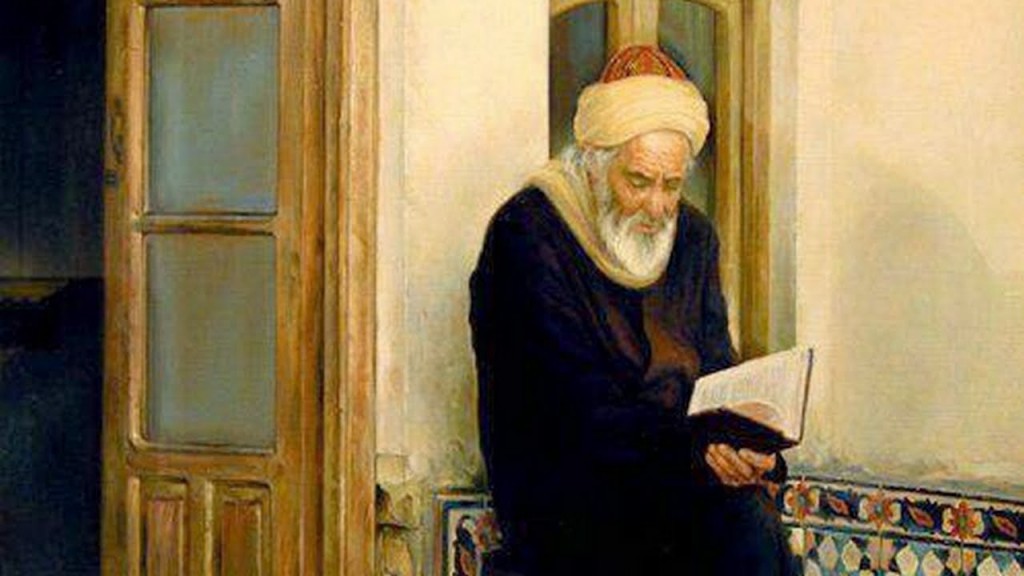
Arab scholar working diligently in the House of Wisdom. (Artist Unknown).
al-Kindi’s claims for astrology commit him to the idea that a wide range of specific events can be predicted on the basis of astral causation. His doctrine of providence goes further by “implying that all events in the lower world are caused by the stars, which are carrying out the benign “command” of God. This doctrine is set out in On the Prostration of the Outermost Sphere” ( Abu Rida 1950, 244–261, Rashed and Jolivet 1998, 177–99) and On the Proximate Agent Cause of Generation and Corruption (Abu Rida 1950, 214–237).
In al-Kindi’s system and, I would suggest, in the Qu’ran itselff, the heavens are possessed of souls who freely follow God’s command so as to move in such a way that the providentially intended sublunary things and events will come about.
This, according to al-Kindi, is what the Qu’ran refers to when it says that the stars “prostrate” themselves before God. In Proximate Agent Cause, meanwhile, al-Kindi gives a more detailed account of the means by which the heavens cause things in the lower world (here he invokes friction, not rays). The most obvious effect of the stars on our world is, of course, the seasons, because the sun (due to its size and proximity) is the heavenly body with the most powerful effect. If there were no such heavenly causation, according to al-Kindi, the elements would never have combined at all, and the lower realm would consist of four spheres of unmixed earth, water, air and fire.
al-Kindi’s account of astral causation and providence is typical of his philosophical method. He combines and builds on ideas from Aristotle, later Greek philosophers, as well as so-called “scientific” figures such as Ptolemy. In his work “Prostration” he provides a rational explanation of central concepts in Islam. His explanation of the meaning o the stars prostrating themselves shows a keen interest in going beyond syncretism to a more enlightened reading of the Qu’ran. Al-Kindi appears to have been certain that once his more enlightened colleagues are exposed to his presentations of Greek wisdom, they will
agree that these non-Arabic and non-Muslim texts can be used —together with “Arabic” disciplines like grammar — in the service of a more profound understanding of Islam. These are heady claims and not ones ultimately shared by Al-Ghazali and his followers. Nevertheless, there existed what could be called an Al-Kindian tradition long ater his passing. This current flourished in the tenth century, which is most obviously represented by the first and second generations of al-Kindi’s. followers.
Musicians and instruments Topkapi Palace Museum Library H. 2164.
al Kindi ‘s advanced contributions to Musicology seem like a natural and intrinsic progression of his cosmology. Al-Kindi’s optimism on this score was not necessarily borne out in subsequent generations. But among thinkers influenced by al-Kindi, one can discern a continuing tendency to harmonize “foreign” philosophy with the “indigenous” developments of Muslim culture. This is one feature of what might be called the “Kindian tradition,” an intellectual current that runs up through the tenth century, which is most obviously represented by first and second-generation students of al-Kindi’s.
In a world off ‘what ifs’ it is clear that the position of Al Kindi and like-minded philosophers would have developed into a more universally tolerant Islam and one in which the reading of the stars was not confused with the worship of them. Today, we have weather forecasts that seem to be false more often than not, but I cannot imagine any sane person considering meteorology as shirk. Reading the sign of nature is something we do all the time, from the practice off horticulture to the study of the biological origins of life and indeed the universe itself.
It is always a daunting task to interpret the subtleties of Marsilo Ficino’s thought. Not only was he brilliant in an age of brilliance, his interests were as deep as they were impressive in their broad compass. He was ever attempting to reconcile different religions and philosophies in search of the Prisca Theologia. His massive translation projects put him at the vanguard of Italian Renaissance endeavours. His syncretic Ne0-Platanism was at the root of his intellectual pursuits, which gives us one key to systems. However, no matter how prepared, I shall no doubt raise more questions than provide solutions. If nothing else, it is my hope that this short study might lead to fruitful discussions.
His father was a well-respected physician in Florence. When Cosimo de Medici met Marsilio he said “Cosimo, perceiving the genius of the young man and recognizing in him the extraordinary desire for study which set him afire, re-joiced greatly as if he had now fully understood that, beyond any doubt, this would be the man whom he had long since chosen to shed light on the
Marsilio Ficino
philosophy of Plato. And presently summoning Ficino, he exhorted him to take especial care over Marsilio’s studies so that he should not go against his natural disposition. He said that there was no reason to take account of domestic hardship, for he would never neglect him in any matter but would supply everything most generously. ‘You, Ficino,’ he said, ‘have been sent to us to heal bodies, but your Marsilio here has been sent down from heaven to heal souls.’ The Life of Marsilio Ficino by Giovanni Corsi p.6
However, Marsilio was also a skilled physician. With the combined knowledge of medicine and astrology, he was also a magus, philosopher and musician. He certainly knew his way around the complexity of a human being from the points of view of body, mind and soul.
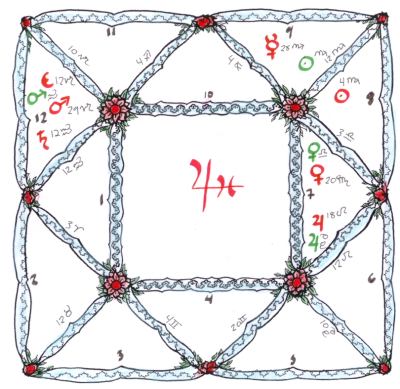
To know anything much about Ficino at all is to know of his life-long project of finding ways to minimise the deleterious effects of Saturn. He was passionate about it. He refers to its influence on himself as the great burden of a Melancholy Humour, otherwise known as an excess of black bile. Ficino was certainly among the brilliant minds of his age and has a reputation of having been a competent astrologer. He certainly knew the humoral system, probably as well as any physician of the time. However, we have Ficino’s birth chart and his comments upon it and they may well give us pause,
He certainly knew the humoral system, probably as well as any physician of the time. However, we have Ficino’s birth chart as well as his comments upon it. Ficino makes numerous comments on his severe Melancholy, but the most succinct passage, dealing with both his chart and humours is as follows in a letter to Giovanni Cavalcanti he writes “Saturn seems to have impressed the seal of melancholy on me from the beginning; set, as he is, almost in the midst of my ascendant in Aquarius, he is influenced by Mars, also in Aquarius, and the Moon in Capricorn. He is in square aspect to the Sun and Mercury in Scorpio, which occupy the ninth house. But Venus in Libra and Jupiter in Cancer have, perhaps, offered some resistance to this melancholy nature.”Marsilio Ficino, Three Books on Life, [Florence 1489] 1989, p. 20
Further in a letter to Rinaldo Orsini, archbishop on Florence, he wrote “Venus subdues Mars and Jupiter Saturn. Letters Vol II. p.15
It was an odd comment to make to Cavalacanti because Ficino didn’t have the salubrious Venus in Libra or Jupiter in Cancer in his horoscope. Venus is instead in Virgo and Jupiter in Leo. This isn’t a minor error. His horoscope would have to have been in the previous year to have the Jupiter he cites. Of course, if Ficino had said or meant that his chart would be better with the impossible planets, we can write this off as an error in communication. No other plausible option occurs to me.
Plato’s natal chart as described by Maternus (Mathesis VI. XXX. 24)
I have no way of guaranteeing the provenance of the chart above but it does closely match his own comments on it. The green planets have been added by an astrologer, noting the disparities between the original, using modern software and Regiomontanus houses, If however we use Porphyry houses the resulting chart is almost identical to the one he describes, with the exception of the impossible positions of the greater and lesser Benefics.
We have seen that Ficino notes that Jupiter in Cancer would have helped the situation, but if Jupiter were at that degree in Cancer, it would set the chart back one year while leaving everything more or less as is..
Instead, Jupiter is very much in Leo It isn’t easy to understand why Ficino would wish that Jupiter were in another sign, because Plato’s horoscope has the same first / seventh house axis in Aquarius and Leo. It is evident that Ficino admired Plato in the highest degree. I think at times the identity of Plato and Ficino got blurred. Further, we can argue that Ficino knew what he was doing, He certainly had extraordinarily wealthy and generous patrons and friends to remind him of the Royal throne of Jupiter.
In Book Six of his Mathesis, the fourth century CE Roman astrologer, Julius Firmicus Maternus, gives the following account of the natal chart of Plato, the fifth century BCE Athenian philosopher:
If the ascendant is in Aquarius, and Mars, Mercury, and Venus are in conjunction in that degree; Jupiter is on the descendant in Leo; the Sun is on the anafora of the ascendant in Pisces; the Moon is in the fifth house in Gemini, in trine to the ascendant; and Saturn is in the ninth house in Libra-this chart produces an interpreter of divine and celestial matters. He possesses a combination of learned speech and divine intelligence and is trained by some kind of heavenly power to give true expression to all secrets of divinity. This chart is said to have been that of Plato. (Mathesis VI.XXX.24)
Standard – Oriental – Occidental considered.
2. Oriental and Occidental ignored
Whether or not Plato shared what Ficino considered salient similarities with respect to his own horoscope, Ficino found his own to be problematic because as he stated “Saturn seems to have impressed the seal of melancholy on [him] from the beginning;” His references to this excess of black bile, which he sometimes refers to as scholarly melancholy are ubiquitous. It’s virtually impossible to think of Ficino without recalling his Melancholy humour.
In spite of the challenges in the horoscope, the philosopher has Sun and Mercury in the 9th House disposited by Mars in his sign of Exaltation.
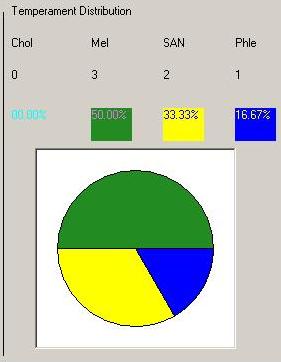
However using traditional methods of determining humor from the horoscope, we see immediately that he actually has more of the Sanguine and Choleric Humour. Sanguine is warm and wet, Melancholic is cold and dry.
So what happened? Did he perhaps feel the leaden weight of Saturn and conclude, considering also the exact Saturnine ascendant, the with the Moon and Mars disposited by Saturn.
At first glance, it appears that his humour is far more balanced than he suggests, with Melancholy taking no more than 16.67% Sanguine shares dominance with Choleric and Phlegmatic takes the same as Melancholy. if we use the classical systems available to us, which take the sign. phase and many other elements into account. If he ignored the Oriental or Occidental significators, he would deduce a Humour that is about 50%. of the Melancholy Humour. This still means the dominant Humour is Melancholy. However, it matters how the black bile is produced. His biographer tells us:
His bodily constitution contained excessive blood which was mixed with a thin subtle red bile. His health was not at all settled, for he suffered very much from a weakness of the stomach, and although he always appeared cheerful and festive in company, yet it was thought that he sat long in solitude and became as if numb with melancholy. This came about either from black bile produced by the excessive burning of bile through continual night study, or, as he himself said, from Saturn, which at his birth was in the ascendant in Aquarius and nearly square to Mars in Scorpio. The Life of Marsilio Ficino by Giovanni Corsi p.46
If we take the considerations or Oriental and Occidental we would have the possibility of “excess blood with thin subtle red bile.” The other calculation renders no Choleric. This is a degree of sophistication that goes far beyond the usual calculations. What Ficino is saying is that how we live affects the expression of our humours. Humours can be altered in the process or their interaction with each other. His penchant for describing his own condition as scholarly melancholy takes on another level of meaning.
There will be a Part II, mostly to tie up one or two loose ends and to discuss his various remedies, including his use of sympathetic magic.
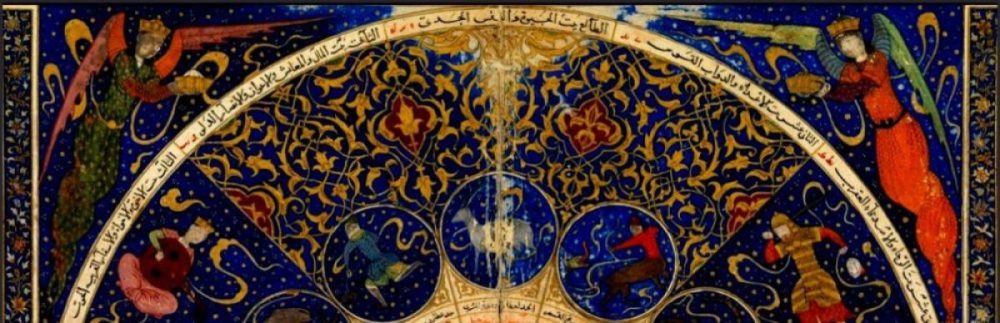
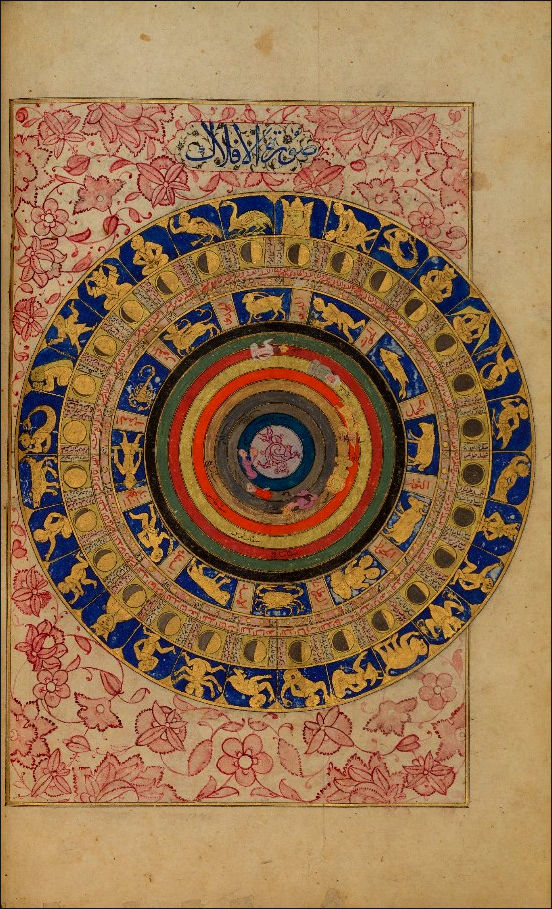
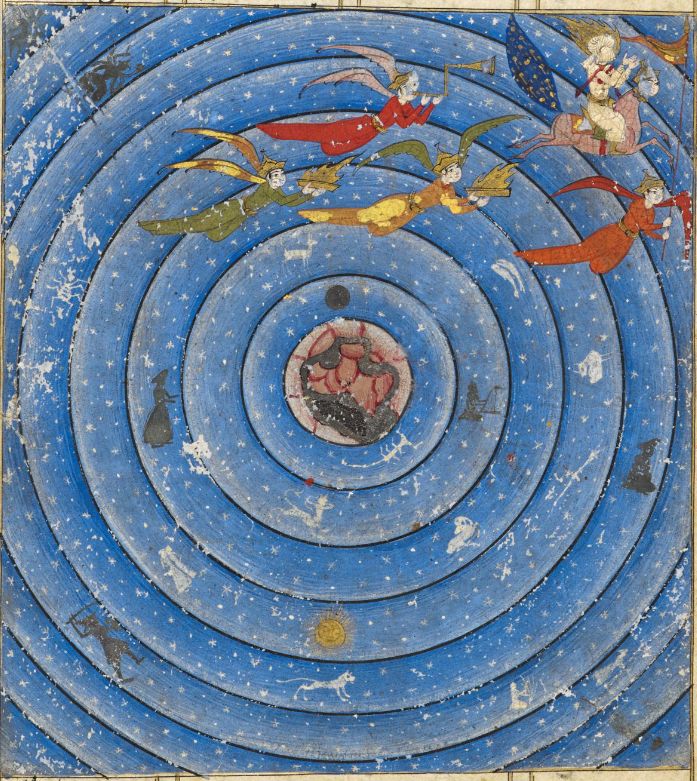
Celestial map, signs of the Zodiac and lunar mansions in the Zubdat-al Tawarikh, dedicated to the Ottoman Sultan Murad III in 1583
First and foremost, I’m fascinated that a book on the natural world is prefaced with a painting of how that world is both sustained and came into being. The Celestial Map or Macrocosm above is the opening miniature in the Turkish Zubdat al Tawarikh or History of the World commissioned by the Ottoman Sultan Murad III. These very fine paintings were on vellum and the work was completed C. 1583.
The visual arts and astrology have long been inseparable. The earliest star-lore was depicted visually in Sumer and far back into the Paleolithic period. The movements of the Heavens has always been of great importance and one picture really can be worth a thousand words when it comes to explaining Cosmologies.
Today, what we call history is not prefaced with a primary reference to the mystical creation. This makes these works most intriguing because they offer us a window into a mostly forgotten, but essential cosmologies. That is because we live in what we think is a linear, largely material reality. Other cultures, including the Turks, believed that time unfolded in spirals.
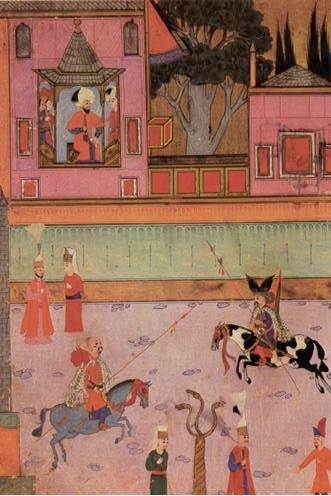
Miniature painting of a parade of two riding Gazi – Veterans from Rumelia – in front of Sultan Murat III from the Surname Ihümayun 16th century CE
Most importantly, we no longer live with the concept of divine origin. Traditional Astrology is very much aware of this reality The image contains an enormous amount of information. Most fundamentally, we have circles within circles At the centre is the source. Next the seven planets and luminaries are shown in their orbits following the Chaldean order. Beyond the orbit of Saturn have the realm of the Fixed Stars and it appears that the artist has chosen to place the zodiac beyond the black circle.
The seven planets and luminaries are shown in their orbits following the Chaldean order in a spiral. Beyond the orbit of Saturn we have the realm of the Fixed Stars and it appears that the artist has chosen to place the zodiac beyond the black circle.
What makes this a particularly fine work, is that it includes the Decans in relation to Lunar Phases as well as the twenty-eight Lunar Mansions, with Angels guarding the Four Directions.
Although the style is very much Turkish and Islamic in style, it is entirely recognizable as what has become known as the Ptolemaic Universe, The relationship between this cosmology and the Night Journey of Muhammad will become clear.
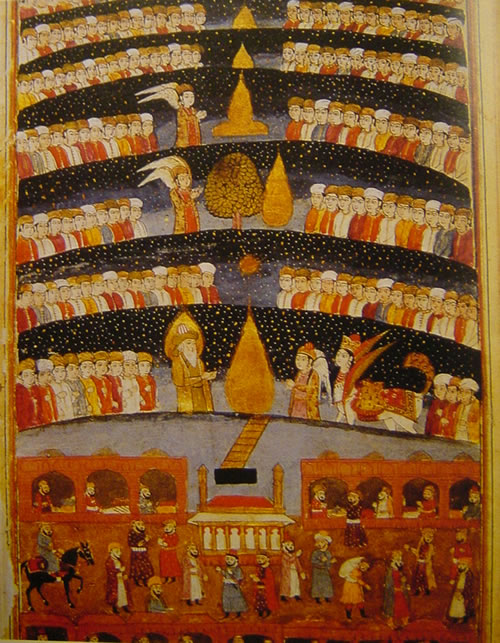
Muhammad travels the seven heavens on Buraq
Muhamad’s Night Journey is in Sura Al Nisra of the Quran and further embellished in the Hadiths It’s controversial these days. Many modern Muslims consider this to be a literal event that occurred at a particularly time and place. – The Prophet rides on Buraq as is taken to Jerusalem where he ascends to meet the various Prophets from what is now known as the Dome of the Rock.
The mystical version has is that the Prophet rose through levels of consciousness. In either case, there is an ascent of Seven spheres, an essential theme that has repeated over and over again. In Ayat 11 we have the following exhortation “And We have made the night and day two signs, and We erased the sign of the night and made the sign of the day visible that you may seek bounty from your Lord and may know the number of years and the account [of time]. And everything We have set out in detail.”
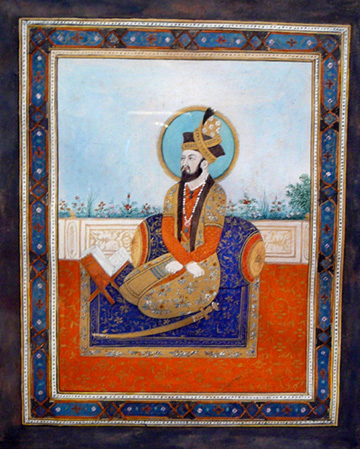
Portrait of Humayun, posthumously painted c. 1700 He was an avid astrologer.
This and other passages in the Quran support astrology as a guide to the wise. The usual context is in ‘to show the way’ which clearly refers to the use of stars in navigation but also implies other uses, such as choosing the correct time for an event,, medical diagnosis military matters and affairs of State. If this were not the case, Islam would have had no cause to compose the type of artwork that we see here, or produce some of the finest astrologers in the Middle Ages and beyond.
The exhortations against astrology are most specifically related to attempting to know such things as the time of the last day and the resurrection. This is the prerogative of the Creator. Common fortune telling won’t find any more support in the Quran as it does in the Bible. Indeed, many sects of Christianity regard astrology as forbidden. In much of my work, I have tried to show the massive difference in intent, method, and applications of divination compared to the disreputable and unwise world of fortune telling.
Imagine for a moment that you visit your physician and she tells you that you have a serious illness and may not have long to live. That physician has just made a prognostication based on medical knowledge. This could be construed as prediction and in fact, it is. When a skilled astrologer reads a chart it for many of the same reason a medical professional might be consulted. Questions about physical, spiritual and mental health can and are addressed by competent astrologers. Likewise, you might be concerned about making a choice between two or more things. The astrologer won’t make the choice for you, but they can offer very valuable information
Likewise, you might be concerned about making a choice between two or more things. The astrologer won’t make the choice for you, but they can offer very valuable information There is time to seed and a time to reap. One of the greatest uses of astrology are, as far as I’m concerned, is in the medical field. Knowing your humour, the strengths and weakness you have are all sound applications of the Celestial Science. If you read scripture carefully, you will not find thes4e applications of astrology to be forbidden.
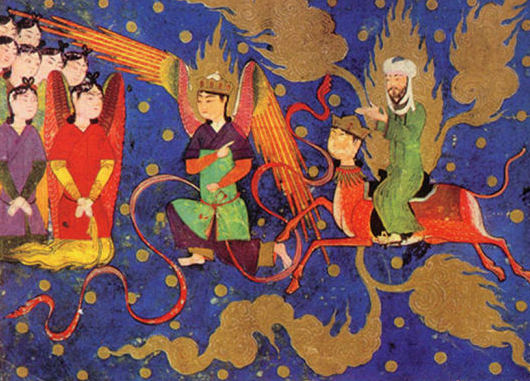
Makhzan al-Asrār by Niẓāmīمخزن الاسرار Folio 3v The Prophet on Burāq
Above, we what is essentially the sane theme found in the previous paintings, but with a slight twist. This Persian Sufi painting describes the Night Journey of the Prophet. This work is far more complex than first meets the eye. The painting has deteriorated, but we can still see the planets, represented anthropomorphically. The Sun and Moon are represented as disks. occupying the first and fourth sphere, as per the Chaldea order. We can also see the constellations, but they are projected in such as a way that we have the illusion of looking through the spheres. Remember that this is illustrating Muhammad’s mystical Night Journey.
Returning to the Quranic position on astrology, let’s examine a few more quotations. There is a Sura in the Quran known as Buruj, an Arabic word meaning ‘Constellation’ or ‘Zodiac sign’. Surah Buruj is the 85th Surah in the Quran. The starting of the Surah is : “I swear by the sky where there are buruj…” (i.e Allah swears by th sky where are zodiac signs.)
“I have created buruj [Zodiac signs] in the sky and decorated them for viewers and I have also protected them from evils…” (Surah Hizr 16)
Prophet Muhammad-Miraj Isra
“How great he is, who has created buruj in the sky and placed the Sun and shining Moon over there…” (Surah Furkan 61 )
In Arabic Astrology, we find that the sign Leo is named ‘Asad Buruj’. ‘Asad’ means a lion thus the Arabic name of Leo, which is represented by a lion, is ‘Asad Buruj’. Similarly, Libra is named, ‘Meejan Buruj’. The Arabic word ‘Meejan’ means a balance.
The emphasis on the creation of constellations, given the context we have, does nothing to indicate that a study of the same is somehow haram.
Finally, we can take a brief survey of some of Islam’s most esteemed astrologer. Most are surprised to find that the poet Omar Khyyam was an accomplished astrologer(1019-1135) He was a an astrologer of Khorasan. He was so accurate in his predictions that he even understood about his own death. This isn’t exactly the same as knowing the time of his death, but points to a deep understanding of the art. Many will be familiar with Sahl Ibn Bishr, Al Kindi, Ibn Arabi, Al Biruni and others.
However, I think the crown should go to Ibn Sina (980-1037) He was brilliant Muslim scientist who developed Alchemy. He was also very much devoted to astronomy and astrology, but other than his prolific philosophical works his contributions to medicine are immeasurable. His massive pharmacopeia is still in use among medical astrologers and natural healers.
This may seem trivial to some, but we have a great deal at stake worldwide. Literal Fundamentalism is not compatible with peace and has the effect of numbing the mind. The golden age of Islam did not flourish because of a stricter adherence to Shariah, as is commonly thought by contemporary Muslims, but because it was a period of openness, serious study of Classical antiquity and a willingness to work with people of divergent faiths and ethnicities.
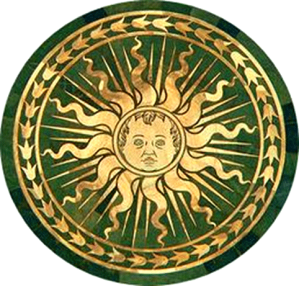
What, you may ask, does the Philosophy of the Renaissance Neo-Platonist have to do with the Winter Solstice and Christmas? The key is in the image and nature of the Sun itself. Astrologically, the Sun is King and the Moon is Queen. At the time of the Winter Solstice, we have the longest night, to be followed three days later by the ‘return’ of the Sun, as he makes his way Northward in that hemisphere, bringing us ever longer days, until the advent of the Summer Solstice, just as the Sun enters the Lunar sign of Cancer..
It has become very popular to conflate all Solar Deities, to carelessly list their attributes, then to take a rather large leap of logic and dogmatically state that they are mere myths and that therefore the Christian version must be a fraud – a cheap knock off — devised to enthral the foolish masses. . It is said that the myths are really just the same story, based on astronomy and recycled to suit the zeitgeist. However, that is to miss the point entirely.
Mercurial messenger of the lights
From the beginning of Christianity, it was received among others by Hellenized Jews.The Christ is Logos. Christian Neoplatonists were quite aware of a plethora of Solar Myths, but remained undeterred in affording Pre- Eminence to Christianity The story of the Winter Solstice and Yule can be told from many different cultural perspectives. Here we have what might be called a Neoplatonic Christmas tale. It is among the most significant of all interpretations.
In his earlier years, Marsilio Ficino had an uneasy relationship with astrology, but by the time he wrote his treatise “On the Sun.” he had managed to wed Platonism and Hermetica with Christianity. He had become more completely syncretic. He seems at this point to be first and foremost a Neo-Platonists, just as many of the best known Christian apologists had been. from before Clement of Alexandria to the Late Renaissance. The newly translated Hermetica was in harmony with the traditions that Ficino was already at home with. He has now translated the Works if Plato, Hermes and Plotinus. Plotinus is regarded as perhaps the most brilliant of the Neoplatonusrs. Ficino was also a priest, so he was in a particularly advantageous position to talk about the Sun from a Christian Neoplatonic point of view that was very much in harmony with his form of Astrology.
The newly translated Hermetica was in harmony with the traditions that Ficino was already at home with. He has now translated the Works if Plato, Hermes and Plotinus. Plotinus is regarded as perhaps the most brilliant of the Neoplatonusrs. Ficino was also a priest, so he was in a particularly advantageous position to talk about the Sun from a Christian Neoplatonic point of view that was very much in harmony with his form of Astrology.
Ficino writes: “According to the Platonists there are three principles: the good itself, the divine intellect and the world soul. Only light clearly contains all of them in itself. It reveals the good itself, since while it surpasses wonderfully all things, it also spreads itself through all things, and recalls them to sublime planes at the same time with its miraculously preserved excellence and purity.”
These are of course divine attributes and the image of the Sun becomes a symbol of the Soul, made in the Image of God. We are no longer generally accustomed to experiencing the natural cycles of the year as divine, in these days marked by conspicuous consumption, ignorance of the skies and a contempt for virtually any form of authentic philosophy. We have mostly abandoned true wonder for fancy and Truth for distraction.
The Sun is studied by scientists, not Christian Neoplatonists. For scientists, the very idea of Soul is synonymous with delusion and naivete. Yet is has recently been discovered that the Sun has what appears to be a kind of heartbeat. Who could reasonably deny that the Sun is alive? Who could fault early humans with worshipping the Sun itself, the bringer of light, warmth and without which there can be no life at all.
The three monotheistic religions are said to be under the following luminaries and planets: Judaism is Saturn, Islam is Venus and Christianity is the Sun. The days held to be holy by each is reflective of this. The Jewish
Sol Invictus
Sabbath is Saturn’s Day; the Islamic is Friday and the Christian is Sunday. In fact, any Solar religion, such as Zoroastrianism or Mithraism would take on the same association. Hinduism is under Jupiter. All the planets can be considered as children of the Sun King. Each of us is a child of the Sun, physically and spiritually.
Marsilio Ficino writes in Chapter Six of the Book of the Sun:
“All [traditions] locate the Sun, like a lord, in the center of the world, although by different arguments. The Chaldeans, for instance, [place it] in the middle of the planets, the Egyptians actually [place it] between two quintuple worlds, as surely the five planets are above it, and below it are the Moon and the four elements…. [Some] actually postulate the disposition of the Sun in this way, such that Saturn, Jupiter and Mars are elevated above him, while on the other hand, Venus, Mercury and the Moon are below the Sun. which proceeds as a king, taking the middle way. Going by other ways, weaker ones avoid him.”
Plato uses the metaphor of the Sun repeatedly. Perhaps the best known is in the Allegory of the Cave. Slaves are chained before a wall watching a shadow play they assume to be real. When one manages to leave the darkness, he is overwhelmed by the brightness of the Sun. The Sun is a metaphor for truth or even God Himself. The Sun makes life possible by enabling a world of light. On a literal level, without the light of the Sun, we would be in darkness. It could hardly be more primal.
The Sun is a metaphor for truth or even God Himself. The Sun makes life possible while enabling by enabling a world of light. On a literal level, without the light of the Sun, we would be in darkness. It could hardly be more primal. James writes: “Every good gift and every perfect gift is from above, and cometh down from the Father of lights, with whom is no variableness, neither shadow of turning;” (James 1:17)
Following the lead of Zoroastrian priests, Ficino is often seen in red gowns. This association of fire and the colour red lives on in a parallel tradition wherein Santa Claus dons read cloths and enters homes by way of the fireplace. It could hardly be more solar and it’s quite natural that Christians adopted this time of year to celebrate the birth of Christ. I should think that by now most Christians are aware that this isn’t necessarily the birthday of Jesus. Most are also aware of other traditions that celebrate Solar deities, many of whom preceded historical Christianity. That doesn’t change the fact that this time of year is sacred
I should;d think that by now most Christians are aware that this isn’t necessarily the birthday of Jesus. Most are also aware of other traditions that celebrate Solar deities, many of whom preceded historical Christianity, while some came after. That doesn’t change the fact that this time of year is sacred to a wide range of traditions, each understanding the deity in their own way.
At the time of the Winter Solstice, we have the longest night as well as a promise of the resurgence of the light force. In mystical Christianity, it is perfectly understood that what is above, is below. That is, after all, the essence of John’s Gospel and in many other parts of the New Testament.
We live in times where if something isn’t literally true, it must be false. This has been adopted by what I call “scientific fundamentalists” such as Richard Dawkins. I have great respect for science, but when there is a complete denial of spiritual vision I have to question its veracity.









 The Classical Astrologer