Ancient Greek Astronomy – A Brief Introduction
Reply

I rarely discuss the charts of living celebrities, politicians or anyone in the public eye. I’m with John Frawley in this respect. whom I applaud for making his case for decorum and common decency. I esteem it important to bring attention to an extraordinary woman running for the office of the President of the United States. This short article will be restricted to Ms Gabbard’s qualities as they relate to her unique abilities in the political sphere.
She has attacked some core elements of what America should mean globally. By urging an end to regime changes around the world, a calling home of troops from Afghanistan and a massive reallocation of military funding to be used for universal medicare, schools and infrastructure. She is bound to make enemies, but she has the chart of one of the greatest warriors I’ve ever seen.

Not surprisingly. she has been a soldier for 15years and served in Iraq, including in the medical corp where she saw the cost of war up close, She knows the cost of war and can speak with more authority on the subject than any of her fellow Democrats seeking the Presidency in 2020. Moreover, at the age of 27, she served in the Hawaiian House of Representatives from 2002 – 2004 politics since the age of twenty-one, Presently, she serves as the first Samoan American and the first Hindu member of the United States Congress. The list continues. She has an unusual grasp of Foreign Affairs. In brief, any opponent has to know what they are up against. She has a common touch and charisma, but it’s plain that her own Party is doing what it can to suppress her.
She was born a year after the Great Conjunction of 1981, which could make her the first post-GenX. President. The previous generation only produced one.
We don’t have time for the chart. Often, in a case like this, an astrologer might use a mid-day chart, but I have chosen instead what I believe is the most plausible. Quite simply, other times would render the house placements meaningless. However, I make no claims for the exact – to the minute – chart.
The first thing that anyone is likely to notice in this chart is the concentration in the Ninth House. This house is the place of spirituality, religion, higher mind. including justice and legal matters. Mars is in his domicile, the Sun in Haze, in his Exaltation and House of Joy, and Mercury is also in Hayz. This is also the house of the Part of Spirit, the SAN. Mercury and Venus. The Sun is the AlmutenMagha Nakshatra and Mars is the final dispositor.
The Ascendant and Moon in Leo, in the nakshatra Magha, are in trine with these placements, associated with Regulus. ‘Magha’ means great, grand, and benevolent and it imparts to its natives, high and respectable positions. It is understood as the symbol of authoritative status and high social respect. It is well-suited to leadership positions
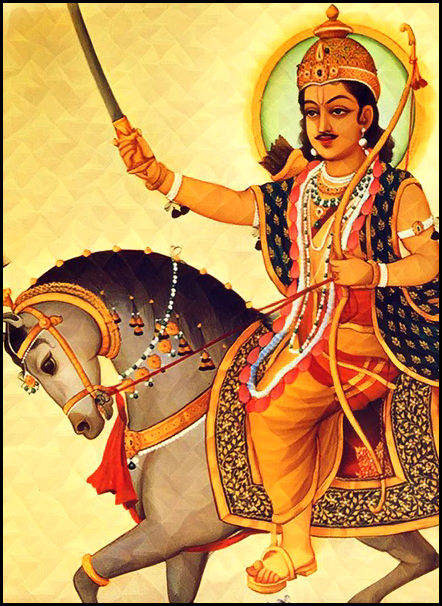
Magha Nakshatra
.The Moon in Leo is not always a blessing at all. In fact, it is peregrine. But the sign is also Feral. The most usual critique of the Moon in this position is that the native has an emotional need to be recognized or praised. The situation here, with the powerful Rahu in Leo driving the first house, the leadership qualities are enhanced.
At this time, Gabbard is in her Lunar Firdaria. but will be transitioning to the Saturn Period on 29 December 2019. One looks to the planets and luminaries in the natal chart to determine how a planetary period is likely to unfold. Here, we see Saturn in his Exaltation, but Rx. Nevertheless, Saturn has the greatest overall dignity. Still, I think things will become more challenging in 2020. But I doubt that Ms Gabbard has ever seen a challenge she didn’t like. I wish her all the very best
Sumerian and Babylonian creation myths are a key element in decoding the origins of astrology. Here, the Enuma Elish are presented as they have recently been re-interpreted

The Summer Solstice is matched in importance only by the Winter Solstice and both Equinoxes. It is a time to celebrate the light force at it’s seasonal peak. Virtually all ancient societies put great emphasis on this moment and most still do to this day. For those who have followed my work for any amount of time, will know that the primary interest should be celebration and joy. However, I always provide a chart for the occasion and discuss the most salient elements, This chart is for GMT on 21 June 2019 @ 4:54:09 PM.


The Moon is void of course, the Ascendant in Via Combusta. In Classical astrology the Quincunx is referred to as an inconjunct or aversion. In this chart there is actually a Yod comprised of the Quincunx of Moon and Jupiter to North Node and the sextile between Jupiter and Moon. Saturn is also involved, providing the opposition. The Yod is considered to be a ‘fated’ aspect – the finger of God – something that cannot be governed with impunity.. This will have varying personal significance depending on where this actually falls in your own chart. However, Here we have a clear direction. The North Node or Rahu is the head of the Serpent who is never satiated because he cannot digest – he is only the head. He is also indicative of the soul’s journey in greater cycles of being.
 The tight opposition of Saturn with the South Node to Mars with the North Node, although the latter is a looser connection, is still heady stuff. By means of Translation of Light, the Sun transfers the light of Mercury to both Mars and Saturn, The Almuten is Jupiter, the Day is Venus and the Hour is Mercury. The fact that Venus is in the Eighth House of Death and in a Mercurial Sign is troubling. However, I think the fact that both Saturn and Jupiter are Retrograde might actually offer some relief.
Having a good feel for the energies of any chart is helpful and the nakshatras provide another contextual dimension. Any planetary configurations can be worked with profitably, but denial is a useless proposition. It is highly likely that over the next six months, that the UK will face a calamity, perpetrated by foreign forces. Knowing that allows for preparation of all kinds.
This is a time of joy, celebration and of dancing in the Sun
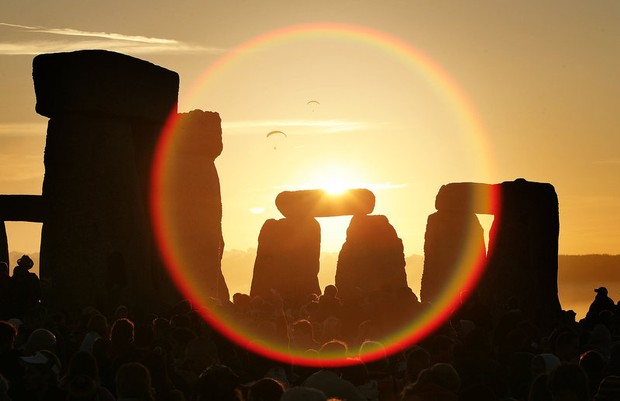
Courtesy of Beyond Orion

I became aware of this upcoming eclipse quite some time ago. It caught my attention because the point of greatest eclipse is over Singapore, within a nexus of volcanoes and frequent seismic activity and of course the date echoes that of the massive tsunami in the Indian Ocean on Boxing Day, 2004 believed to be the deadliest tsunami in history, with a death toll in excess of 230,000 people in 14 countries.
It began at 7:59am local time on December 26, 2004, when a 9.1-magnitude quake struck off the northern tip of Sumatra in Indonesia, reminding us all that this region is extremely volatile. In fact, it was at the site of present-day Lake Toba in Sumatra, Indonesia. that the extinction level super volcano killed off all but about 10,000 human beings about 70,00 years ago.
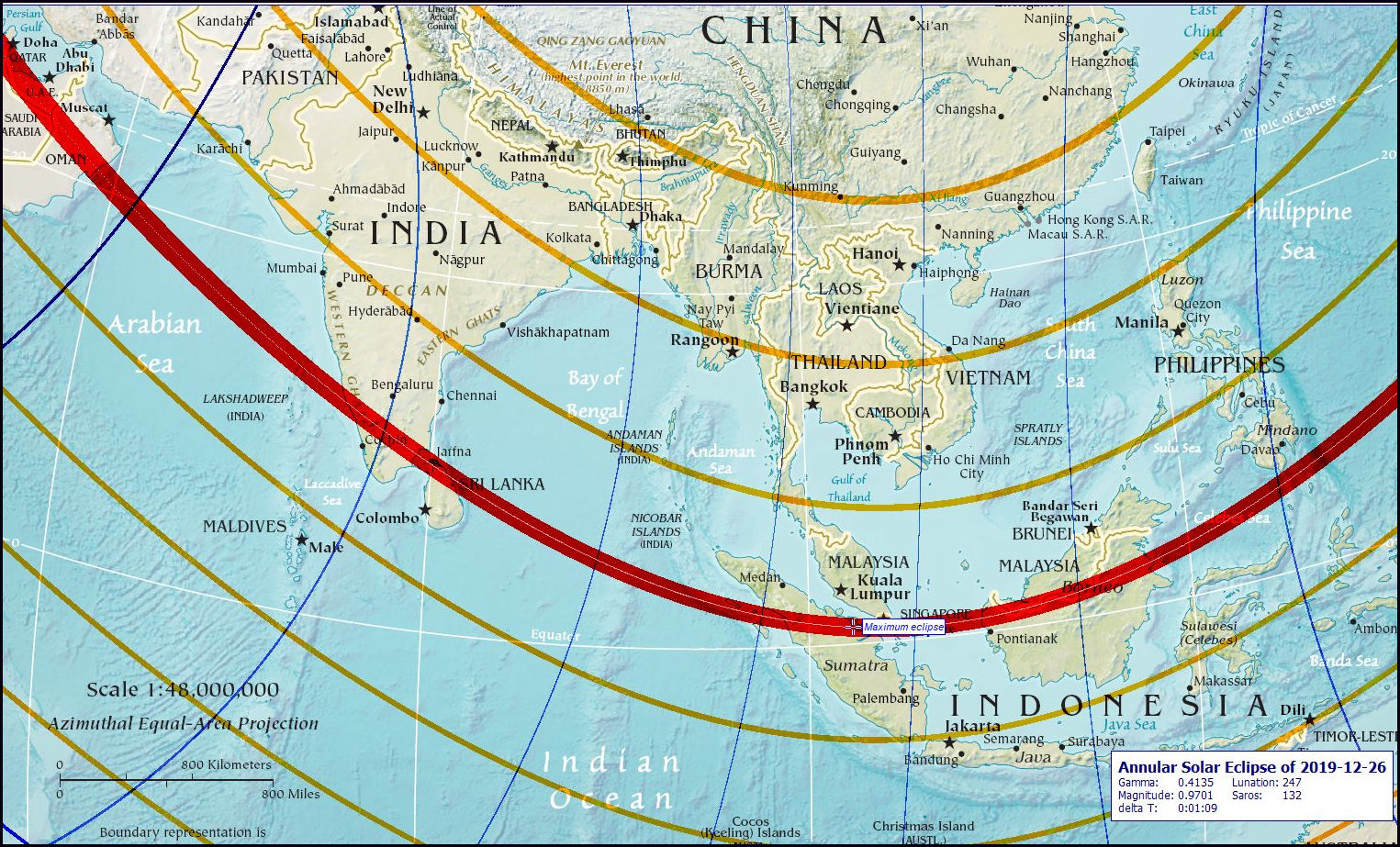
The upcoming eclipse is .3 minutes and 40 seconds in duration, affording a window of more than two and a half years of influence, but that doesn’t mean that we would have to wait that long for results, particularly considering. the larger pallet of celestial events, not least of which is the momentous Superior Conjunction of 2020 12 Dec 2020.
The chart for the eclipse is, of course, diurnal, the Planetary Day is Jupiter, the Hour belongs to Saturn who is also the Almuten. Mercury is Matutine Waning, Venus is Vespertine Waxing. No planets are in their Joy. Significantly, the Hyleg is the Sun – this evokes an image of the life force being diminished at the time of the eclipse. Five planets and luminary are deposited by Saturn and Saturn’s reach extends to Mars in his own domicile with his exaltation in Capricorn. Importantly, the Sun in Capricorn is in aversion to his domicile. The N. Node in the fourth house.gives us the image of the ‘end of things’ as well as earth and its roots.
The Greater Malefic is unleashed. Saturn is the key player for this eclipse and even more so for the upcoming Conjunction.
 There is a crucial element that might be missed by many astrologers using the tropical zodiac exclusively. The Eclipse occurs in the Moola (Mula. )nakshatra, which is the 19th nakshatra or Lunar Mansion.
Each of 27 (or, according to some texts, 28) equal divisions of the ecliptic through which the moon passes during the course of a sidereal month; a lunar mansion; the period of time with which each of these corresponds. In Sanskrit, nakṣatra means star, lunar mansion (lit. ‘with dominion overnight’) from nak, nakt- + kṣatra dominion See (OUP)
The significance of ‘Moola’ is root and its symbol is a bundled bunch of roots tied together. Moola nakshatra is ruled by the Goddess of destruction, i.e. Goddess Maha Kali. – sharp or dreadful. Ketu is also attributed to the nakshatra.; writes: “The planets and luminaries Mula Nakshatra is the first Nakshatra of the third (and final) Sattva group of nine Nakshatras, and it arises out of the very difficult Abhukta Mula Gandanta Zone: 2 deg either side of the transition from the sign before: Jyestha, to this Nakshatra: Mula.” See https://blog.starwheelastrology.com/
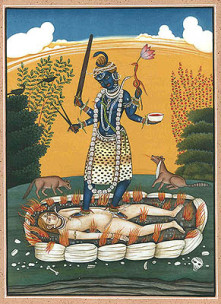
mahavidya goddess with a pair of scissor_
This is an obvious potential pitfall of using the Tropical zodiac which is oriented to the Solstices and Equinoxes The sidereal zodiac is fixed and based on the position of stars and the Moon. So, when we draw up a chart using Tropical, the nakshatras will, of course, remain in the same place, but do not appear to belong to the signs and asterisms from which they were derived. So, we have the odd situation of a planet in the early degrees of tropical Capricorn, whilst the sidereal charts place it in the early degrees of Sagittarius. This is the case in this chart. Moola is the galactic centre in Sagittarius ad to miss this is to lose much valuable information. In my own view, the nakshatras are too important to ignore.
Saturn itself, however, is in the 22nd nakshatra, Shiravan Chandra (Moon) owns this Nakshatra. This constellation spans from 10°00′ to 23°20′ in Makara, owned by the Shani (Saturn).
See the chart below, calculated using the Fagen-Allan zodiac.
It is becoming increasingly apparent that astrologers such as Vettius Valens and those before him used a sidereal (Babylonian) zodiac and sometimes in concert with a Tropical zodiac. Of course, for some time, the two systems would have yielded similar results. It would see that the exclusive use of the tropical zodiac came into being either by or through Ptolemy. We are now seeing more clearly how the Indian, Persian and Hellenistic astrological traditions influenced each other. An increasing number of contemporary traditional astrologers have taken it upon themselves to discover what can be gained by knowledge of Indian and Persian astrology.
Having said that, the reading of the tropical chart for this event provides a great deal of information and could be used as a stand-alone chart. However, we would miss some extremely important elements in the process.

There is no denying that this a difficult configuration for the eclipse. We also find a strong Mars in the House of Death. Volcanoes and seismic shifts are notoriously difficult to predict, but with this chart, I think it would be wise to take careful note and do whatever needs to be done to minimize the loss of life The magnitude is uncertain, but it will be a highly significant impact that by no means will go unnoticed. By including recognition and analysis of the nakshatra, we are given deeper insight into the nature of the event.
The following video of the last eruption of Krakatoa was taken by Martin Rietze, who retains Full Credits.
Watch Professor Lauren Kassell introduce the casebooks of Forman and Napier. Courtesy of the University of Cambridge

Shree Yantra
The term classical astrology is often used in a rather narrow way. The fact is that we are really discovering the convergence of different cultures, from the Hellenist to Persian and both to Indian. Babylonian and Egyptian. There is no absolute boundary between one and another. This is not to say that there are no significant differences., but on many occasions, the commonalities are hiding in plain sight Zodiacal Releasing, Firdaria and Dashas are Time Lord systems with very similar intent and comparable methodology and indeed expression.
This is part of a series on Jyotish in relation to western traditional astrology. It has long been my contention that we understand best when we understand how things came to be and how wisdom was transmitted through what was then the known world. Indian, Persian and Hellenistic astrology clearly have common roots. It is my view that by studying elements of Indian or other schools of astrology and philosophies that we enrich our understanding of our own.
Puruṣārtha is an element of Sanatana Dharma (Hinduism) that can easily be applied in Traditional Western astrology as well as to Jyotish. Puruṣārtha might be profitably employed by a range of systems, certainly even beyond astrology itself. At the core of all traditional astrology, there are various forms of creation myths, which are quite similar. To understand that is to get to the root of authentic astrology.
The number four is referred to extensively in astrology, as in innumerable other contexts and most. cultures. The most obvious of these are the four seasons, the four elements, the four directions, the four winds and the four humours.
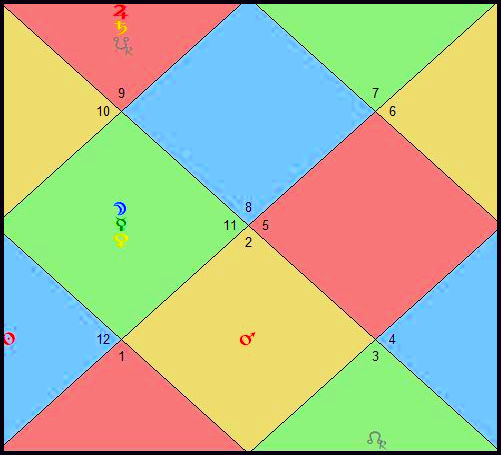
Hinduism created or recognized a four-part guide to live, including all dimensions of life in the Puruṣārtha. These have both personal and universal dimensions and can be expressed quite well by reference to the divisions of the horoscope.
As in many elements of Santana Dharma, there is no consensus about whether these pillars should be considered hierarchically, but they do constitute a complete system. They give us four elements of the circle of life, existing in four sets of trigons. This is the same as the Western House System to that extent. Both Hellenistic Astrology and Jyotish both use the Whole Sign system, bring us closer together.
However, the progressive element is not so widely understood in the West. We see how the fourth house of Moksha Houses proceeds to Death in the 8th and to Moksha. in the 12th. All three phases are required and work with the other Puruṣārtha. They also impart significance to the houses of the horoscope. In Hellenistic Astrology, there are two fortunate houses, the 11th and. the 5th along with two evil houses. 12 and 6. This is a simplification but serves to se5t the scene. The Second House is the Gates to Hades and the House at the other end of the axis, is the House of Death. Indian astrology is similar but not identical. I believe the origin of assigning such caution to the 2nd house is due to a concern for materialism that is rarely seen in most parts of the modern West but is still central to Indian thought. Asceticism is celebrated in the lives of Saints. Clearly, from this point of view, attachment to the material world is considered deleterious.
Houses 1, 5 & 9 are the Dharma Houses and the element of fire, marked in red.. The Artha houses, 2,, 6 & 10 are Earth and marked in saffron. 3,11 & 7 are air and the Moksha houses are 4.8 and 12, and associated with the water signs..
For Hindus and Buddhists, dharma is the moral order of the universe and a code of living ethically that embodies the fundamental principles of law, religion, and duty that governs the social structure and indeed all rares of human life. The Hindu worldview asserts  that by following one’s dharma, a person can eventually achieve liberation from the cycle of death and rebirth (samsara) Difficulties grasping an exact definition of what dharma means in Hinduism arise because there are so many uses of the word in stories and scriptures. Bot the essence of living an ethical life us shared by all. Hinduism is the religion of one god with a million faces. There are dualistic schools and non-dualistic schools. In the final analysis, understanding is very much the same.
But mostly it’s equated with principles such as duty, honour, justice, good works, character, and virtue. In many stories of Hinduism, when a person is in trouble, they turn to dharma to find their way out of a difficult situation.
The astrological houses of Artha are 2, 6 & 10, as you might expect. These are concerned with what one possesses, of work and the hope of recognized achievement or eminence. Artha (Sanskrit: अर्थ) is one of the four aims of human life in Indian philosophy. The word is translated as “meaning, sense, goal, purpose or essence” depending on the context in which it is used. This includes aspirations and attainment.

Plucking Tea in Assam, India.
Best understood as aesthetics, the definition of Kama involves sensual gratification, sexual fulfilment, the pleasure of the senses, love, and the ordinary enjoyments of life regarded as one of the four ends of man (purusharthas). This would naturally be closely related to the associations we have of Venus in Traditional Western astrology. Kāma (Sanskrit, Pali) means desire, wish, longing, but it would be a great mistake to think of this as trivial. I(n Hinduism, it is understood that without desire there would be nothing.at all In the time before time and creation, Vishnu dreams the Universe reclining on the coils of the serpent Shesha, accompanied by his consort Lakshmi, as he “dreams the universe into reality” It is Lakshmi who stimulates the Universal dream by her touch.

page from the kama sutra
So, in fact, the Universe was born of desire. The astrological houses are 2, 5 & 9. This will seem somewhat alien to the western astrologer, but that is because we tend to want to separate pleasure from wisdom. The pleasures of Kama include the pleasures of the higher mind. If our pleasures lead us astray, then Dharma is there to reset the balance.
Moksha is understood as liberation from the cycle of death and rebirth known as samsara.
Vivekachudamani, a popular text on Moksha, defines it as the following:
Beyond caste, creed, family or lineage,
That which is without name and form, beyond merit and demerit,
That which is beyond space, time and sense-objects,
You are that, God himself; Meditate this within yourself.-Vivekachudamani, 8th Century AD
The first house in the natal chart is always the ‘Udaya Lagna’ or the Ascendant, the sign that is rising on the eastern horizon at the time of birth. his is the same in Hellenistic astrology. The other houses follow the zodiacal sequence and the trigons each deal with an aspect of human life. Here we have the water trigon – the three stages of enlightenment. It is crucial to remember that the entire system is required and that difficulties in one house can easily affect the other signs in the trigons.
The fourth house in Jyotish is about roots, including Ancestry. Everything that refers to strong ties to your native place comes under the dominion of this house. But chiefly, it’s about roots. Without roots, there can be no blossoms.
It will be seen that Indian concepts and techniques may be gainfully introduced into virtually any form of astrology, without detracting from the form currently being used. This actually has intriguing similarities to Hellenistic astrology Both systems have at their root the will to be better and to further the good. The works of Plotinus and Philo remind one of Hindu metaphysics. In other words, they are both centred in an ethical framework.

Shri Vishnu Lakshmi
 The Classical Astrologer