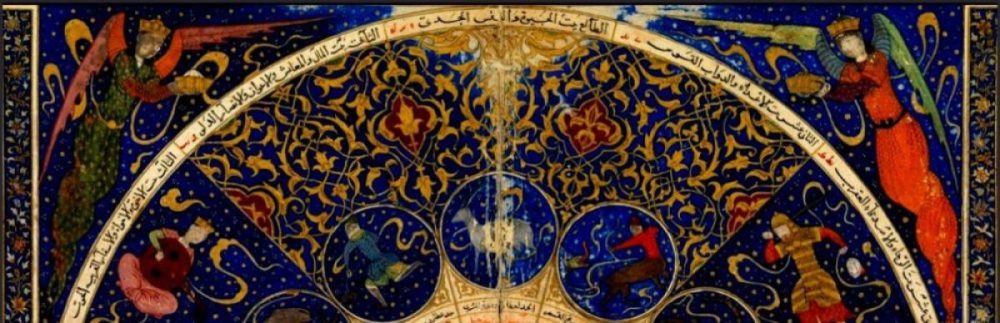
Aldebaran (Tascheter) the Watcher of the East.

Icon of Archangel Michael (detail), Yaroslavl, 1216.

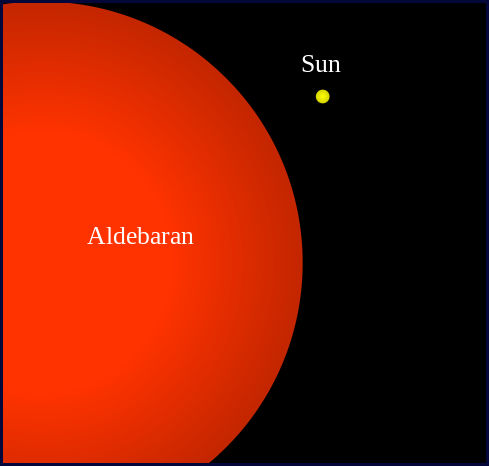
The constellation of Taurus holds the red eye of Aldebaran (Tascheter) the Watcher of the East. He is almost universally considered to the be the Watcher of the Pleiades. The association is with the Spring Equinox when the system was conceived. The Pleiades are associated with rain and even tears. To suffer a dry Spring was considered a bad omen indeed, as crops would fail.

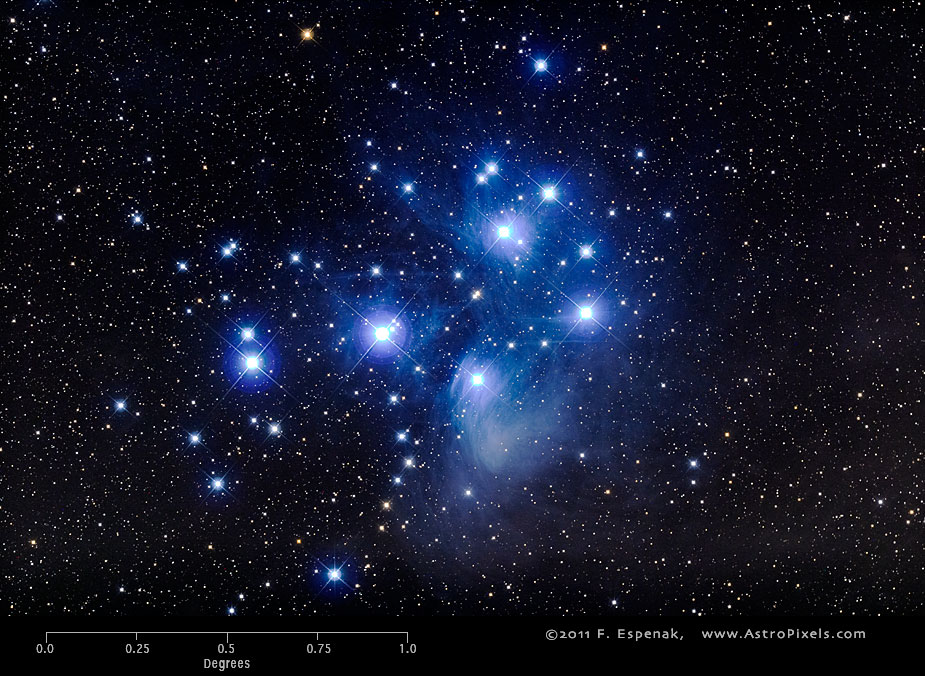
The Pleiades aka The Seven Sisters is probably among the best-known star clusters in the heavens. It is easily visible with the naked eye on a clear night in the winters of the Northern Hemisphere.  It has also been of particular interest since antiquity and to a variety of cultures. There are references to the Pleiades in Hesiod, The Odyssey, The Bible, and the Quran. The asterism is also revered in  Hindu mythology. The Pleiades have always been one of the most studied asterism in our history. Manilus writes: ”

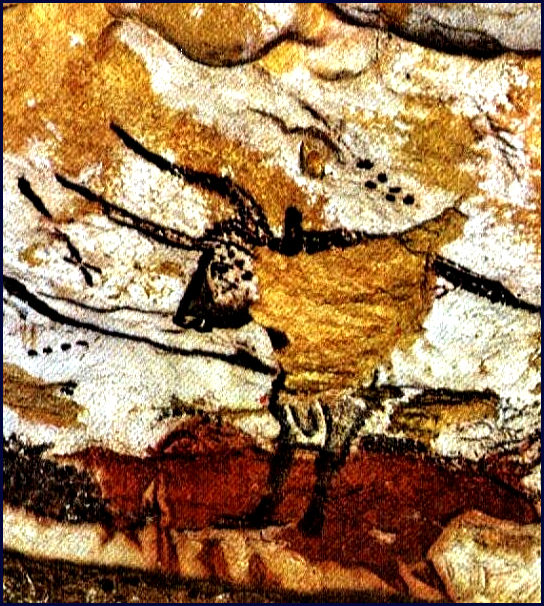
Auroch (Bull No 18) Hall of Bulls Lascaux

“The Bull will dower the countryside with honest farmers and will come as a source of toil into their peaceful lives; it will bestow, not gifts of glory, but the fruits of the earth. It bows its neck amid the stars and of itself demands a yoke for its shoulders. When it carries the sun’s orb on its horns, it bids battle with the soil begin and rouses the fallow land to its former cultivation, itself leading the work, for it neither pauses in the furrows nor relaxes its breast in the dust. The sign of the Bull has produced a Serranus and a Curius, has carried the rods of office through the fields, and has left its plough to become a dictator [eque suo dictator venit aratro]. Its sons have the love of unsung excellence: their hearts and bodies derive strength from a massiveness that is slow to move, whilst in their faces dwells the boy-god Love (Cupido).” [Astronomica, Manilius, 1st century AD, book 4, p.233].

The Pleiades (M45) as imaged with the Takahashi E-180 Astrograph from Bifrost Observatory. For complete details about this image, see Pleiades (M45). Photo copyright 2012 by Fred Es[panak of NASA

In the image of the Bull from the Lascaux caves, we find that the astronomical detail is stunning. The Bull is enmeshed in the Hyades, with the Pleiades clearly articulated just above him. You can also see the belt of Orion. That we have such a clear a Neolithic representation of the constellation is a testimony to how long the heavens have held particular meaning for us and also that there has been far less changing in our interpretations than we might reasonably expect. Of course, this begs the question.

The Angel of the East is Michael the Archangel. He is best known as something of an Avenging Angel but is more properly known as a protecting Angel. His sword is always ready.  The East is the place of the Sunrise and the beginning of things.

This is what Vivian Robson says about Alderaban: “It gives honor, intelligence, eloquence, steadfastness, integrity, popularity, courage, ferocity, a tendency to sedition, a responsible position, public honors and gain of power and wealth through others, but its benefits seldom prove lasting and there is also danger of violence and sickness. [Fixed Stars & Constellations in Astrology.  p.120.] Aldebaran is known as the Eye of God but also associated with blindness. Many of these attributes are the blessings and shortfalls of youth. We are facing the origins of creation.

We can’t forget that this is the element of Earth or that the Hebrew meanings are oxen in the sense of the yoked power of the Bull, Aleph is the first letter of the Hebrew alphabets and speaks to powerful potential. The name aleph is originally derived from the West Semitic word for “ox”, and the shape of the letter derives from a Proto-Sinaitic glyph.  It is thought that this glyph was in turn based on Egyptian hieroglyph, however, I find insufficient evidence of the last claim.

The tarot card that embodies this quite consciously is The Fool. The Fool is in a sense outside of the system and has the value of zero and perfect potential. In mosy decks, the Fool is shown with a staff with a sack over his shoulder, which is undeniably associated with virility. the Fool is youth personified: optimistic for no particular reason and most of all, unaware of the potency he carries and is about to walk off a cliff while sniffing a flower.

The name Aldebaran (pronounced /ælˈdɛbərən/) comes from the Arabic word al-dabarān, meaning “the follower.” The name refers to the Pleiades cluster (Messier 45), which the star appears to be following across the sky.

Antares – Watcher of the West

he Temptation of Adam and Eve. 1430s. Harley 2278 f. 1v

Until I started to write this article, I had no idea that there was so much confusion regarding the Watchers and their associations. I read some pieces that were truly bizarre. The situation therefore indicates the need for an introduction regarding the historical origins and essential meaning of the four Royal Star of Persia. Such an introduction is long overdue in any case and will assist in reference to other articles.

These stars are clearly of particular significance and importance Thier significance is cross-cultural, but the most complete explanation is found n Persian sources and it’s entirely possible that the narratives in The Tanakh also owe their Persian origins as demonstrated in The Book of Enoch, Daniel, Isaiah, Ezekiel and other books; 

This means that the Book of the Watchers was almost certainly heavily informed by the Persians. The Jews drew heavily on Persian tradition and their knowledge of the heavens. A copy of the complete Book of Enoch can be found here.  

Horoscope from ‘The book of birth of Iskandar (Persia 1411) Credit: Wellcome Library, London. Wellcome

Some background history will assist in showing the context and transmission of these Persian, Zoroastrian idea to 3rd century B.C. Jewry. Cyrus the Great – reigned from 550 to 530 B.C.conquered Babylon on October 11, 539 B.C. and set Darius the Mede as “vassal” over Babylon. It was Cyrus the Great that formed the Achaemenid Empire (Persian Empire) as the successor to the Babylonians.

Cyrus is mentioned 23 times in the Bible and is called “the Lord’s anointed” (Isaiah 45:1) and the “My shepherd” (Isaiah 44:27-28). 150 years prior to Cyrus’ birth, Isaiah foretold his birth, his name, and the tasks that God determined Cyrus to accomplish. Only a very few biblical commentators believe that Cyrus was Esther’s husband. The Cyrus Cylinder was discovered in 1879 and describes the conquest of Babylon and Cyrus’ desire to repatriate to their homelands those who had been exiled. This included the Jewish people held captive in Babylon. The Persian Empire is often called the Achaemenid Empire in honour of a man named Achaemenes, who is considered the patriarch of the Persians, and whose very name means “having a friend’s mind.” See The Persians and the Achaemenid Empire 

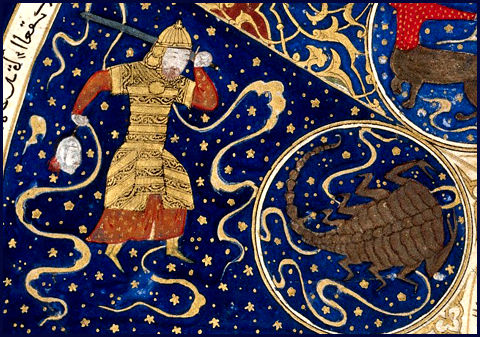
Archangel Uriel, Orthodox Icon

Antares The West is associated with the Autumnal Equinox (Watcher of the West) and is also imbued with the symbolism of the setting Sun and the realms beyond the Western horizon. The Western Isles have great symbolic currency in many traditions, including the Druidic-Celtic culture and in fact most Aryan mythology. Scorpius is a very bright constellation and Antares (Satevis) glows orange and bright in the heart of the Scorpion. If you have reasonably clear skies and don’t live in a major city, it’s easy to spot.

Students of The Bible will recall that the Garden of Eden is guarded by an angel to prevent Adam and Eve returning to Paradise: “So he drove out the man; and he placed at the East of the Garden of Eden Cherubims, and a flaming sword which turned every way, to keep the way of the tree of life”. (Gen.3:24).  The Angel guarding the entrance to paradise is understood to be Uriel. Innocence cannot be regained, so another way must be found. This is very close to what William Blake means by “Innocence and Experience.” The sword is a virtually universal symbol of truth – one has to cut through illusions. In this respect, Uriel has much in common with Manjushri, who also wields a flaming sword.

Uriel comes from the Hebrew name אוּרִיאֵל (‘Uri’el) which meant “God is my light”. He is mentioned only in the Apocrypha, for example in the Book of Enoch where he warns Noah of the coming flood. For an extensive list of Uriel’s associations, see here.

The Four Directions are associated with the Fixed Astrological Signs: and stars -Aquarius (Fomalhaut), Taurus (Aldebaran), Leo (Regulus) and Scorpio (Antares). I have found a number of articles on the web that place Raphael with Antares.as the healer, The rationale seems rather weakly connected to Orphiacus. However, the imagery of the Heart of a Scorpion speaks less of healing in the

Manjushri (Jampel Yang)

Manjushri is the embodiment of the wisdom that cuts through illusion to realize enlightenment

ordinary sense and more to do with ‘only by the fire may you be purified.” Uriel is not only the Angel with the flaming sword. He is always shown with a flame that denotes both light and heat. The courage to travel to the Western Isles ultimately becomes an inevitability. Conquering the fear of death is a lesson for the warrior. These are quintessentially Scorpio themes

Iran & the Aries Ingress Chart

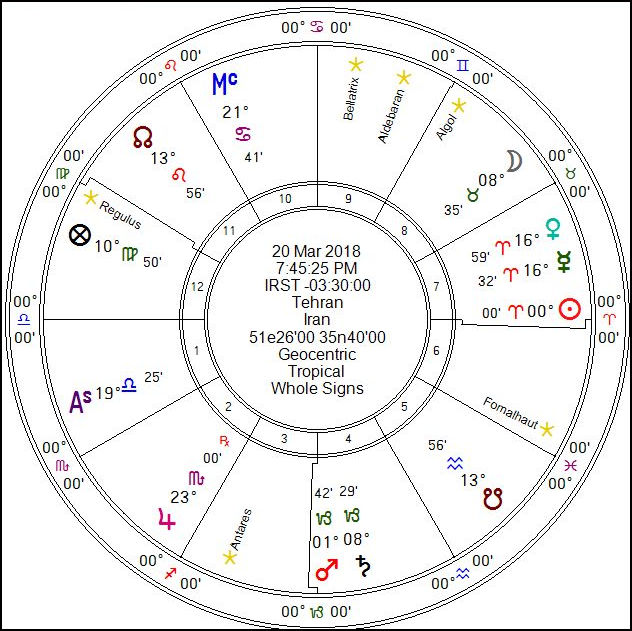
I’m not a fan of using several charts to determine the nature of an event or whether it will occur at all. Here, I draw exclusively on the Chart of the Year as calculated for Tehran at the Spring Equinox and Nouruz. The general query is to assess the position of Iran at a time when once again, The Islamic Republic of Iran is being threatened with more than sanctions and covert attacks. It seems almost an absurdity to ask if Iran will be at war. It has been on a war footing since 1979 and many times prior to that. This is more of an examination than a prediction.

Predicting wars is a very bad habit. Assessing relative strengths, what’s at play and the nature of the subject is much wiser, because wars can be prevented. I’m a firm believer in studying what Tibetan Buddhists refer to as “causes and conditions.” These can be so powerful that it seems they cannot be resisted. The fact is, we do not live in a purely deterministic realm and, if we did, there would no point in talking about it.

This is a fascinating chart. The Lord of the Year is the Sun and here we see him setting in the Sign of his Exaltation. He is also the Hyleg. The Seventh House of open enemies is disposited by a strong, exalted and angular Mars, conjunct Saturn. So both malefics are involved in the matter of that house, both are in a square relationship to Sun, Venus and Mercury.

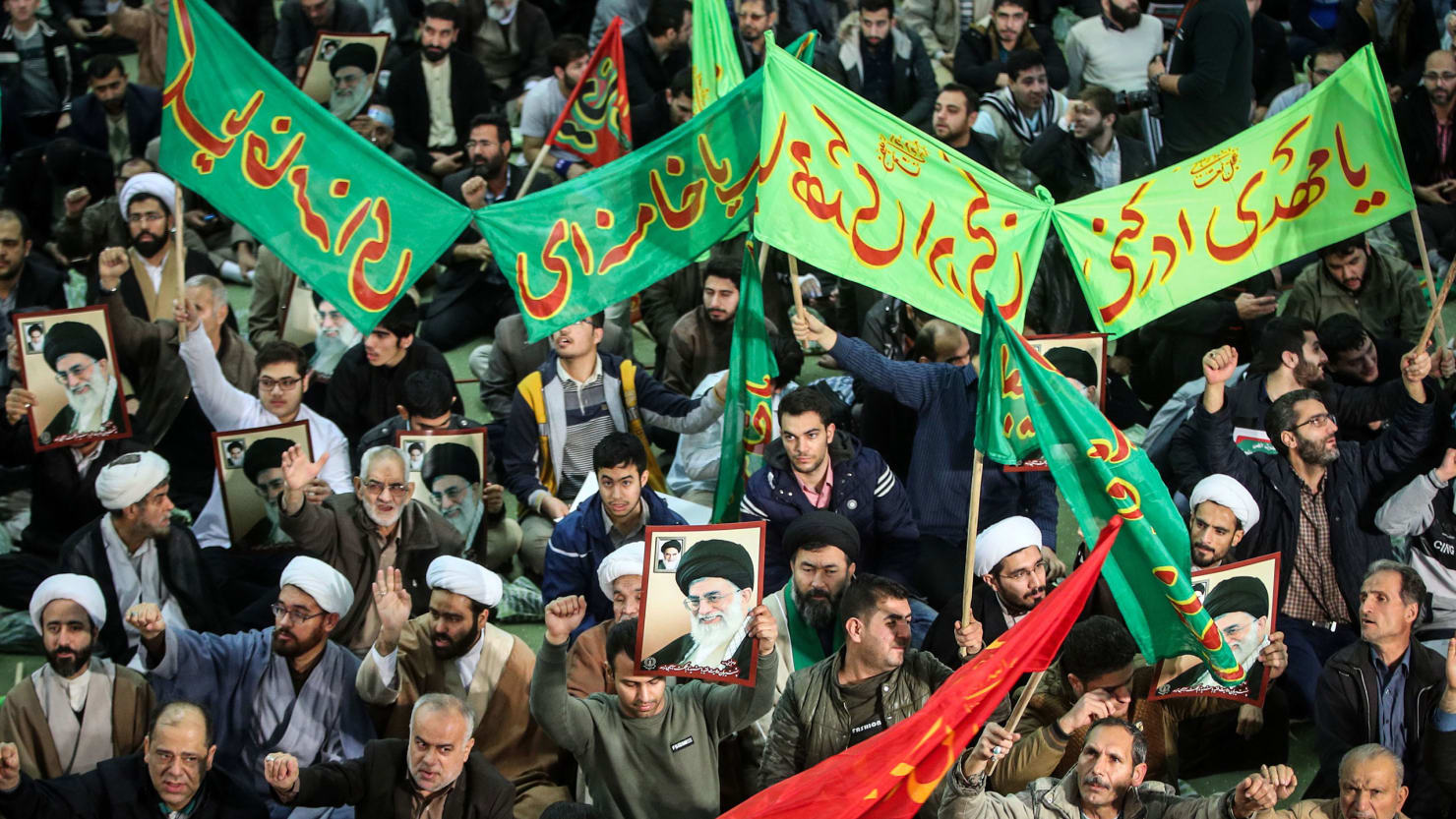
Tens of thousands gathered across Iran Wednesday in a massive show of strength for the country’s Islamic rulers after days of deadly unrest, with state television showing vast crowds marching…

Venus is in her detriment but is the Lady of the Ascendant, which is most appropriate for the Islamic Republic. Venus is the chart Almuten and is the planet of Islam. An examination of the Ascendant is a means to evaluate the relative strength of a native, which in this case is a nation. In relation to Aries, Libra is the weaker partner. The detrimental status of Venus only diminishes strength further.  Venus also disposits the Moon, in her exaltation but in the Eighth House of Death.

The Moon represents the common people as does the Sixth House, disposited by the Geater Benefic and in the sign of Venus’ Exaltation. However, Jupiter is retrograde and disposited by Mars.  The Moon in Venusian Taurus is Lady of the MC.

The Twelfth House of (among other things) self-undoing and secret enemies is the unfortunate position of the Part of Fortune.

The chart speaks strongly of a regime change and Iran cannot protect herself form open and secret enemies in a region that has seen the destruction of several countries, at least by herself. I do not see open warfare with Iran in the next while, but the regime change has been working its way forward for quite some time. The last thing Iran needs is more aggression from Israel, Saudi Arabia, the US or NATO wholes motivations have precious little to do with nuclear deals and everything to do with maintaining global hegemony and petrodollars.

Iran sentences woman to two years in jail for removing veil

Of course, Iran has its own internal struggles. She is a rich and ancient culture and is ill-suited to a dictatorial theocracy that features a specialized police force to enforce not only the wearing of veils but limits the colours that can be worn. There have been the well publicised anti hijab and ongoing human rights protests as well as the mostly unpublicised resurgence of the ancient Persian religion, Zoroastrianism among Kurds and ethnic Persians.  There have also been counter-protest and many believe the anti-hijab movement was instigated by foreigners.

Iran is clearly ripe for change.

The Eclipse of Castiglione

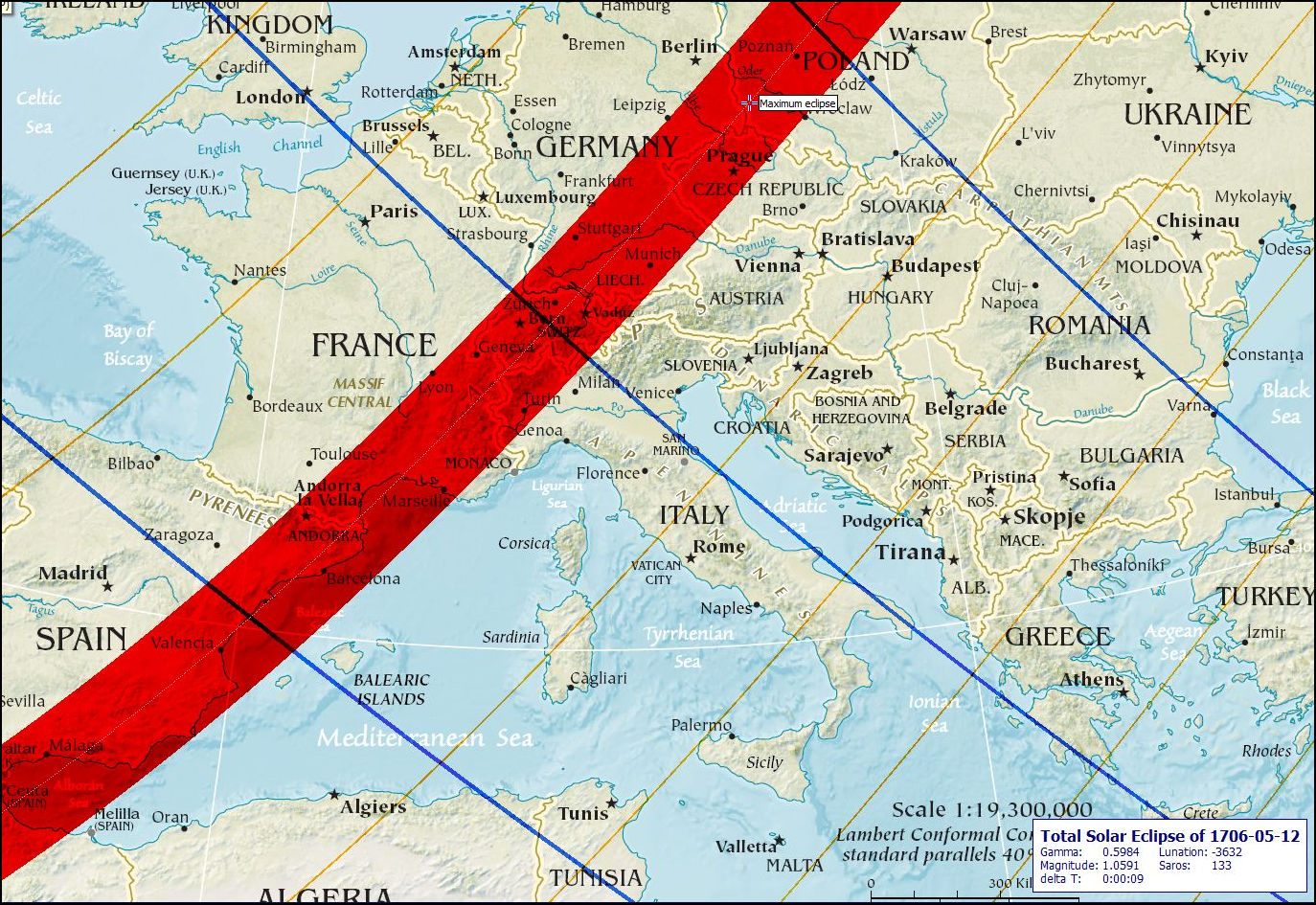
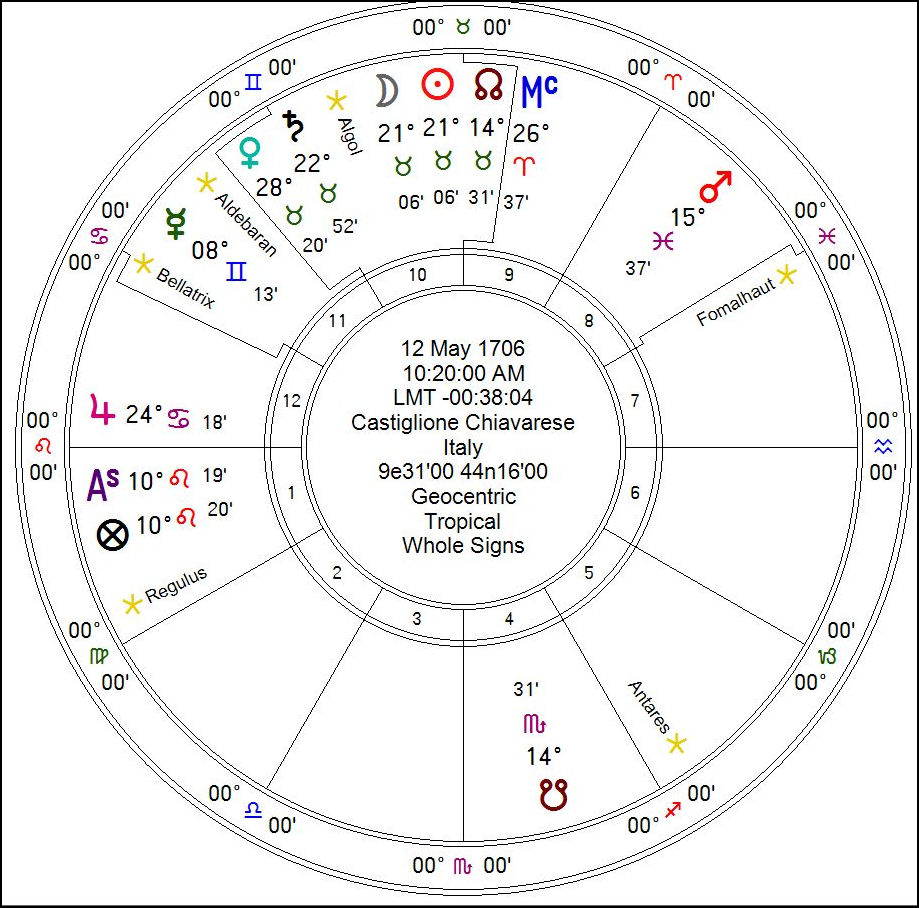
On the 12th of May, 1706, there was stunning Total Solar Eclipse, with the Path of Totality running through the heart of Europe, from Southern Scandinavia through Spain. The chart for the eclipse in Castiglione Savarese, a town now in Northern Italy looks very ominous indeed. Any astrologer reading this chart would have taken it as a harbinger of things to come, particularly knowing the strategic value of their city and the.extreme turbulence of Europe, involving several powerful countries jockeying for increased wealth and hegemony. This needs to be said because making a prediction of an event that cannot possibly take place, such as a major earthquake in an area that has no significant seismic threat or to push the point further to predict a tsunami in Mongolia. When predictions are made, it is to the great advantage of the practitioner to take realities into account. This includes political realities. 

The path of the eclipse also looks like a visual depiction of the Swedish army’s sweep through Europe, over the Alps as it races from one conflict to another. or the French army under Louis d’Aubusson de La Feuillade marching to a decisive and assured victory.

The eclipse was exact for that location at 10.20 AM. The Sun eclipsed by the Moon in the 21st-degree of Taurus, which conjuncts Algol, the most pernicious star in the heavens.  Furthermore, Algol is between the eclipsed Sun and Saturn. This configuration in the  Tenth House augurs for the fall of Castiglioni. This is not to be confused with the more famous battle at the same location on August 5, 1796.

The history and political intrigue germane to our topic should be understood as part of a series of many, many battles. In one way or another, the conflicts began with the crisis of the Spanish Succession and the hydra head of ensuing conflicts involving several countries in Europe. The details are too many to release here and are not likely to be of great interest to anyone other than a historian of the period. However, a summary of the events that lead up the more than a century, the political and military situation is summarized thus:

Since May 1706 a French army of 48,000 under the said Louis d’Aubusson de la Feuillade was besieging the Savoy capital, Turin. Another army 44,000

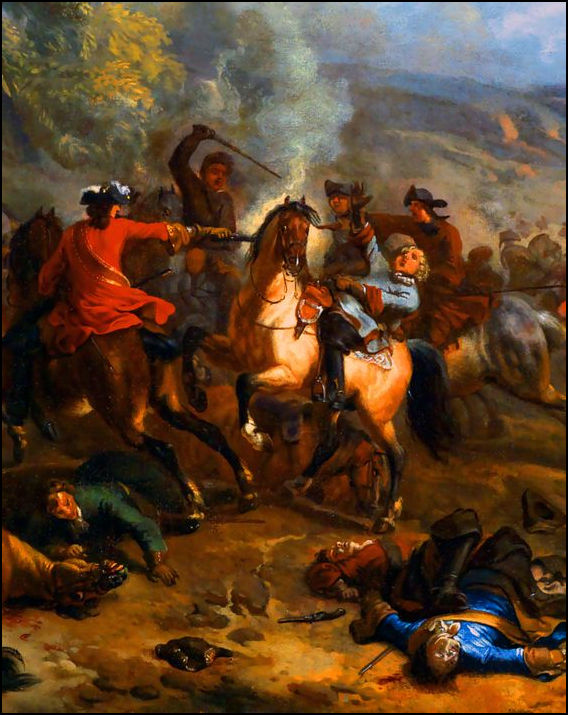
Battle of Luzzara, War of the Spanish Succession

under Louis Joseph de Bourbon, duc de Vendôme was employed to bar the Austrians’ path from Lake Garda. However, Vendôme was recalled to Flanders to restore order after the lost Battle of Ramillies, leaving command to the inexperienced Duke of Orléans. Eugene of Savoy exploited the situation and dashed to Turin, forcing Orléans to split his forces. He left 23,000 men under the Count of Médavy near the Adige in case allied reinforcements appeared from the other side of the Alps.  The Swedish army under the Crown-Prince and future King Frederick I of Sweden, crossed the Alps and besieged Castiglione. Here, Médavy attacked and totally defeated the Hessians, inflicting a loss of 8,000 killed, wounded, and missing.”  These historical facts have been gathered from various sources, all or most of which can be found  @ Wiki

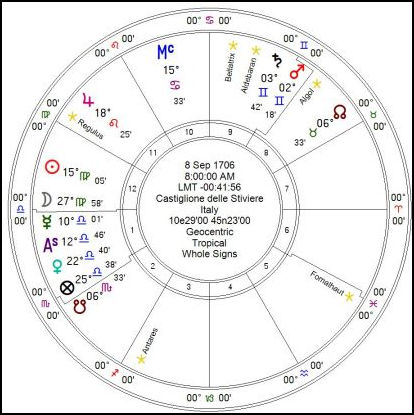
We are now in a position to see the progressions and comparisons of the two charts. Saturn has moved to conjunct Mars in the Ninth House and we can fairly read that as indicative of the foreign invaders, particularly with Aries opposing the city’s Ascendant in Libra. The lights are now weak in the 12th House and acting as hidden enemies. Saturn is Almuten of the First and fifth House in the Hour of Saturn. The chart Almuten is Mercury.The Scorpio/Taurus Axis of the Nodes in the Axis of Hades reflects themes of the Eclipse.

Tokens of Impending Doom

An image of Halley’s Comet taken in 1986. Credit: NASA

First of all, the title is part of a quotation from Manilus, one of the most respected astrologers of his time. This is a rather different kind of article.  It’s a short introductory piece on the nature, history and reputation of what must be the best-known comet

The long history of this object and the events associated with its arrival are less well known. It is the latter I wish to address, after providing some essential history, including how the comet got its name. The comet we know as Haley’s Comet has been visiting us for 200,00o years, It’s a once in a lifetime celestial spectacle which last occurred in 1986 and the next predicted perihelion will be July 28, 2061 .

It was Edmund Halley, a close friend and colleague of Isaac Newton who calculated that the comet that was to bear his name was the same comet that repeatedly returns to the vicinity of the earth in a predictable pattern of time. Halley was indebted to Newton’s physics and it is perhaps one the greatest ironies that Newton practised astrology, while Hally considered it nonsense and was greatly puzzled how his brilliant and learned friend could succumb to such an ‘irrational’ pursuit. Halley once confronted Newton, asking him how he could believe in such things. Newton famously answered; “because I have studied it sir and you have not.”

Edmond Halley

Halley published his findings, “A Synopsis of the Astronomy of Comets” in 1705, cataloguing what he had discovered from researching historical records of 24 comets from 1337 and 1698. Three of those observations were strikingly similar in relation to orbit and other parameters. Halley proposed that the same comet appeared to be returning to Earth again and again.

Based on the appearance of the comet in 1531, 1607 and 1682, he was able to predict that the comet could return to Earth in 1758.  He wrote ““If it should return, according to our predictions,” he vowed, “impartial posterity will not refuse to acknowledge that this was first discovered by an Englishman.” Halley died long before that in 1742, nevertheless it was natural that the comet would bear his name. The comet returned on Christmas day in 1757.

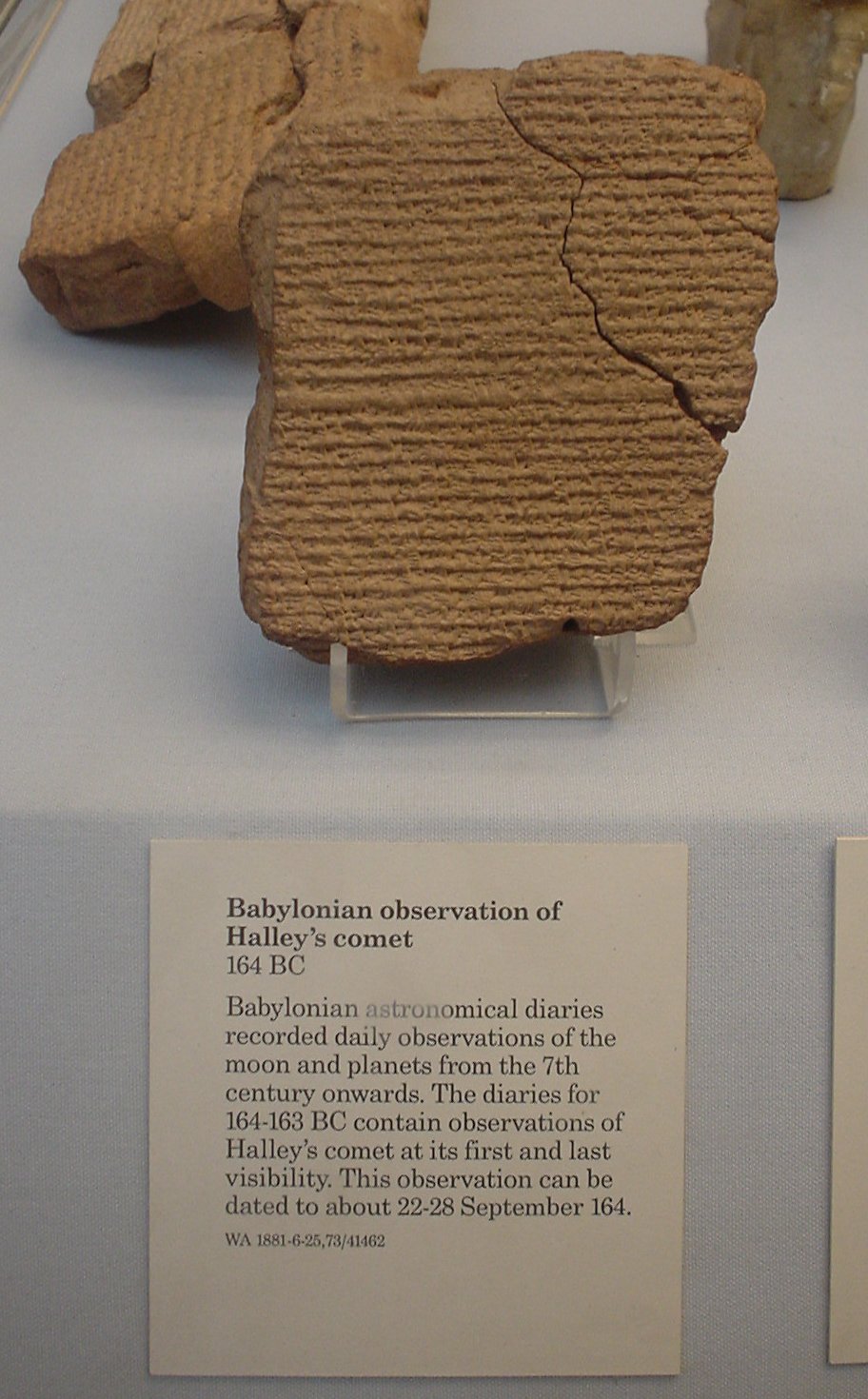
We know that observations of the comet had been made by Babylonian astronomers in the third century BC, It had been recorded by the Chinese and later the Japanese and throughout the European Middle Ages. It was of varying brightness. One report stated that the comet appeared to be half the size of the Moon and just as bright. Ancient Greek texts reveal the earliest recorded sighting of Halley’s comet, 2,500 years ago

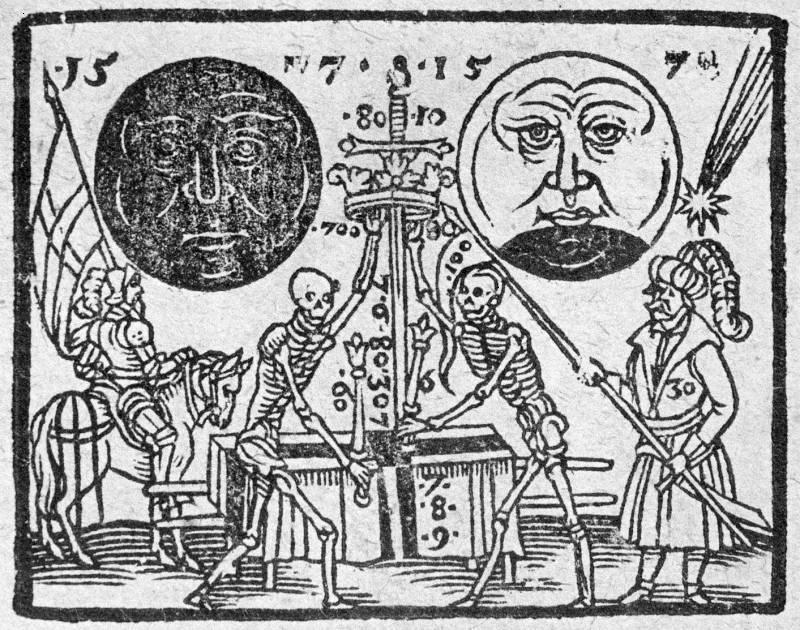
1607-skeletons with comet

I will focus on three events that coincided with a visit from the famous Comet in which the world was radically changed in one way or another. Halley’s Comet has been plummeting through the solar system for approximately 200,000 years. Comets had always had a sinister reputation according to ancient astronomers and astrologers alike. Halley has lived up to the reputation as a harbinger of massive changes in established order, including its coincidence with the destruction of the Temple in Jerusalem, described by Josephus a devastating attack by Ghengis Khan, the fateful and successful invasion of  England by William the Conqueror. Halley is in fact included in the Bayeux tapestry.


Babylonian tablet recording Halley’s comet

Ian Redpath writes: “A comet looks like a portent, and it is not surprising that people always regarded them as such. Writing 2000 years ago, the Roman astrologer Marcus Manilius summed up the prevailing opinion: ‘Heaven in pity is sending upon Earth tokens of impending doom’. Included in his list of cometary ills were blighted crops, plague, wars, insurrection, and even family feuds. In short, anything could be blamed on comets, and usually was.” (A Brief History of Halley’s Comet)

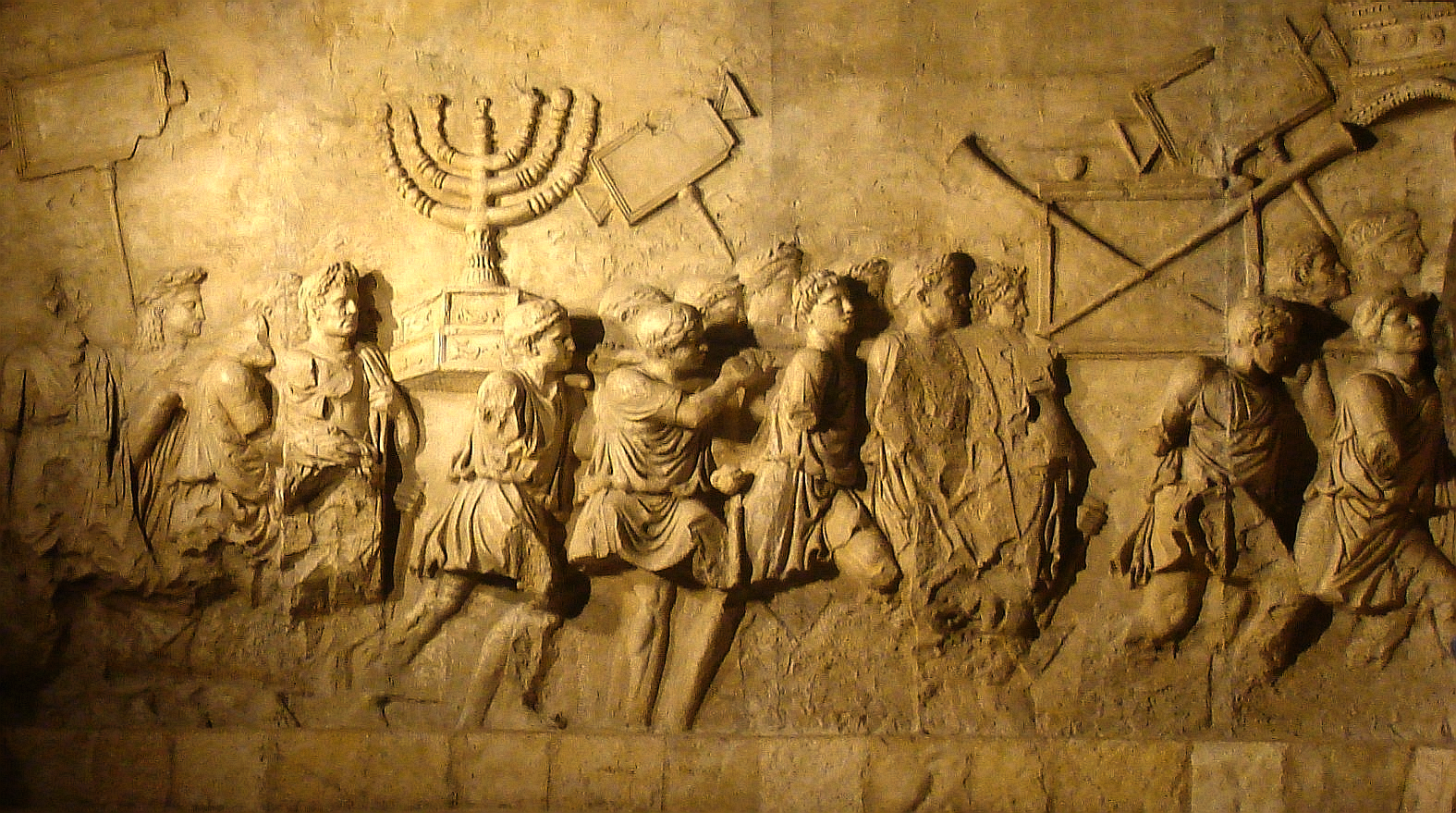
Josephus provides us with a vivid image of the comet and what ensued: “like men infatuated, without either eyes to see or minds to consider, did not regard the denunciations that God made to them. Thus there was a star resembling a sword, which stood over the city, and a comet, that continued a whole year. Thus also before the Jews’ rebellion, and before those commotions which preceded the war” (The Wars of the Jews J. BJ 6.288)  The comet was Halley’s and the writer’s sense of horror is unmitigated.

Roman soldiers brought back a Menorah and other holy relics from the Second Temple in Jerusalem.

This event and other associated with a visit from the comet is of incalculable importance. It was the end of the temple elements of Judaism which has not been restored to this day. The Roman victory was massive, leaving the Jewish population in a state of humiliation and disarray.

Alireza Salzberg writes “Jewish people following the destruction of the Second Temple. The story of the founding of Yavneh represents the birth of rabbinic Judaism, a way of life focused on Torah and Jewish law, rather than Temple worship or political sovereignty.” (Judaism After the Temple) The singular event of the temple’s destruction and desecration radically altered the path of Judaism for the next two millennia.

Turning to the Battle of Hastings: “at that time a star appeared in the north-west, its three-forked tail stretched far into the southern sky remaining visible for fifteen days; and it was portended, as many said, a change in some kingdom”.(attributed to William of Jumiege).

Halley’s Comet appeared above England 24 April 1066. It was immediately interpreted as signifying an event of considerable significance. It was believed that it was a divine symbol, a warning that the kingdom was in great danger. The main elements of the Norman invasion are well known. But it is sometimes forgotten that this was the most brutal battle ever fought on English soil. Needless to say, with a Norman king on the throne, the country would never be the same again, for better or worse.

Comet lore is such that they are regarded as sufficient omens unto themselves. Most of the usual astrological considerations take a back seat. While it is true that not all visitations of Halley’s comet presaged disaster and mass destruction, there have been more than enough to assure it’s sinister reputation.

Tapisserie de Bayeux – Scène 32 : des hommes observent la comète de Halley

But spurring on the Norman invasion of the British Isles wasn’t sufficient for Halley’s Comet Its return in 1222 augered far worse violence.  Genghis Khan considered the comet as his own personal star. The trajectory of the comet was westward and this inspired Genghis to travel west, instigating an invasion of southeastern Europe. Millions of Europeans were butchered, their towns and cities sacked. The comet always seems to favour the aggressor. It is hardly surprising that the visit of a comet (they did not yet know it was the same one) struck terror and foreboding in populations.

There are of course dozens of other examples which lend substantial support to the ancient idea that comets are signs of devastation of all kinds. However, not least is the awe-inspiring 200,00 years of predictable returns which speaks of cycles longer than we usually consider of something that had appeared to be ephemeral. Further, the date roughly coincides with the emergence of modern human beings, making it something of a shadowy companion to humanity itself.

Prise_d’Alamût_(1256) Bibliothèque nationale de France. Département des Manuscrits. Division orientale. Supplément persan 1113, fol. 177v

When Halley’s Comet returned in 191o, it brought forth fear of an apocalypse because Earth would pass through a small part of the tail. The spectroscopic studies of comet tails conducted by Sir William Huggins revealed that among the many organic molecules found in comets was lethal cyanide gas. Speculation became hysteria in some cases, convinced that the humanity stood a very good chance of being asphyxiated by cyanide molecules. Newspapers fueled the panic, people sealed off their chimneys and doorways. There were many suicides, strange new remedies were offered for sale and oxygen sold for high prices.

Apparently, many people also confessed to crimes they had committed because they believed they would soon be deceased in any case.

Of course, every year has its share of disasters and political strife at least somewhere in the world. Nevertheless, 1910 is mostly remembered as the calm before the storm of WWI  or the sinking of the Titanic. Although the details were entirely spurious, it is fair to say that the Comet was a sign of the events in the terrestrial world – that it somehow mirrored mundane events, rather than being the cause of them, I will concede that some of the other instances may require some reflection.

Spring Equinox – Nowruz 2018

Aries Ingress 2018-03-20 G 16:15:25 UT Greenwich, United Kingdom 000° e 00′ 51° n 29′ Asc: 00°00′ Virgo, Moon: 08°36′ Taurus – showing Hermetic Lots

The Ingress of the Sun into zero degrees Aries marks the Spring Equinox and Nowruz. In some respects, this astrological event is the most important in the yearly cycle because it marks the astrological New Year and the chart provides us with insights into the entire year. Most importantly, we can derive the identity of the Lord or Lady of the Year – an influence which will be felt throughout.

This year the Moon exalted in Taurus in the Ninth House is the Lady of the  Year. The Sun is Exalted in Aries and we find Mars in his Exaltation with Saturn in his Domicile in the Fifth House. The planetary Day is Mars and the Planetary Hour belongs to Mercury. The Almuten of the charts is also Mars. Venus is in her Fall and Mercury is not strong in Aries. Both are Under the Beams – invisible due to the light of the Sun.

The Hyleg according to Ptolemy is the Moon. Much of this chart is a balancing act between the natures of Mars and Moon, but the Lady carries the day in the third Lunar Mansion. According to Cornelius Agrippa, this Mansion is called  Aldebram or Aldelamen: eye or head of Taurus. 8°34’17” Taurus.  destruction and hinderances of buildings, fountains, wells and gold mines, the flight of reptiles and creates discord revenge, separation, enmity & ill will  A soldier on a horse, holding a serpent in his right hand. However, Ibn Arabi suggests the Mansion is Universal Substance, prima materia – the last Divine Attribute. For those of you who have an interest in the Mansions, I recommend studying the principal stars of each one.

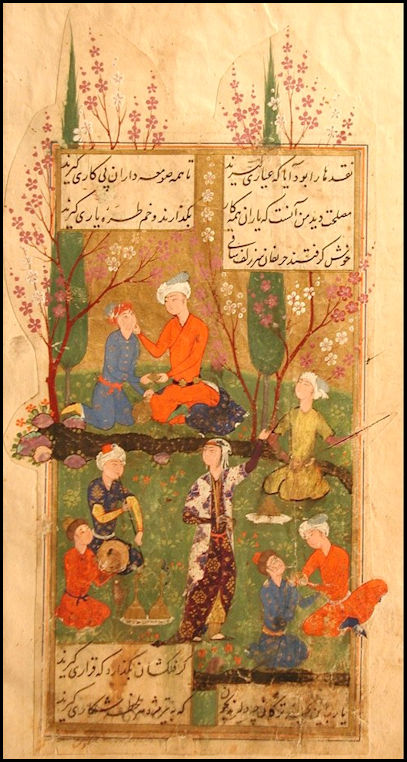
Illustration from the Divan of Hafez 1585 miniature. Iranians of all faiths – Muslims, Baha’is, and Zoroastrians turn to Hafiz on Nowruz, the Persian New Year, for guidance about the year to come. According to my friend in Afghanistan, the Divan is used as a kind of divination where the book is opened at a random page to read what it says.

I don’t go into great detail on the charts for the four Equinox/Solstices unless it is part of a specific prediction for two reasons. First of all, the chart will be significantly different for various locations.  The Equinox chart for Tehran, for example, has a Libra  Ascendant and the Moon in the Eighth house. More importantly, I think, these events are primarily a time of celebration and reflection. The Aries Ingress is the New Year and in Iran and other countries with a Persian diaspora, it is a time of cleansing and renewal in other spiritual and religious traditions also. The seasons resonate with us all.

The writer at http://www.mihanam.com tells us thatNowruz ceremonies are symbolic representations of two ancient concepts – the End and Rebirth. About 3000 years ago Persian’s major religion was Zoroastrianism, named in honor of its founder Zoroaster, and arguably the world’s first monotheistic religion. Zoroastrians had a festival called “Farvardgan” which lasted ten days and took place at the end of the solar year. It appears that this was a festival of sorrow and mourning, signifying the end of life while the festival of Nowruz, is at the beginning of spring signified rebirth, and was a time of great joy and celebration. Nowruz was officially acknowledged and named “Nowruz” by mythical Persian emperor, Shah Jamshid, from Achaemenid Dynasty (500 BC).”

Persian woman playing the traditional Kamancheh at Nowruz celebration.

For Nowruz,  each household will display symbolic items on a table, called a haft seen. On the haft seen, there is a minimum of  seven items, the names of which begin with the Iranian letter that looks like an “s.” Each and every item carries a meaning –  coins are for wealth, hyacinth flowers for rebirth, apples for health and beauty and germinated wheat or barley seeds for fertility. It’s a celebration of renewed life and the waxing light force. Comparable celebrations occur around the world, including Easter. The latter is timed using the Lunar Calendar, which is why it’s a  moveable feast. The theme remains new life, resurrection, and fertility.

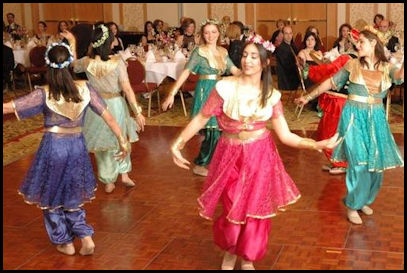
Canadian Iranian Foundation – Nowruz-Gala 2006


Elements of Astrological Medicine

The topic of traditional medicine used in concert with traditional astrology is a massive one and deserving of several volumes. Happily, these exist and date back to early antiquity, continuing to be developed throughout the 17th century by authors such as Nicolas Culpeper, a student of William Lilly.  Richard Saunders. an accomplished physician, all of whom were part of a larger group of what might be called ‘medical activists’ who wanted the practice of medicine to be available to the common people. This is the time in our history when the art of midwifery was being denied to the peasantry and absorbed by male physicians. In many respects, these struggles continue.

This is written as an introductory piece, demonstrating the various elements and history of the art. For those who seek a more in-depth  view, there are some very fine contemporary books written on the subject, such as Heal Thyself: Nicolas Culper and the Seventeenth Century Struggle to Bring Medicine to the People by Benjamin Woolley; Culpeper’s Medicine A Practise of Western Holistic Medicine by Graeme Tobyn and Passions and Tempers: a History of the Humours by Noga Arikha. Virtually all the seminal texts from Hippocrates through the Seventeenth century are readily available.

In his article “Delusions of Medicine” (2112) Professor Henry Draper, MD writes: ” It is instructive to the philosophical physician to trace, as in the case of Greece, the passage through fetichism, miracle-cure, and astrol­ogy to a sound system of medicine such as that propagated by Hippocrates, well called the Divine Old Man. ”  The article is for the most part well informed and well written I agree with some of his conclusions. Nevertheless, I think this is another case of something assuming they know what astrology is when they clearly do not. There is really no place in astrological medicine for what I think he means by” fetishism” or the offer of “miracle cures.” Moreover, and this is the greatest irony,  Hippocrates with Galen were and are the greatest primary Classical sources for medicine in concert with astrology.

This is rather like the Christian who believes that astrology is evil because scripture warns against fortune tellers, necromancers, and poisoners. Again, no informed or self-respecting astrologer would accept any of those titles as being even remotely relevant to what they do.  This subject is deserving of another post that is already in the works.  For now, I will say that traditional astrology properly used and for the right reasons is both beneficial and conducive to Christianity if the judgment of someone such as St. Thomas Aquinas is to be given consideration.

Our immediate interest is in the legitimate and ancient art of astrological diagnosis, using astrological techniques. These have been tried and true for millennia and are still relevant.  Modern medicine has made enormous contributions to healing, largely in the realm of diagnostic technology. antibiotics and other drugs. However, here traditional and modern can co-exist to some extent.  It has to be said, however, that even now a definite and timely diagnosis of many ailments are not as effective as they might be. Also, many modern drugs are toxic to the body and can often trigger secondary problems.

Modern allopathic medicine treats the symptoms of dis-ease. Traditional Western medicine is holistic and sees the human being within the context of the macrocosmic/microcosmic relationship.

In the spirit of introduction to traditional astrological theory and practice, we can begin with what has come to be known as the Astrological Man.

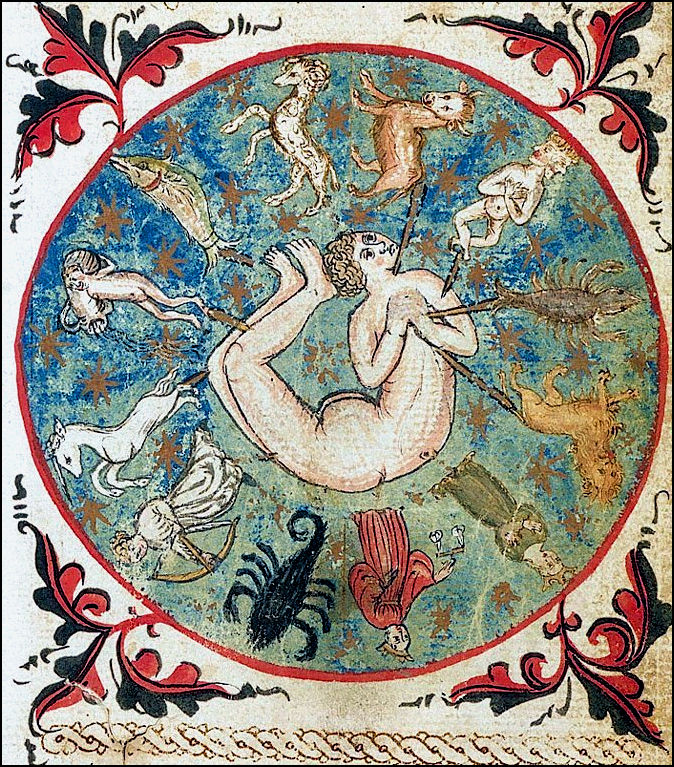
Zodiac correspondences of the human body – Michael of Rhodes ~1434

Contemporary modern astrologers associate each sign with a house. No matter what the ascendant, the first house ‘belongs’ to Aries and the twelfth to Pisces. This is a modern aberration and has nothing to do with traditional astrology except in the correlations between parts of the human anatomy. Although there are some applications of this in horary astrology, the most important is as a tool in medical astrology.

The image above is a simple reference tool – one can readily see the correspondences between the parts of the human body and the sign to which they are associated. For it to make any practical sense for an individual, we use the natal chart. In Lilly’s day, it would look something like this.

From Christian Astrology by William Lilly – Sample chart

The image itself is believed to derive from Egyptian sources. You can see also that the human form is placed in a circular position with the head in Aries and the feet in Pisces – the alpha and omega.

The writer at Wikipedia summarizes the traditional system of medicine very well: “Temperament theory has its roots in the ancient four humors theory. It may have origins in ancient Egypt or Mesopotamia, but it was the Greek physician Hippocrates (460–370 BC) who developed it into a medical theory. He believed certain human moods, emotions and behaviors were caused by an excess or lack of body fluids (called “humors”): blood, yellow bile, black bile, and phlegm.”

“Humoral” derives from the word “humor,” which, means “fluid.” The human body was thought to contain a mixture of the four humors – black bile (melancholy), yellow or red bile, blood (sanguine) and phlegm. Each individual has a particular humoral constitution. In this system, health is defined as the proper humoral balance for that particular individual. An imbalance of the humors is considered at the root of illness. 

The humors are also used to refer to the four individual psychological temperaments: melancholic, sanguine, choleric, and phlegmatic. What is immediately relevant here is the fact that the physical health and individual personality were part of the same whole.

The development of humoral theory is associated originally with Hippocrates (ca. 460–370 BCE). In the second century CE, Galen elaborated on this theory, which was further developed by Arabic writers beginning in the 9th century and by European writers beginning in the 11th. Though several important publications—Andreas Vesalius’s De Humani Corporis Fabrica in 1543 and William Harvey’s De Motu Cordis in 1628—challenged aspects of humoral theory, it remained dominant among both physicians and the public through the 19th century.

This system is always used in concert with the humoral medicine of Galan and Hippocrates. Modern medicine tends to believe that a given medicine will work the same way for different people. That may be true of some treatments but certainly not the vast majority. Traditional astrological medicine determines the Temperament of the patient by reading the Humoural nature of the chart, communicated by the planets in signs, among other considerations. People who have a very strong Choleric nature, which is hot and dry, will tend to suffer from more fevers than someone with a Phlegmatic temperament, which is cold and wet. This is not the place to engage in a detailed explanation of Humoral medicine, but suffice it to say that only a foolish doctor would treat the two as they were exactly the same.

The planets are also associated with anatomy in a wider sense. To give a small sample, Saturn governs bones and teeth, but also long and chronic illness. Mars governs the blood and is also associated with cuts (including surgery) and fevers. Mercury is associated with the nervous system and is a part of the assessment of mental disorders, often in concert with the Moon or Saturn. Clearly, all of the components must be read in the process of diagnostics. I hope at some later date to delve into this more deeply on this blog, for those who have an interest.

table courtesy of wiki commons

Super Blue Moon Eclipse – January 31

This Total Lunar Eclipse on the Leo/Aquarius axis will be among the many wonders of the night sky this year that stargazers won’t want to miss. The view from Victoria, B.C. will be superb, if atmospheric conditions don’t interfere too much. The Total Lunar Eclipse will begin at 2:51 am, will peak at 5.29 am and end at 7.50 am.  The West Coast of North America, Asia, Australia, the Western side of Hawaii and elsewhere in the Eastern hemisphere, will also be positioned for excellent observation. For a graphic image of the areas of visibility, consult the map at the bottom of the page.

Image courtesy of NASA who will be offering live coverage @ https://twitter.com/NASA?ref_src=twsrc%5Egoogle%7Ctwcamp%5Eserp%7Ctwgr%5Eauthor

This is a Blue Moon and a Super Moon. A Blue Moon occurs when there are two Full Moons in a month. A Super Moon occurs when she is much closer than usual to the Earth. The Moon will turn red as she moves into Earth’s shadow and this phenomenon is known as a “Blood Moon.” The combination of the Blue Moon, Lunar Eclipse, and Super Moon makes this a rare sight.  The last time this triple event occurred was in 1982 and the next won’t occur until 2037. However, the last time all three occurred with a total lunar eclipse was reportedly in 1866. The next Blood Moon will occur on 19 January 2019. It will also be a Super Moon, but not a Blue Moon.

The Moon is in the Eleventh Lunar Mansion, named Al Zubrah (The Mane) This Mansion begins at 8°34’17″ Leo and ends at 21°25’40″ Leo. According to Ibn Arabi. this is “The First Heaven, the Sphere of Saturn, the Sky of the Visited House and Lotus of the Extreme Limit, the Abode of Ibrahim (Abraham).”(ca. 1200). Elias Ashmole tells us “When the Moon is in this Mansion, let out no prisoner. Besiege cities. Sow and plant what thou wilt. For merchandise and journeys, this Mansion is neutral. Lay foundations and build. Take fellowship and you shall win. Wear no new clothes. Shear your hair if you will.”

The astrological chart is calculated for the time of Maximum Eclipse when the Moon is closest to the center of the shadow, as seen from Victoria, B.C.

If your location permits, be sure to enjoy this rare event.  You will be able to view it with the naked eye, but binoculars or a simple telescope would enhance the experience. If you are not in the viewing range of the eclipse or there are problems with visibility, you could instead watch events via the NASA website I cited under the image of the Blood Moon.

U Naval Observatory showing the day and night sides of Earth at the instant of the greatest eclipse 2018 January 31 at 13.30 UTC

Ishtar & Aphrodite – Part I

It seems particularly apt to begin this article with a reference to Gustav Klimt’s “The Die Jungfrauen” (The Virgins) 1913  shown above because it celebrates the stages of a woman’s life and the intertwining rhythms and themes which I would like to explore in reference to the understanding of Venus.  This work isn’t to read as a single moment in time, but as depicting the evolution into womanhood. The curator at the Klimt Museum notes that there ” are six women in the painting (or one woman with four sides to her persona) and all of them seem to be intertwined. The lines are clear and the human themes of love, sexuality, and regeneration are obvious in the circular cyclical shape of the work. In painting The Virgins the different life stages are represented by the same woman. Dislocated body parts in outrageous poses move as if underwater. The empty shell of a woman’s dress at the bottom gives birth to a child (the next generation) via a cascading waterfall of colour.”

In order to understand the essence of a thing, it behoves us to discover and contemplate its origin. But Aphrodite is not a thing, she is an archetype used to inform us of the meaning of the planet Venus. For those wishing to avoid a psychological approach, Plato’s Forms will adequately explain the relationship. Not everyone will be happy when I suggest that the better an astrologer understands the essence of the signs and planets, the better astrologer he will be. . I would suggest that it isn’t enough to say that astrology is a symbolic language. It is that too, but one needs to know what the symbol points to in all its wealth of meaning.

There is a view among some so-called traditional astrologers that astrological delineation is a more or less a mechanical process. Any reference to myth or spirituality is seen as a betrayal of tradition. I think the reverse is true. The history and expression of astrology since earliest antiquity, and indeed even during the Paleolithic period, has always been imbued with a soul and I contend that it should be approached in this spirit.

Contemplating the origins of astrology fascinates me personally, but this is something that astrological thinkers have to do a great deal of. In order to know why there are twelve houses with specific significations, we need to go back to the beginnings of horoscopic astrology and indeed to that which preceded it.  The same is true of the signs.

Most constellations look nothing like what they are purported to represent, yet the record shows us that for the most part there was a surprising degree of agreement on what they were. Why is that? We also gain a great deal by studying the earliest interpretations of the planets and the cosmologies that inform them.  However, the understanding we have cannot be universal, unless we can truly understand the root essence of the meanings allocated to planets. Authentic astrology is rigorous and works on more than one dimension. As will become evident, with Venus the core meanings are in the Venus cycle and her associations with the feminine.

The Evening Star – Venus in the Pleiades star cluster April 3, 2012.© 2012 Alan Dyer

In the case of Venus, most modern and contemporary astrologers subscribe to the European understanding of the Roman Venus. She is absconded from Greek mythology to Rome. from Aphrodite to Venus. Not much else changes and she seems not just rather domesticated but separated from some of the most basic elements of the real feminine.  This is the Venus we see in the newspaper columns and in popular star sign books, where Venus is almost always spoken of romantic. But even serious modern astrologers have a very narrow view of Venus. Presumably, William Lilly only had access to Classical and Medieval sources.

Lilly wrote: “”[QUALITIES OF MEN & THEIR PROFESSIONS.] Musitions, Gamesters, Silk—men, Mercers, Linnen—Drapers, Painters, Jewellers, Players, Lapidaries, Embroiderers, Women-tailors, Wives, Mothers, Virgins, Choristers, Fidlers, Pipers, when joyned with Moon, Singers, Perfumers, Semi lers, Picture—drawers, Gravers, Upholdsters, Limners, Glovers, all such as fell those Commodities which adorn Women either, in Body (as Cloaths) or in Face, (as Complexion-waters.)”

The list contains musicians, indeed all the decorous arts, and among the Venusian professions we have wives, mothers, and virgins. The portrait is suitably one of harmony, peace, and beauty. There is absolutely no doubt that all this belong to Aphrodite, but it is missing key feminine qualities on a grand scale. This is a somewhat sanitized version of the feminine and I’m reminded of the old English nursery rhyme: “sugar and spice and all things nice – that’s what little girls are made from.”

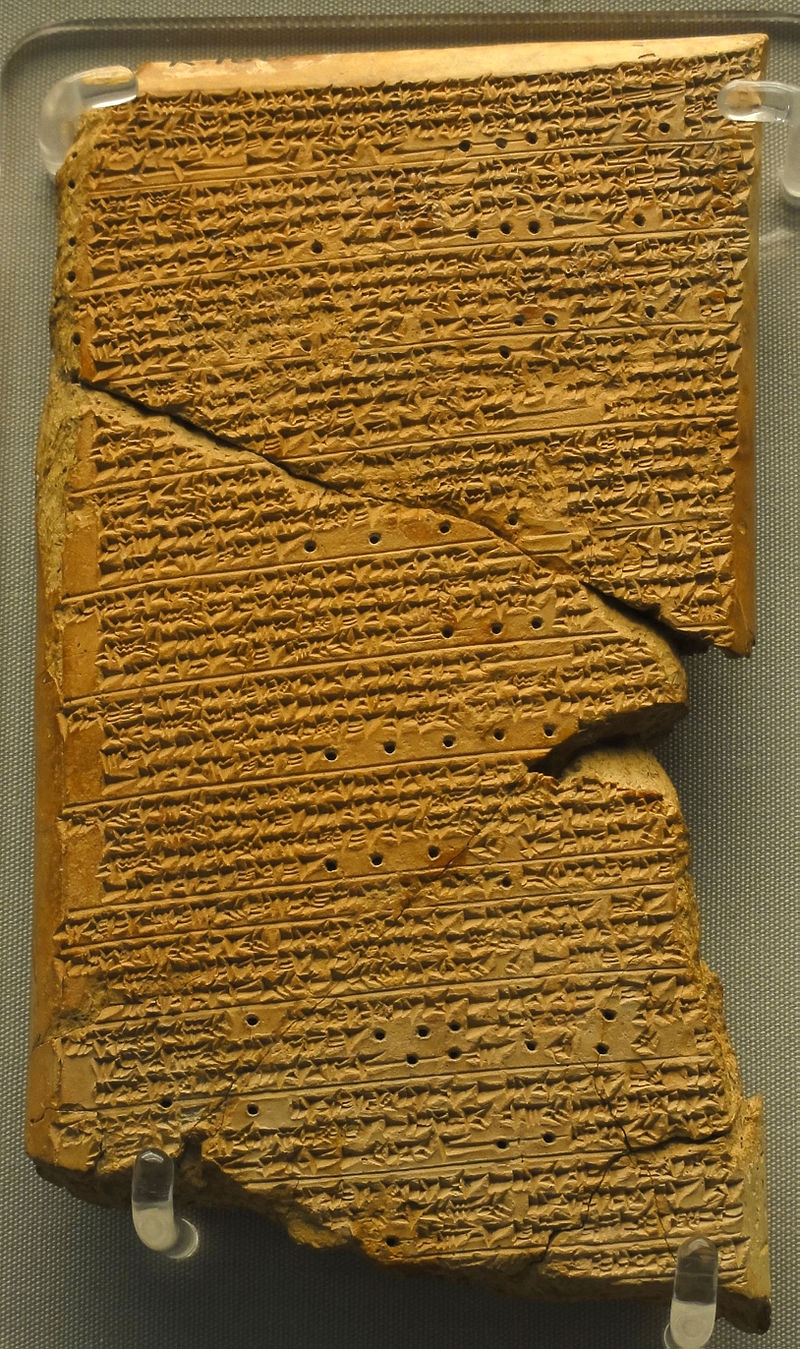
Venus Tablet of Ammisaduqa is the sixty-third Tablet of the Astronomical omen series Enuma Anu Enlil. The tablet records the heliacal risings and settings of the planet Venus (Ninsianna) for a period of twenty-one years. (British Museum).

The original ‘Venus” was Innana and was associated with the planet Venus and her phases. She was the Queen of the Night with a ferocious libido and her story passed down to us in the Babylonian sources is one of the earliest and most articulate representations of “hell hath no fury like a woman scorned.” Hers is a chthonic force that has no truck with the rational. She is a Kali – dishing out death while giving birth. – a goddess of Creation, Destruction, and Power. Indeed, the two are so similar, that it’s quite plausible that they derived from the same source.

In The Epic of Gilgamesh, Innana travels to the underworld, dies and is resurrected. This is a reference to the Venus cycle. Her period of visibility, including her passage as morning and evening star, is very close to the traditional period of the gestation cycle of 260 days, associating her with creation and childbirth. She is not visible for about three months of the year (about 105 days) which would correspond to Innana’s ‘death’ or passage to the underworld.

When Innan rises (as does Venus) she is rising before the Sun, ready for war. During this phase, she is also known as Lucifer and Phosphorous. This fire turns to more sensual pursuits when she is the evening star, behind the Sun. Here we once again see the Garden of Hesperides. The Mayans also placed multiple significance on the Venus cycle, identifying it with the gestation cycle and the growing cycle of maize. I recommend an article by Erika Reiner and David Pingree that provides a great deal of detail on this matter.

There is an important distinction to be made regarding Innana and her ‘successors.’ Inanna is not a Semitic deity. This is of some importance because of the cultural milieu. The early Sumerians clearly had a goddess-based religion. It is in her and her closest forms that the feminine has the capacity for its fullest expression. The more Patriarchal cultures of Greece and Rome to some extent recreated Venus in their own image – or more precisely in the image of a domesticated feminine who could occasionally be quite naughty, but a not a woman who occasionally expressed herself as a raging volcano. This is why cultural milieu is always relevant in deciphering these things. What is most striking is that the traits of the physical planetary Venus have been minimized. Classical or Hellenistic astrologers and those who followed did take the phases of Venus into account and this was true until at least the 18th Century. But Innana has been stripped of her chthonic and primal nature.

The writer in the Encyclopaedia Britannica states: “Ishtar / Innan’s primary role in Sumer was that of fertility. However, she evolved into a far more complex character, with associations with death, the underworld and all kinds of catastrophic disasters in short order. She was a goddess of contradictory connotations, of comfort and wrath. fire and fire-quenching, rejoicing and weeping, justice fair and enmity. As a goddess of Venus, delighting in physical pleasure,  she was the protectress of prostitutes and patroness of the alehouse. Part of her cult worship almost certainly involved temple prostitution.”

With the inception of Islam, there is a monumental shift in the meaning of Venus. Illustrations of the Islamic Venus, lack any real sensuality. She has the image of a beardless man and is mostly associated with music and dance, although she is considered the lesser benefic and Islam is said to be “under Venus,” in the same sense that Judaism is under Saturn.

Venus is the star in the Crescent of Islam. If we also consider Isis as an element of the Primordial Goddess, we can see how these Semitic, Mesopotamian. Egyptian and Roman manifestations of the goddess inform the culture as well as show how the feminine force was interpreted. Some cultures hold the goddess as a divine creator, while others perceive her in a more subservient role. No doubt this is a reflection of the cultural views of women. Nevertheless, I would say one ignores or underestimates the power of the feminine at their peril. It is not an irony that an acceptance of these traits enhances the more traditional ones. It is easier to understand Venus as the evening star if you know where she has come from and where she will return.

Kali_Devi 1770 Print Coloured etching on paper,

The extent to which anyone wishes to take this to heart is perhaps a personal matter.  Nevertheless, the full spectrum of Venusian power will be better appreciated by examination of the essence and roots of the archetype and the close relationship to the planet Venus, in all her phases.  I suspect it may also cause some to more closely examine the phases of Venus, which has been a core element in traditional astrology from the very beginning. Discussion of this subject can only provide a deeper understanding and illuminate both tradition and cultural bias.

Clearly, the main elements of this article require a later expansion – for example, the Venus phases themselves.. The Lunar cycle and the Venus cycle are intertwined and to a lesser extent, so are the phases of Mercury.  The intent of this article is to raise some of the main issues regarding the interpretations of Venus.