Unknown's avatar

About P. James Clark

.

Mars in Aries 2020


Mars ingresses into his cardinal and diurnal domicile of Aries on 28 June 2020. He will finally leave Aries during the current cycle on January 6, 2021. This means that Mars will be impossible to ignore as we approach the Winter Solstice and the Grand Conjunction. Mars is the Lord and scorching emissary of the chart.

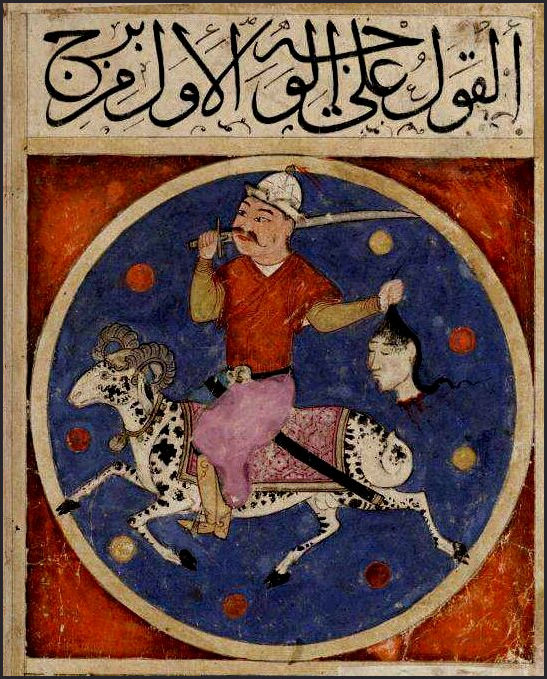
Mars is less agitated in his nocturnal domicile, as the night is said to cool his burning rage. In Aries, there is no holding back. The Islamic representations of Mars almost always portray him carrying a severed head with apparent glee. Mars in Aries is like a rambunctious and aggressive adolescent one a good day and far worst on a bad one. However, there is mercifully no guile in this placement,. This is unlike Mars in Scorpio. He is direct and sure of the rightness of his cause, entirely unconcerned what others may think of that.

Let’s look at the larger picture as Mars ingresses into Aries.

As I have had many occasions to mention, we are in the middle of a highly volatile mix. Jupiter is consorting with Saturn and both are retrograde. I have written also on the eclipses preceding this event with “Ancestral voices prophesying war” The moment is of the Hour of Moon, the Day of Saturn and the Almuten is Venus, in Mercurial Gemini and disposited by Mercury in Cancer, retrograde and in the Exaltation of Jupiter.

We might think of Jupiter and Saturn as the big brothers of Mars; and in this case, they will tend to cool his heels with saturnine gravitas for the time being. This relationship is made all the more intriguing by the fact that Capricorn is the Exaltation of Mars, the sign in which Jupiter lingers in his Fall.

“Pandora.” Completed by John William Waterhouse in 1896

Of course, when a malefic favours another malefic we don’t expect all sweetness and light. 2020 is a year full of pretty much all the things listed in Pandora’s box, a tale first was written down by Hesiod in his Theogony and Works and Days in the 7th century BC. These didactic poems relate how the gods came to create Pandora and how the gift Zeus gave her ultimately ends the Golden Age of humankind.

Specifically, when she opens the box, all manner of strife and torment is leashed upon the world. In the words of K. Kris Hirst, ” Pandora is a trick gift, a punishment for the good of Promethean fire, she is, in fact, Zeus’s price of fire.” But metaphorically, all that plagues humanity, including plagues themselves, swarms of locust in numbers hitherto unseen and destroying subsistence crops over an area never before seen,  combine to give the impression of an apocalypse.

Cities are replete with arsons and looters, tearing down and defacing monuments, including those with strong religious significance. It is as if W.B. Yeats; “Second Coming” is being enacted before our very eyes; and we want to know where we will all be when the wheels fall off the chariot.

The story of Pandora is the story of the fall from an ideal world or state of being, strikingly similar to the story of the biblical fall. This is a productive way to understand the nature and purpose of the malefics.  They are the price we pay whilst we inhabit this sub-lunary sphere. The ladder to the empyrean is fraught with all manner of difficulties and Saturn guards the Gates of Paradise.

With this in mind, even the most difficult times are not without meaning and that can make even the worst times bearable, but hardly pleasant. Angst and fear are permeating the collective and those states of being are decidedly Saturnine qualities, made all the more dramatic and painful by Mars.

Mars is going to really stir things up, for good or for bad. The opposition to the Venusian Moon in Libra is unfortunate and Mars squared the Cancerian Sun and Mercury, also retrograde as mentioned, is cause for alarm.

Considering the larger picture, including the approaching Grand Conjunction and the powerful eclipses involved, cooler heads may not be in ready supply. But the alternative is chaos and war. This is a pivotal time for humanity to cultivate a consciousness higher than the one that brought us fast food, deforestation and propagandistic networks.

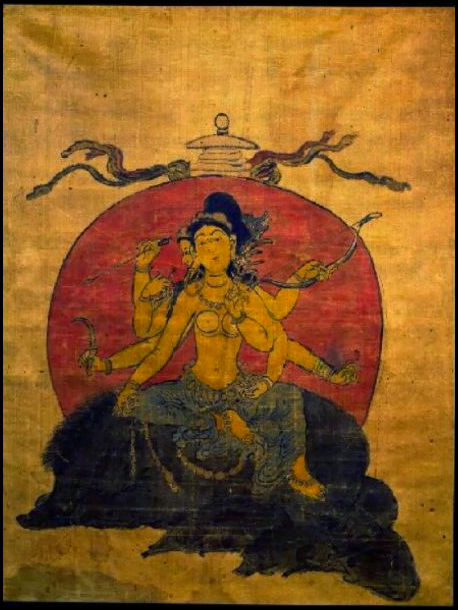
More than anything, this is a struggle for truth in an ocean of deceit.  Much like Manjushri, we cut through the roots of illusion that keep us enslaved to a world even more alienating, kept passive by the shadows on the wall of the Plato’s Cave.

The spectre is Saturn as Falsifer. For now, Mars works with Saturn to a great extent, but Mars can make a great servant when not busy being a terrible master. Yet in spite of all that faces us, indeed because of it, we must find a way to put all that plagues us back into the box. Pandora’s power was rooted in her ability to deceive – to appear to be what she was not, much as the sweet voice of the serpent in Genesis made the forbidden fruit appear to be a wonderful gift

This is a time of enormous opportunities and one which we cannot ignore. The threats we face are existential, even to the Earth herself.  Gaia is in torment and we hear and see her clearly as if awakening from an enchanted sleep.

July 4-5 Penumbral Lunar Eclipse – Burning down the house. 

Photos by Reuters. Montage by ITGD Design TeamVikas Vashisht and Vikram Gautam

North and South America get the best view of the July 4-5 lunar eclipse. People in the westernmost parts of Africa and Europe will also view the event.

However, most affected will be the US is ruled by Cancer and the fact that this is a Lunar Eclipse makes it all the more relevant.

There are several other countries under the sign, such as Paraguay, Scotland, Holland, the Democratic Republic of the Congo, Croatia Djibouti, Kiribati Laos,  Madagascar, Malawi Mozambique, Rwanda, Slovenia Solomon Islands, Somalia, and South Korea, but these are not in the path of the eclipse.

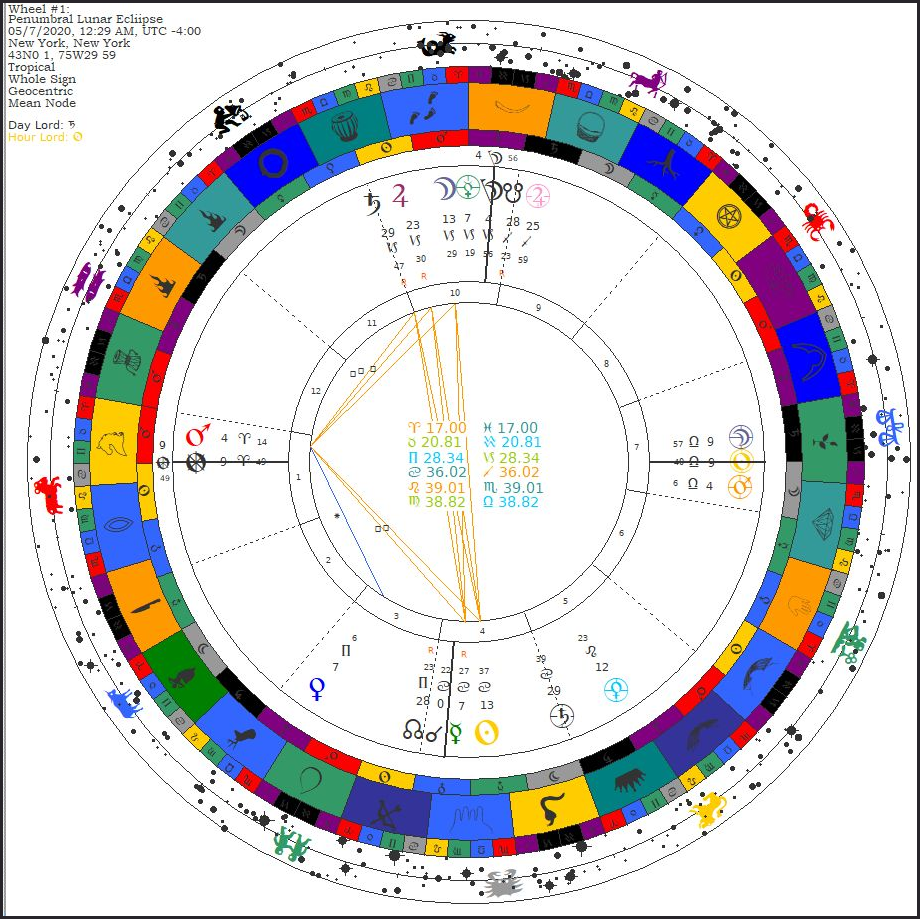
Robert Zoller claimed that the de facto capital of the US is New York and NYC will end the U.S. Independence Day (July 4) with the penumbral lunar eclipse. Commencing at 11:07 p.m. local time, the Moon will begin to move into the Earth’s outer shadow. At maximum eclipse (12:29 a.m. on Sunday, July 5) Approximately one and a half-hour later after maximum, at 1:52 a.m., the event ends. The eclipse duration will be 2 hours and 45 minutes. As a lunar eclipse, the effects will be felt for the coming weeks.

Screenshot - 2020-06-17 , 3_36_45 PM

Mars is Ascending in Aries in the decanate of Mars in the nakshatra of  Ashvini (अश्विनी aśvinī). This is the first of the nakshatras aka lunar mansions. In the Hindu system, the nakshatra spreads from 0°-0′-0″ to 13°-20′, corresponding to the head of the Ram. This nakshatra is under the governance of Ketu.

The corresponding Lunar Mansion is known as the Ram’s Horns.

The eclipsed Moon in the 23rd Lunar Mansion Al Sa’d al Bula (The Lucky One of the Swallower) 12°51’22″ Capricorn to 25°42’51″ Capricorn. Al Biruni tells us that  Sa’d bula, the glutton, is marked by two stars on the left hand of Aquarius, between them is a third about to be devoured by the glutton. Picatrix adds “The twenty-third Mansion is Zaadebola, and it is for destruction and devastation.”

Screenshot - 2020-06-17 , 5_48_20 PM

Lunar Mansions and Fixed Stars for 05 07 2020 Penumbral Eclipse

The Planetary Day is Saturn. The Planetary Hour is the Sun and Saturn is the Sign ruler of the Moon and the Moon is the Nocturnal Triplicity ruler of  Saturn, the Almutem. Mars is the Lord of the Eclipse.

We have watched as this Saturn and Mars domination unfolds and here we have Saturn and Jupiter making their way to the Grand Conjunction at the Winter Solstice; both are in Saturn’s domicile and retrograde. Each eclipse leading yo to and following the GC provide essential details to afford us a more complete picture of what is to come.

This is what is being eclipsed – the established order. The picture is one of a violent revolt unlikely to succeed because it lacks the elements required for sustained results. There is also solace in the fact that the Mars aspect to the eclipse and the planets in Capricorn, is separating.

Mars may be soothed by Venus. but here the sextile is undermined by the fact that Venus is mercurial Gemini. Mars and Mercury are of little help to each other except when an explosion is a goal.

Mars is in an antagonistic d relationship with both luminaries as well as Mercury Rx. Both benefics are essentially neutralized, while Mars is burning down the house.

Minneapolis Police Department’s 3th Precinct 2020 05 28 – Wiki Commons

The east coast and the midwest of the US will experience electrical storms od unusual force. Storms are to be expected in the Caribbean, particularly the Antilles, the Bahamas as well as northern areas of Columbia.  Some flooding is to be expected.

Animation courtesy of NASA


Cosmologie indienne: mysticisme astrologique dans la Surya Siddhanta – traduction française

Un Panchānga, illustré ci-dessus, est un calendrier hindou et un almanach, Il présente les dates importantes et leurs calculs sous forme de tableau. C’est Jyotisha

La terre est une sphère

Ainsi partout sur [la surface de] le globe terrestre,
Les gens supposent leur propre place plus élevée [que celle des autres],
Pourtant ce globe est dans l’espace où il n’y a ni dessus ni dessous.

—Surya Siddhanta, XII.53
Traducteur: Scott L. Montgomery, Alok Kumar

Beaucoup de gens qui connaissent l’épopée indienne du Ramayana, se souviendront des nombreux actes de Ravana, y compris la capture de Sita. Moins connus sont les exploits extraordinaires du roi Maya. Selon la légende, le dieu du soleil hindou, Surya, a transmis à Maya une connaissance très spécifique de l’univers. La série de traités sur ce sujet est connue sous le nom de Surya Siddhanta. C’est le livre le plus ancien sur l’astronomie qui existe et il est d’une précision alarmante. Dans l’histoire de l’astronomie et de l’astrologie, c’est un document clé d’une valeur inestimable.

Pour définir nos termes, Surya est le Soleil ou le dieu Soleil. Les divinités solaires sont omniprésentes pour des raisons assez évidentes. Sans le soleil, il n’y a ni lumière ni chaleur, rendant la vie impossible.

Siddhanta est un terme sanskrit désignant la vision établie et acceptée d’une école particulière au sein de la philosophie indienne. Littéralement «opinion ou doctrine établie, dogme, axiome, vérité reçue ou admise; Tout manuel fixe ou établi ou canonique sur n’importe quel sujet »(Monier-Williams Sanskrit-English Dictionary). Surya (la lumière suprême) était la principale divinité solaire de l’hindouisme; Et représente également le Soleil en Inde et au Népal. Il est l’un des éléments centraux de l’astrologie hindoue; «Surya était le chef de Navagraha et des planètes classiques. Il avait 3 femmes; Saranyu, Yama et Yami. Du nord-est de l’Inde, 11e siècle CE ». (Conservateur au National Museum of Scotland, Édimbourg, Royaume-Uni)

Une sculpture du dieu soleil hindou Surya. Le dieu est dans une pose typique tenant des fleurs de lotus. Karnataka ou Andhra Pradesh, Inde, v. 1100-1150 CE. (Musée d’art du comté de Los Angeles)

C’est devenu de plus en plus évident, avec la redécouverte de l’astrologie hellénistique et arabe que nous n’avons pas toutes les pièces. Sans l’étude de l’astrologie, de la métaphysique et de l’astronomie perses et indiennes, il nous manque des éléments qui provoquent la décomposition relative dans les systèmes ultérieurs. Je le constate souvent dans les vénérables textes grecs, où je ne suis pas seul à me demander ce que pensait l’écrivain. De plus, certaines des techniques qui nous ont été transmises à partir de ces sources manquent de crédibilité constante. Certains semblent presque inutiles après des décennies d’expérimentation.

Il serait bien sûr tout à fait impossible de faire plus que de fournir une introduction aux systèmes indiens et d’indiquer des sources d’influence particulièrement pertinentes. Je crois que la plus grande synthèse de la première synthèse astrologique a été réalisée dans l’ancienne Perse. Ce n’est que naturel car la Perse est comme un pont géographique entre l’helléniste, le babylonien et l’indien. Ceci est le premier de ce que je prévois sera trois articles.

Métaphysique hindoue – Yantra Mandala illustration

La culture occidentale, à commencer par les Grecs, a développé le goût et la capacité d’écrire des histoires plus ou moins objectives. Les cultures qui privilégiaient la raison et la logique à la mythologie ont de forts avantages et de nombreux inconvénients. Les Indiens n’ont pas fait de distinction absolue entre l’histoire et la mythologie et semblent avoir été particulièrement habiles à trouver un moyen pour que la raison et le mysticisme prospèrent. Les Vedas n’ont jamais été considérés comme de la «fiction» en tant que telle. Un récit linéaire n’a pas sa place dans cette vision et, en fait, la plupart des Indiens pensent que les Védas n’ont ni commencement ni fin. Ils sont immortels. Ils sont spirituels. Ils offrent des conseils pratiques et même des connaissances mathématiques. En même temps, l’âge de l’univers est l’âge de Brahma.

https://youtu.be/IJQbXTeuauI

La manière la plus simple de réaliser la différence, que j’ai certes simplifiée dans une certaine mesure, est de fonder la compréhension sur l’infini, une réalité dans laquelle le temporel est subordonné à l’infini à tous égards. L’infini est, bien sûr, la source du temporel, mais la culture occidentale est devenue amnésique à ce sujet il y a très longtemps. Les catégories logiques peuvent être utiles, mais elles peuvent rapidement devenir rien de plus que des emporte-pièces. Ce système tente de réduire la complexité de l’existence humaine en faisant paraître les choses plus petites, plus faciles à gérer et séparées les unes des autres. Cependant, la consolation n’est pas toujours le chemin de la vérité.

Le Surya Siddhanta est un traité sur l’astronomie indienne traditionnelle, qui remonte à plus de 1500 ans et attribué à Mamuni Mayan, un héros prométhéen de la culture tamoule. Il existe une tradition dynamique qui nous dit que l’œuvre a 2 millions d’années. Quoi qu’il en soit, il constitue la base des calendriers hindou et bouddhiste. Des mathématiciens et des astronomes ultérieurs comme Aryabhata et Varahamihira y ont souvent fait référence.

Dans son propre ouvrage, intitulé Pancha Siddhanta, le estimé Varahamihira, outre les Paitamaha Siddhantas (plus ou moins identiques)

This painting from a manuscript depicts the Sun and Moon. The deer is associated with the moon in Indian culture and often used to symbolize the Moon in pictures. Image by British Library (copyright CCO 11,1 Creative Commons).

Solar eclipse of June 21, 2020

Totality of the solar eclipse of July 2, 2019, captured from La Serena, Chile

I discussed this eclipse about six months ago in my article on the Saturn & Jupiter Grand Conjunction which will occur at the Winter Solstice of 2020.  I recommend reading that article in concert with this one.

The annular solar eclipse occurring on June 20, 2020, is an extraordinary event, even among eclipses. The location of the maximum eclipse will be seen from Katmandu, Nepal. This region and the borders between China, India and Pakistan are the central focus. The duration of the eclipse informs us that the effects will be felt right up until the Grand Conjunction of Saturn and Jupiter at Winter Solstice.  It is necessary to observe the eclipses leading up the Grand Conjunction. You will find my articles on two previous eclipses.

It needs to be made clear that eclipses have influence over the collective – entire nations – and in traditional astrology, they are not regarded as of great effect to individuals. This is a Mundane event.

Also, the literature passed down to us makes it plain that the eclipse cannot have influence over areas where it cannot be observed. Thes two simple rules will help the astrologer focus on the where and the who (collective).

The most striking element of this chart is that all planets are retrograde, except a severely debilitated Mars – disposited by a Jupiter in his Fall, in the 6th house in Pisces. Direct action is thwarted. Mars in this house is sometimes referred to as the tiger in the cage.

The Libra Ascendant is disposited by Venus, retrograde in an Air Sign and conjunct the Fixed Star Aldebaran.  The latter is sometimes referred to as “the eye of God” but is also associated with blindness. Stars operate at better potential when thy have supportive planets to work through. In this case, it is at best ambivalent.

So, when the lights go out, we are left with the general impression of chaos – another case of the “falcon cannot hear the falconer.” The area in which this is occurring cannot help but remind us of the gathering storms of conflict between India and China and India and Pakistan.

None of these countries is directly associated with Cancer. Both Pakistan and India are under Leo. China is decidedly Capricorn. Saturn is dominating theme throughout 2020, not least because of the nearing of the conjunction in Saturn’s domicile. We can say that China’s bullying of India over border disputes to facilitate China’s access to South Asia via the Himalayas is not likely to be successful for the foreseeable future and in a way that could be maintained.

An annular solar eclipse is one in which can occur when the Sun has a larger apparent size than the Moon, whereas a total eclipse can occur when the Moon has a larger apparent size. Annular refers to the ring effect during an annular eclipse,  from Latin annulus.  Be aware that during an annular solar eclipse, direct sunlight passes around the moon and reaches Earth, so eye protection must be worn to prevent eye damage.


The Importance of Scepticism: the Chart of Prince Harry, Duke of Sussex

HRH Prince Harry - July 2017

HRH Prince Harry – July 2017

I’m admittedly reticent regarding reading the charts of famous people who are still alive, but my concerns are twofold. This article is written specifically for other astrologers if only to raise what I believe to be a legitimate concern.

The wise astrologer is also a sceptic when it comes to received information. There is no virtue in rushing to interpret something that may not be legitimate in the first place. There are few mega sites, that offer staggeringly extensive databases holding the alleged natal information of tens of thousands of famous people, such as celebrities, politicians, scientist, royalty and other figures of historic interest.  This is a wonderful resource to be able to offer and the amount of work compiling all that data and then constructing charts to be viewed is a work of almost mythic proportions.

The problem is that the delivery can lead one to suppose accuracy even when it isn’t there. However, I find it very disturbing that these charts are accepted as definitive when there are many reasons they may not be, An inaccurate chart assumed to be associated with a person we only think we know is of no use at all, but moving to interpret and disseminate the results may be quite damaging indeed.

There is always some sort of rating system used in these databases, but even the highest rating given to the evidence of a birth certificate deserves a moment of reflection. Clerical mistakes do happen.  Even diligent hospital staff have historically rounded off the birth time. There can be a great difference even in a chart calculated for a few minutes away from the actual birth time. It is, however, when you get to the next category, usually labelled “AA,” that the possibility of hearsay comes into play and therefore any pretence of certainty is lost. It is common for example, for relatives, perhaps decades after the birth cannot quite recall if the nativity occurred just before or just after lunch, but the human find fills in what it isn’t at first clear about.

Even worse, some celebrities have been known to deliberately publish false natal information, sometimes with the assistance of an astrologer. This is more likely to be the case if the celebrity believes in astrology and therefore grasp the consequences of revealing so much personal information, that can then be *interpreted* by anyone with an astrology program or indeed access to the many online astrological chart services.

This has always presented me with an obvious ethical dilemma. as well as practical ones. Just because someone is famous for pretending to be other people in film, doesn’t mean we actually know them and  I question the moral right to expose what ought to be private. I should alert you to the fact that I am in the great minority on this position, but Traditional astrologers of the calibre of John Frawley have made their own concerns well known

As with any profession, at least some consent is required, boundaries should be observed and rules of simple etiquette respected. The usual argument for dispensing with common decency is that studying charts of people you know can be a great learning tool. I have two comments in this regards. First of all, you can study charts without making them public. Secondly, we only think we know people whose livelihood depends on deception should not be the cosmic paparazzi.

With the ethical and practical considerations in place, let’s take a look at an example of an almost certainly incorrect chart – that of Prince Harry. Below is the chart as calculated using a well-known on-line astrological database of famous people. I will refrain from making personal, prying observations and limit myself to discussing how and why we determine if a given chart is deemed to be authentic or not. I’ve been leaning towards posting an article on this chart, with the larger purpose or astrologers to consider being more circumspect and discriminating when accepting natal information as given, with a particular focus on the astrology of celebrities, including the British RF.

In most cases, it is not necessary to draw up multiple charts, such as the various forms of progression, in the attempt to line up life events. This may be helpful, but is also notoriously off the mark and reference to the natal chart would be required in any case.

We don’t need to go into any great detail to see that this chart doesn’t belong to Prince Harry. Yes it is accepted by countless people who viewed it online and never thought to question it

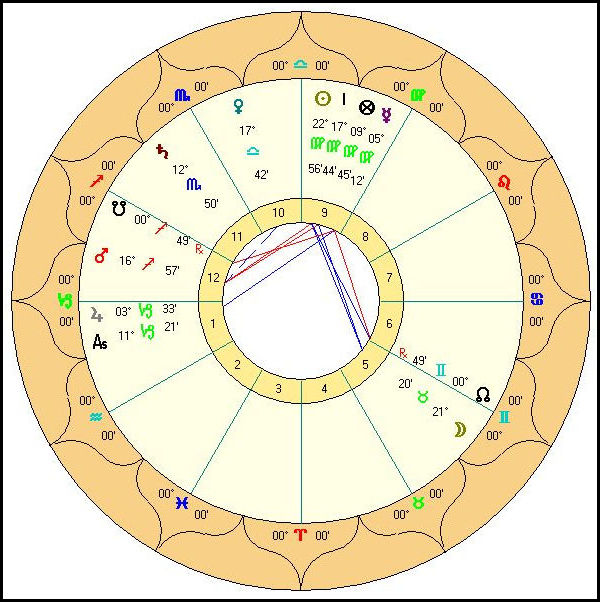
HRH Prince Harry, Duke of Sussex. 15 Sep 1984. 4.20 pm. Paddington. United Kingdom

This chart has a Capricorn Ascendant. Almost universally this is said to denote someone dark and of diminutive stature. Saturn Ascendant is known to be on the short side. Harry is 6′ 1″.  His Mars in Sagittarius in the 12th House isn’t what we would expect of someone so devoted to military life. The Sun, Mercury and Part of Fortune in the 9th House would be stretch. Harry is known to popular and social, with many friends. So  Saturn in the 11th house raises questions.

Now, let’s look  at the chart with an Ascendant in Sagittarius

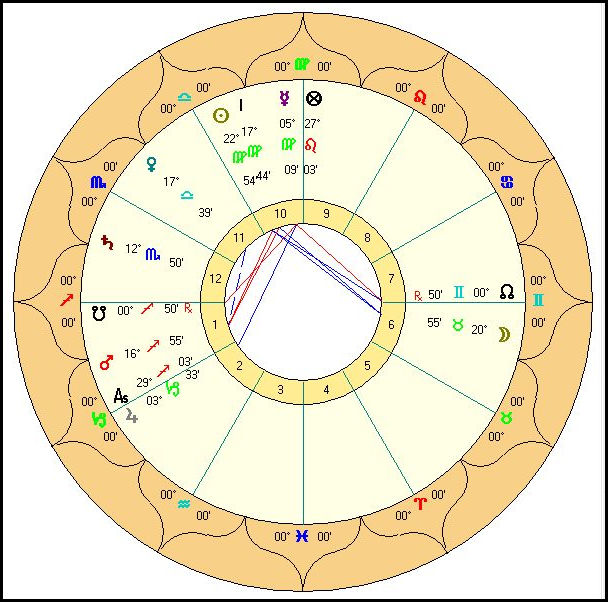
HRH Prince Harry, Duke of Sussex. 15 Sep 1984. 3:20 pm. Paddington. United Kingdom

Sagittarius is ruled by Jupiter and gives us the chart with someone taller than in the previous chart. This also has Mars in the 1st house. Ancient authors, those from the Hellenistic, Medieval period and the Renaissance make militaristic associations regarding this placement. Harry is also known to be far more impulsive than his elder brother. When playing polo, it has been noticed that William is more thoughtful about the game, whereas Harry is far more fiery and visceral. traditional authors also mention red hair as indicative of a fiery, not a Saturnine Ascendant.

Instead of having and cold and limiting Saturn in the 11th house, we see Venus in her own domicile, which I believe speaks for itself. He has the North Node in its Exaltation in the 7th house and a Taurus Moon, the other domicile of Venus in the 6th house.

Without going into more personal details, these combine to suggest a boisterous person, who is likely to be the weaker partner. Clearly, the Sun and Mercury are far more credible here than the position in the Capricorn Ascending chart. The Sun in the 10th house is another strong indication that the Sagittarius Ascending chart has far more merit.

I promised to be brief in analysis, but even with these few observations we would have every right to question the veracity of the AA natal This not yet a chart rectification. The one-hour difference is arbitrary and employed to show what changes occur.  I do, of course, consider it plausible, but the investigation relies on the change of sign on the Ascendant and makes no attempt to establish a precise degree of the Ascendant.

From this point, we can begin to consider many more elements in detail, that will render a chart closer to the exact degree. If this is a private chart reading, questions of verification may are usually presented  Then we have countless methodologies at our disposal, some more exotic than others. There is no need to go into the various methods here, nor to consider relative accuracies. The simple fact that we are alerted to serious discrepancies, indicating the chart is almost certainly derived from spurious natal information. This is a very good beginning.

A Vast Image Out of Spiritus Mundi

The Divine Monochord – Robert Fludd 1617

As I wrote more than once over the last year or so, this was going to be an exceedingly difficult year and we are closer now to the Grand Conjunction of Jupiter and Saturn on Winter Solstice 2020. This marks the nature, essence and direction for the next 20 years, with the various phases watched carefully – such as the opposition and squares that will occur during that period. There will also, of course, be a myriad of other influences that will stand in the larger framework. The events do at times seem to be genuinely apocalyptic.

Spiritus Mundi was a term used by W.B. Yeats to describe the collective Soul of the universe, containing the memories of all time. The current title is from “The Second Coming” by the poet, which also connects in important ways to an article I wrote in the Summer of 2017. The title, “Slouching towards Bethlehem,” was taken from the same poem. The themes are similar insofar as chaos and irrational action express itself, rooted in fear and anger, with global violence as a result. I will argue here, also, that awareness of the cosmic forces at play and what they are really showing us is the key to avoiding reactionary responses that lead us to an ever darker place and state of mind.

Cancer Ingress of The Sun. 20 Jun 2020. 10:43:33 pm. London, England

I would like to say that this is not a time for negativity, fear or projection. Many of the elements that we have considered essential parts of our lives have changed drastically and may appear to be beyond redemption. There is a centre to the storm and in that centre lies peace. However, the key is in understanding what we are experiencing. Terms such as “social isolation” and all that implies are quintessentially Saturn – Cold and Dry. One of the traditional names of Saturn is Fasifer, the keeper of Gate to the Fixed Stars, the final barrier, if you will.. His metal is lead which is extremely heavy and toxic. The lead used in the Roman water mains caused insanity in the population.

The Saturnine influences have been felt internationally and the greatest poison at this time is that of the mind and consciousness, even of the soul perhaps. We cannot run from Saturn, but he is far less dangerous if we understand what he’s all about. In everyday life, we may be presented with poisonous thoughts, in the form of lies, for example, but we don’t have to fall for them. We certainly don’t have to live by them.

If we turn to the Summer Solstice charts, we find that Saturn is the Almuten of the chart as well as the lord of the Ascendant. He is in one of his own domiciles in retrograde. As he slips backwards, he will be in his other domicile of Capricorn. Either way, he is strong, but perhaps a bit discombobulated. The eye is on the two social planets as they move toward the Great Conjunction. It’s a time of tumultuousness and intrigue.

Mars is the Jupiterean sign of Pisces, which thwarts much direct action. Jupiter is also in his Fall in Capricorn. We can say that for now, Mars has to do as he is bidden by the Great Malefic. Because of the natural idealism of Jupiter, it’s as if Mars is running amok, driven by a confused and misunderstood motive – is it to demonstrate for the greater good or to loot, driven by a state of chaos in which the message is scrambled in the smoke and rubble of a rebellious but incompetent urge to tear all asunder? The sextile between Jupiter and Mars is not particularly helpful in this case.

We have a relatively strong Mercury, but he’s also retrograde. He is free of the Sunbeams, in the 7th house (angular) of open enemies and the Sun in Cancer is Perigrine in the same house. Nevertheless, Mercury is Lord of the Moon in Gemini, within the North Node in Exaltation.

The Moon is in a very tight applying square to Mars. This is a shortlived transit but is also an integral part of this Cardinal chart – the influence of which will be in some effect until the Solstice.  The Moon works as an emotional impulse to Mars. That in itself is not always a bad thing, but we are mixing emotional with mental in a way that isn’t going to be graciously received. This is evident on streets around the world and in the resulting chaos and polarization in the media, including social media.

The theme of a dispossessed Mars is becoming manifest in calls for police forces around the world to be defunded. The Martian impulse is running rampant and at the same time, the Martial forces are being told to disband, to be de-funded even in very large cities with high crime rates. You will recall that Mars in the 3rd House is indicative of conflicts with brethren in this situation  That is one of the indications we might consider in the chart of a civil war.

Again, the theme of “Social Isolation” has become something of a racial Isolation, where for the greatest extent in decades racism of all stripes calls for distinguishing and separating people based on race, no matter how irrational that may be. But it isn’t about reason. This injured Mars resorts to vicious temper tantrums on a global scale, which affects the same on the other end of the polarity. Most importantly of all, nobody ever said that Mars was a wonderful ambassador unless of course, you think that napalm bombs are the greatest, most effective form of diplomacy Yet Mars is the Lord of the Geniture, the best ambassador available and perfectly mimicked by the Martian Hornets that line up to induce terror.

Venus is trine Saturn, which might have been a faint call for a gentler war among the masses is spoiled by being too little too late and both planets in retrograde motion.

The truly positive nature of this celestial map is that it calls us to step back and see what is actually going on, not only now, but always. We see Falsifer eagerly doing what he does best in such situations. How much of it is real and how much of it is hype? How could the world find itself in this extraordinary predicament – dropping the concerns of a pandemic, overnight and before its over, to gather in incendiary mobs, burning down the small businesses of the people they purport to fight while they wait for the Murder Hornets to arrive?

Sometimes it takes a sustained blow like this to force us to see the absolute madness of the status quo and the very real dangers of throwing it out before we know where we really want to go. The death of civilisation, as we know it, is miserably married to global financial ruin. All this is on the menu of the mainstream media, as is another far worse wave of the only virus to attain mythic dimensions in the collective psyche for more than a hundred years.

afp_16b91h-e1529582325859

Stonehenge at the moment of Summer Solstice

Vernal Equinox 2020

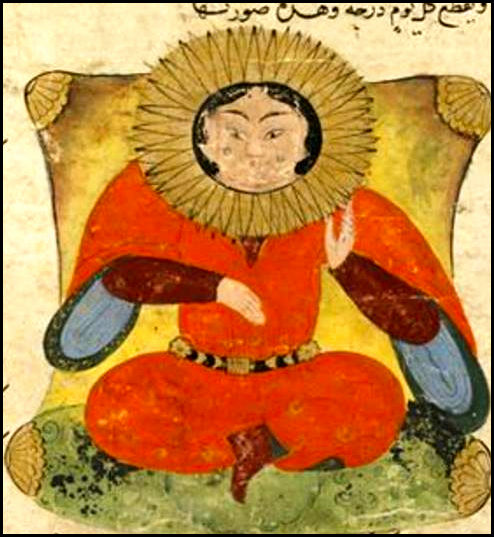
Aja’ib al-Makhluqat Wonders of Creation) by al-Qazvini; recto Symbol of the Sun

Reading a chart for the Ingresses and Solstices has become a tradition here, following a truly ancient tradition. Because of these points are crucially relevant to the Solar cycle, they have tended to be a time of celebration across cultures and time, virtually universal. The Aries Ingress chart provides us with the Lord of the Year and what we may expect to dominate the year. I’ve had a policy of brevity on these occasions and in any case, the interpretation will differ in many details due to the selected time zone.

Mars is the undisputed Lord of the Year, He’s exalted in Capricorn and with the South Node. This rarely if ever ends well. The most critical situation involves Mars and Saturn besieging Jupiter and the Ascendant. Guido Bonatti tells us that a besieged planet is one that separates from a malefic and applies to another (Con. 6). It shows a situation that is going from bad to worse. Saturn is in his own Domicile but in the Anaretic degree and with Mars as his Altumuten. Using Whole Sign, this nest of vipers squares the Sun.  The Moon in Aquarius is also in a Saturnine domicile.

Both Capricorn and Aquarius oppose the lights – Capricorn the Moon and Aquarius the Sun. Nevertheless, the Sun is strong and exalted in Aries and holds the anchor, as it were. However, it is still in a martian sign and the overall picture is easy to see. We might say that Jupiter is weak by sign, but still a benefic. But considering that Jupiter is under siege from the two malefics and in detriment, he is unable to act effectively,

The results are there for all to see. We have a pandemic with no known antidote that is besieging entire countries. Moreover, the locust seams, the greatest in decades, have spread from Africa to the Middle East and to the Subcontinent. Both are forms of contagion and beyond human control at this point. This won’t be an easy year, although we have opportunities that only such catastrophes can reveal. The greater catastrophe would be to miss them.

An Ethiopian girl attempts to fend off desert locusts as they fly in a farm on the outskirt of Jijiga in Somali region, Ethiopia January 12, 2020 Giulia Paravicini/REUTERS

To put this in perspective, Saturn will form a Grand Conjunction with Jupiter at the end of there year in the Saturnine sign of Aquarius. I have written substantially on this phenomenon on this blog. Essentially this Conjunction will set the stage for the next two decades. The Grand Conjunctions heralds what we may call a mini-age. Saturn will be much stronger than Jupiter. The phase we are well into at this time is fraught with great challenges to humanity, both existential and ethical in nature.

The Great Year – Plato & the Four Yugas

Hear ;of the Milky Way. Photo from NGC.

The Milky Way. Photo from NGC.

The problem of describing the beginning and the end of Astrological ages is notoriously chaotic, yet it is widely assumed that this information is readily available. Nothing could be further from the truth. This article cuts a wide swath across the

A colleague recently questioned my assignment of the current Age to Aquarius), when both the sidereal and tropical Vernal point is in Pisces. The enormity of the differentials in calculations require some history and knowledge of what is referred to as “The Great Year.” There have been concerted efforts to equalize the boundaries of the constellations, but the fact remains that there are massive differences in the number of degrees covered by a given constellation.  The attempts, much of it in the 20th century, has left us with the illusion that each constellation matches a sign of thirty degrees. Yet the constellations such as Leo, Virgo, Pisces and Sagittarius are much larger. Artificially equalizing the constellations causes as many problems as it is meant to solve.

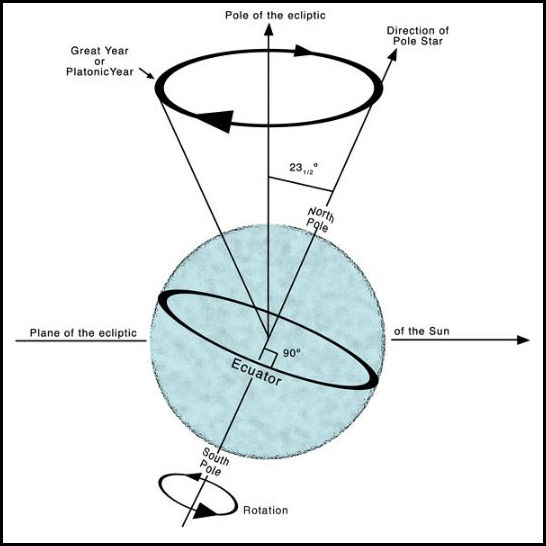
Where the blue circle in the diagram (right), represents the path of the pole in the northern hemisphere over a complete cycle.

Many consider astronomy to settle these kinds of things. Surely, astronomy can provide rational and lucid answers based on science.  Let’s look at “the Age of Aquarius from an astronomical perspective.”

The International Astronomical Union (IAU) – which in the 20th century assumed the duty of officially naming and defining all things astronomical – created official constellation boundaries in 1930. From the perspective of astronomy, then, the beginning of the Age of Aquarius is based upon IAU constellation boundaries, which astrologers or New Age practitioners might or might not choose to use in their computations.:” See Bruce McClure at EarthSky.

I find the term””official constellation boundaries” amusing. In reality, the constellation boundaries are what they are. Making them precisely equal in size in an attempt to tidy up the heavens has no useful purpose, not least because the  “official boundaries.” are merely a convenient substitute and a construct. It doesn’t solve the problems of determining where the boundaries are and muddied the subject, doing nothing regarding the exact placement of the Vernal Equinox.

This entire approach lacks the required self-reflection to address the question as to whether or not the constellation gives us the sign or the sign gives us the name of the constellation, but this is what happens when astronomical busy-bodies try to make elements of the universe official.

So far, we still don’t have a direct relationship between signs and constellations. Of course, for everyday practical use. the questions will be ignored. Nevertheless, this presents a problem if we are attempting to ascertain the beginning or end of an astrological Age.

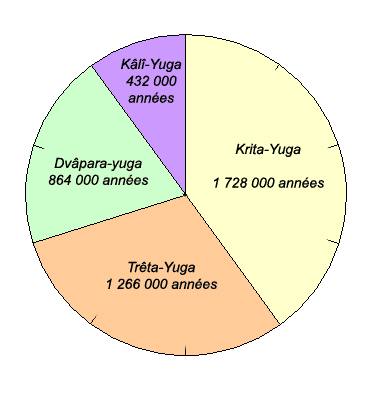
There is also an Indian version of this. This system is associated with metals and references to India concepts, such as Sattva and the Kali Yuga. There is no attention given to arriving at equal-sized periods., The ages are also incredibly long.

The Mahabharata (which was used by Aryabhatta in his calculations) and the Manu Smriti have the original value of 12,000 years for one half of the Yuga cycle. According to one Puranic astronomical estimate, the four Yuga have the following durations: Satya Yuga equals 1,728,000 human years, Treta Yuga equals 1,296,000 human years, Dvapara Yuga equals 864,000 human years, Kali Yuga equals 432,000 human years
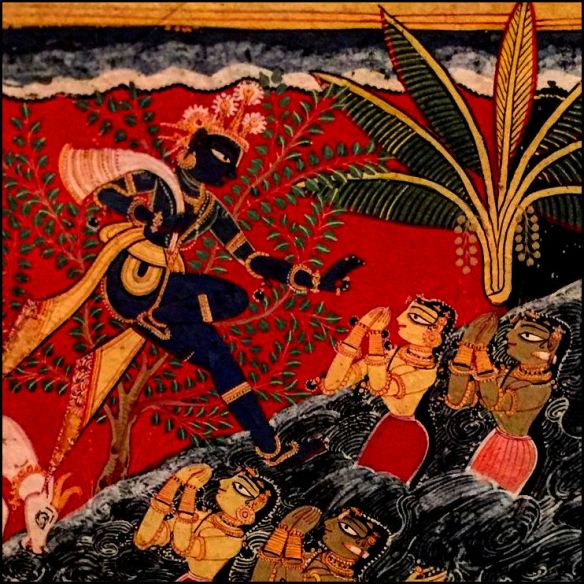
Krishna Stealing the Gopis Clothing, folio of the Isarda Bhagavata Purana, India, Delhi-Agra area, 1560-65

Krishna Stealing the Gopis Clothing, folio of the Isarda Bhagavata Purana, India, Delhi-Agra area, 1560-65

Puranic sources, tell us that Krishna’s departure from the world marks the end of Dvapara Yuga and the start of Kali Yuga, which is dated to 17/18 February 3102 BCE We are also given a precise time of birth for Krishna. However, the detailed qualities of the Yuga largely revolve around Krishna. The Dvapara Yuga follows the Treta Yuga and precedes the Kali Yuga. According to the Puranas, this yuga ended at the moment when Krishna returned to his eternal abode of Vaikuntha There are two main pillars of religion during this age: compassion and truthfulness. The Dvapara Yuga lasts 864,000 years.. Knowledge of the Vedas is specific to the Yugas. The Dvapara Yuga is restricted to two. 

The Kali Yuga is the lowest point of descent. It is a time marked by avarice and ignorance. an Age associated with the demon Kali (not the goddess).

The term has two main meanings. In scientific astronomy, it is defined as one complete cycle of the equinoxes. This translates to a period of about 25,800 years”. A more precise figure of 25,772 years.] The position of the Earth’s axis in the northern night sky currently almost aligns with the star Polaris,

Age of Taurus – Marduk became associated with Jupiter and is sometimes shown with Solar symbols including lions

The Platonic Year also called the Great Year, has a different more ancient and mystical significance. Plato theorized that winding the orbital motions of the Sun, Moon and naked eye planets forward or back in time would arrive at a point where they are in the same positions as they are today. He called this time period the Great Year and suggested that such a unified return would take place about every 36,000 years. There is no evidence that such a realignment has ever or ever will take place. (]Walter Cruttenden, Lost Star of Myth and Time (St. Lynn’s Press, 2006), p.xix–xx. Plato did not have knowledge of the Precession of the EquinoxThe origin of the Platonic Year would appear to have no connection with the precession of the equinoxes because that was unknown in Plato’s time

The crucial knowledge of the Precession of the Equinox came with the Greek astronomer Hipparchus (second century B.C) is credited Ptolemy considered Hipparccus his most important and much of what we know of his work is in the Almagest of Ptolemy.

Claudius Ptolemy has been accused of fraud for giving us the figure of 36,000 years when he had adequate information or a far lesser period. See R.R. Newton  The Authenticity of Ptolemy’s Eclipse and Star Data. (1974)

No study of the Precession in Astrology, as well as the Great Ages, is complete without reference to the work of Nicholas Campion, “The Great Year: Astrology, Millenarianism and History in the Western Tradition” (Arkana/Penguin Books, 1994) Campion. in The Book of World Horoscopes, indicates that he has collected over 90 dates provided by researchers for the start of the Age of Aquarius and these dates have a range of over 2,000 years commencing in the 15th century AD. The range of dates for the possible start of the Aquarian Age range from 1447 to 3621.

The 20th-century British astrologer Charles Carter famously stated that “It is probable that there is no branch of Astrology upon which more nonsense has been poured forth than the doctrine of the precession of the equinoxes.“See ]Nicholas Campion, The Book of World Horoscopes, The Wessex Astrologer, Bournemouth, Great Britain, 1999, p. 485

Lastly, we assign events and ideas to different ages which may bring us important insights or lead us astray. For example, the Age of Aries is associated with the wars and the beginnings of monotheism and not a great deal more We might want to include Solar Cults, for example, but these were strongly represented in the Age of Taurus and the Age of Piscis. The fleeting monotheism in Egypt was soon stamped out. Judaism is touted as full-blown monotheism. Yet the Bible is replete with goddesses. If we put this n context, Judaism was a small tribal entity and monotheism outside of that world was non-existent. If we take a global view, then monotheism will not appear to be dominant in the Age of Aries. The Age of Taurus is perhaps more self eloquent because it’s a sense of beauty attracts us. Every sign will have a specific meaning for us. and it’s likely that similar themes will not be interpreted differently according to our cultural milieu. When all these elements are considered, we can say that the themes of the Ages have more in common that is commonly believed..

That we are still not in agreement on the beginning or end of any Age, may be extraordinary, but is not a failure. Indeed. we have not fallen prey to the demands of astronomical exactitude at the expensive of the visionary. Astrology is not mechanical.

Michael Wood brings a literary sensibility to this piece on The Platonic Year

“The Platonic Year, or the Great Year, is a traditional name for the period in which all the planets and fixed stars complete a cycle and return to a configuration they have occupied before, some 26,000 years according to the calculation Yeats is using — his instructors, he said, meaning the spirits who spoke to him through his wife, ‘have … adopted the twenty-six thousand years of modern astronomy instead of the thirty-six thousand years Spenser [in The Faerie Queene] took from the Platonic Year’. This Year could be divided into twelve ‘months’ that became for Yeats the spells of two thousand plus years between catastrophic historical incarnations. Such a month would, in turn, have its months, and every division, including what we ordinarily call a calendar year, would have its seasons and phases of the moon and would allow us to think, at the most immediate level, of what Yeats calls a ‘symbolical or ideal year’, incredibly long or reasonably short, ‘each month a brightening and a darkening fortnight, and at the same time perhaps a year with its four seasons’. The pattern runs all the way through the different levels and dimensions, and it’s easy to see how the Platonic Year could become for Yeats an emblem of remote but undeniable regularity, and a figure for whatever there is that ultimately, however belatedly and at whatever cost, refutes randomness and asserts the enduring principle of order, or perhaps simply of the possibility of such a principle.”

I believe that the Aquarian Age began in the early decades of the 20th century. In no small part, I’m indebted to W.B. Yeats for his visionary poetry and drama. The Second Coming is particularly notable. I’m also indebted to his A Vision and his theory of the gyres. I also find it impossible to deny the Aquarian nature of modern warfare and the proliferation of secular totalitarian states, the rapid development of technologies and a cooling of human interaction and the extreme distractions brought about by information technology. Yates was himself a Sun sign Aquarian. and close friend Rabindranath Tagore. Yates also provides a bridge, for those that can find it, with the Renaissance through Blake and the Romantics.

The Indian Yugas are not standardized and Swami Sri Yukteswar was convinced that Kali Yuga had already passed at the end on the 19th Century. He also believed in sub-ages. Dwapara Yuga is “known as the age of energy, a time of awakening consciousness and rapid advancements. The ascending Dwapara Yuga started it’s 200 year transition period in 1700 AD and the 2,000-year-long Dwapara Yuga proper period started in 1900 AD.. We have seen electricity discovered, the atomic age and the age of computers begin, in an explosion of new developments. Within this period quantum physics, space travel and digital phone/cameras have become commonplace. The science of psychology is less than 100 years old and we see how it has merged with so many other modalities to expand our awareness. With this understanding, the myriad examples of society’s changes and the surge in energy and complexity that we all feel is seen in a new light.” See Indra Rinzner The Yugas

Swami Sri Yukteswar arrived at the same period that I allocated to the Age of Aquarius, matching the Dwapara Yuga proper period started in 1900 AD. Yet there is no specific astrological reference at all  The agreement where we find it is energetic. The qualities he mentions are compatible with Aquarius, not essential.
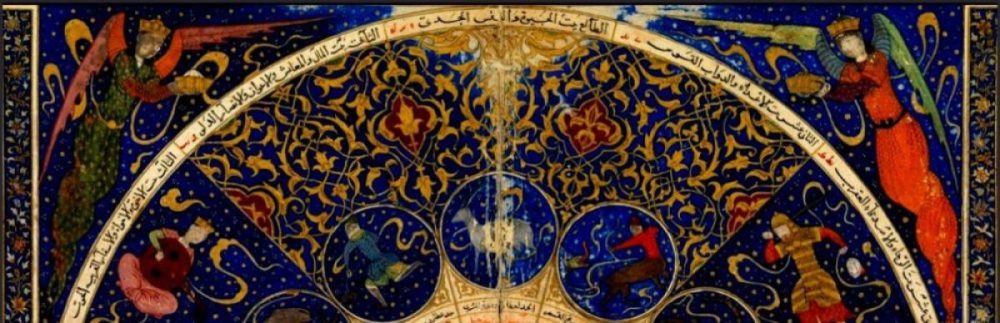
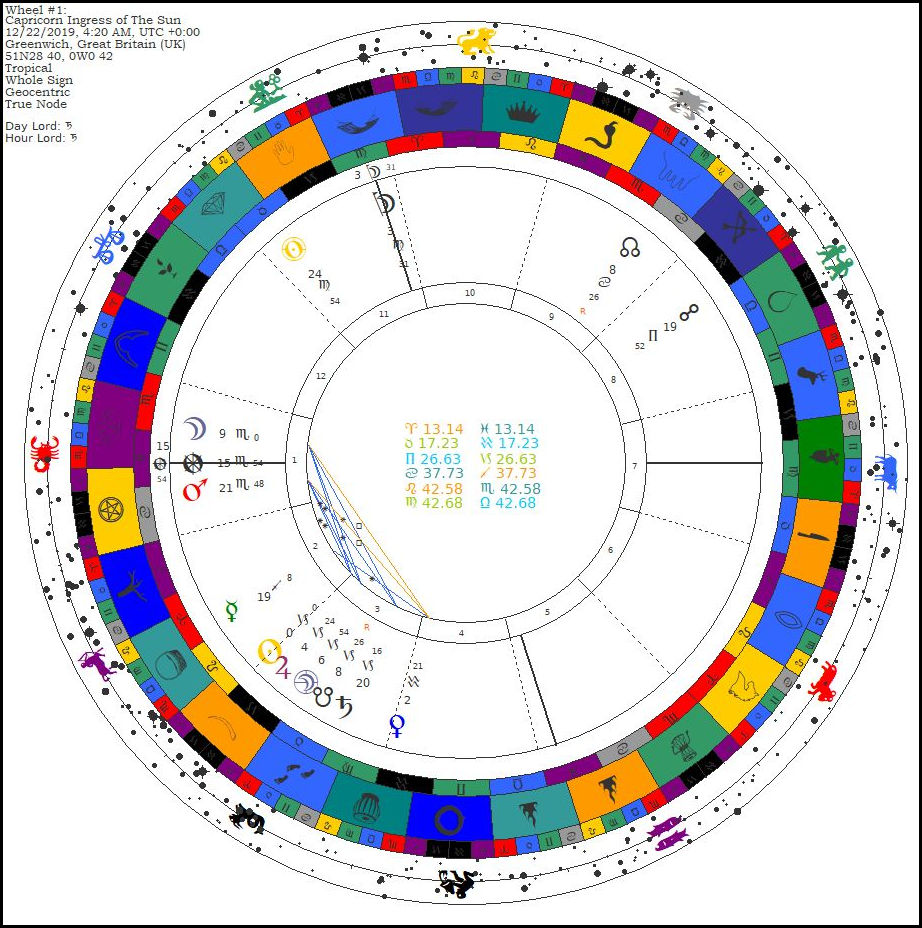
Yuletide 2019

The four Cardinal Ingress charts are drawn up for the Solstice and Equinox points. Many traditional astrologers, such as William Ramesey are almost entirely concerned with the Aries Ingress, also known as the Spring Equinox, for sound reasons. It is how we derive the Lord or Lady of the Year.

Nevertheless, the Equinox and Solstice charts are also valuable and for that reason, I publish and read all four each year. The Capricorn Ingress has great significance in various cultures around the world. For most of us, the Winter Solstice coincides with Christmas, but also with Yule, St. Lucia’s Day, a festival of lights celebrated in Scandinavia, the Persian festival Yalda, or Shab-e Yalda, as well as lesser-known celebrations such as Alban Arthan (Welsh). Saturnalia, Dongzhi Festival (East Asia) and the Slavic Korochun festival.

What they all have in common is the theme of the rebirth of the Sun. However, the Four Quarters are equally important and moreover,  they are connected to each other on the Wheel of the Year. This has clearly been of great concern since Neolithic times.

This particular chart is drawn up for GMT, in part because of the momentous events occurring in the UK very recently. It’s something of a sombre chart at first lance, on the Day and Hour of Saturn and with a Martian Almuten. Mars is also Lord of the Geniture. The chart is essentially divided between the string of Capricorn / Saturn and Scorpio. A Mundane chart with the angles in Fixed Signs has a farther reach than one with even Cardinal angles would have. There are no retrograde planets.

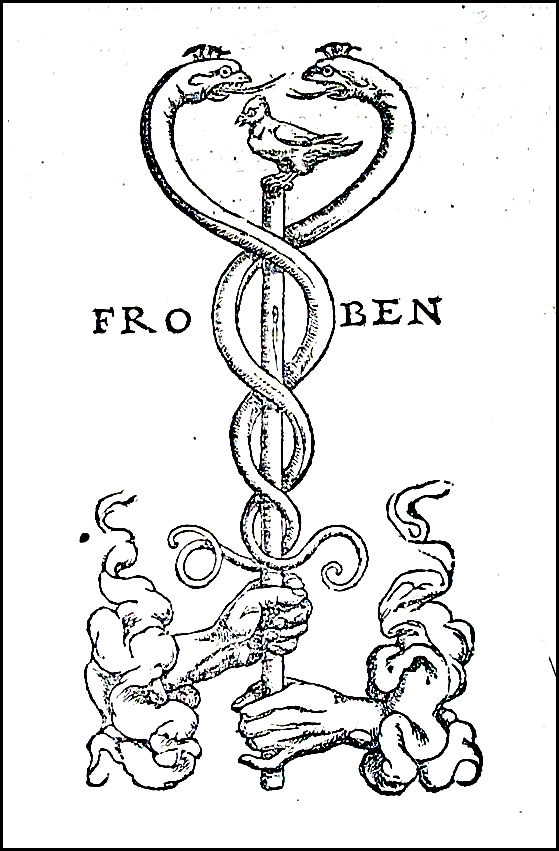
Caduceus – The Staff of Hermes Johann Froben’s printer’s symbol

The First House carries the Moon, Mars and Ascendant. In a Mundane chart, the First House signifies the nation and the people as a whole, its general condition of prosperity and health or the reverse. The Moon also denotes the common people, women generally, crowds, and all matters of a common or public nature. It shows where the focus is for the people of the country. It is noteworthy that the Moon and Mars is a volatile mix and this will be part of the picture, as we experience social unrest.,

However, Ramesey suggests that “If the planet to which the Lord of the Ascendant or the Moon does apply or is in aspect with, be Jupiter, they shall be safe and secure that year, shall enjoy their liberties, shall be free from all manner of molestation, shall have justice and good laws executed and shall be in credit and honour.” (Book IV – Astrologia Munda Section II – Chapter III 46) The aspect, in this case, is a sextile to Jupiter. The results will be dampened but perhaps not entirely negated by his unfortunate placement. Jupiter in the sign of Saturn’s domicile is hard-pressed to be truly jovial. He is in his fall. The close conjunction to the Sun is also a main consideration.

If we also consider the Lunar Mansion. number 18.  al Biruni, tells us that “Al qalb, i.e. qalb al aqrab, the heart of Scorpius, Antares, is a red and trembling star which astrologers describe as having the nature of Mars; in front of it is another star, and behind it is a third, the three being disposed in a curve.:

The names for the Mansion is The Caduceus.  Al Kalb (The Heart) 8°34’17″ Scorpio to 21°25’40″ Scorpio. This is a time to heal and prevent illness in all its forms.

Venus governs women’s issues, national birth rate, social factors connected to marriage and children. Artists, musicians and the arts. Facilities for sport and entertainment. Peace and diplomatic resolutions. She is in the Fourth House, which is the place of the Ancestors, the land. This brings a more celebratory tone, a sense of connectedness with kin,

Mercury in the Second House augers well for trade, merchants and the collective national wealth, the exchequer, revenue, banks, the Stock Exchange and so on. It is indicative also of trade deals.

Saturns thrives and Jupiter flounders in Capricorn. We are witnessing the end of a 20-year dance between the two social planets and they approach a Grand Conjunction in a year from now.,

Ramsay writes that “Saturn in the third if he is well dignified, shall generally denote mirth and jollity to the people, that they shall delight and associate themselves one with another, and all heart-burning and differences between them shall be forgotten and laid aside. ” (Book IV – Astrologia Munda Section II – Chapter VI p.64)

Japanese Sun Goddess (660 Bc) – Amaterasu

All references to William Ramesey’s Astrologia Munda are taken from Steven Birchfield’s Revised English Ed. (2006).