This is a succinct documentary on the library at Alexandria. It is much better than the ‘ancient mystery’ label would suggest
The Library of Alexandria
1
This is a succinct documentary on the library at Alexandria. It is much better than the ‘ancient mystery’ label would suggest

Hermes Trismegistus, floor mosaic in the Cathedral of Siena
This brief article is intended as an introduction to a much larger study of the relationship between enlightened wisdom versus narrow-minded dogma. In the process, I will focus on the Universal approach to religion as taught by Zoroaster and demonstrated by the extraordinary tolerance and benevolence of Darius I, king of the Persian Achaemenid Empire. The Persian Empire at this time included most West Asia, the Caucasus, Thrace, -Macedonia, and Paeonia. It also reached the Black Sea coastal regions, the North Caucasus, and Central Asia
Darius was the author of the first bill of rights, was the liberator of the Jews, banishment of slavery and subscribed policy of noninterference with the religions of other groups. This meant that the religion of Zoroaster had been spread through most of the known world. long before Alexander.
The Prisca Theologia is one of the most important ideas in the history of at least the last two millennia. This is true for a number of reasons. First and foremost it frees the mind to consider all sources of wisdom on an equal basis – without pre-conceived ideas. If we can allow that all religions might be called Pagan by somebody, even if they don’t match the definition. The most problematic religious beliefs are the Abrahamic religions – Judaism, Christianity, and Islam.
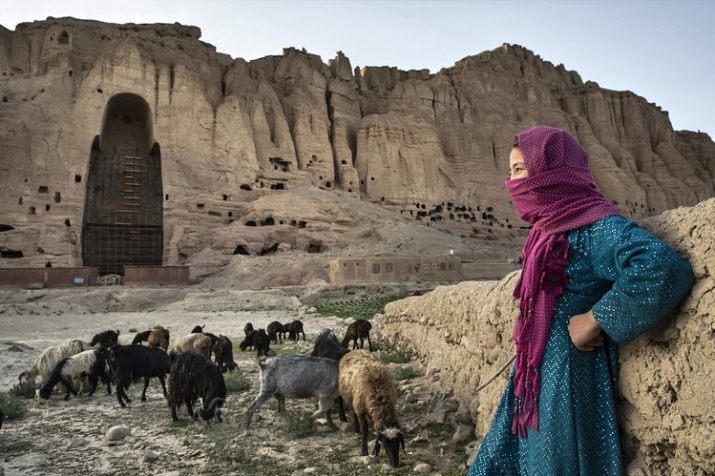
A girl watches over her sheep and goats as they graze before one of the destroyed Bamiyan Buddhas.
The problem lies in an extraordinary and ingrained intolerance in virtually all forms of these religions. With particular reference to the last two, it is common for one sect to be at war with others, even though the differences in thought do not seem extreme enough to warrant the degree of conflict we see on an ongoing basis. Sufis have a reputation for deep and benign mysticism expressed through music and art, including dancing. Yet Sunni Muslims destroy their shrines in Pakistan and parts of Africa.
Afghanistan used to be a Buddhist country, but in the contemporary nation of Afghanistan, under the Taliban, saw fit to destroy the Bamiyan Buddhas. The religious scholars could not distinguish art from idolatry. In my mind, the inability to distinguish shows a spiritual blindness. This paranoid mindset has dogged us through the centuries, sapped our creativity as well as our acceptance of other points of view and other values as well. It is both ironic and inevitable that these qualities have ultimately lead to a preference for atheism.and secularism.
The Abrahamic religions tend to take the position of ‘us and them.’ Certainly, something like astrology takes more than it’s fair share of abuse, even though all three Abrahamic religions support at least some forms of astrology. Rigid religious think has never been capable of expressing great creativity and closed minds are considered safe minds. If it could be shown that all true wisdom comes from a single source, we could no doubt diminish conflict. However, it is not true that all paths lead to Paradise. The latter is a New Age view which is patently false. We make little or no progress by pretending that all paths as laid down are the same, but we make the ultimate progress when we discover common roots and through the process of learning and inspired discernment, we can indeed find the pearl of great price. The metaphor of the pearl and also the that of the mustard seed show us what needs to be done.
If we turn the clocks back to the European Renaissance and the fortunate fall of Byzantium the means by which the opening of an inexhaustible mine of wisdom and inspiration became apparent. The details of the various traditions will be spelled out in further articles, although some have already been covered in some depth.
The philosophy of Plotinus, a Neo-Platonist, is full of imagery – such as a fountain of light – that provide powerful insights into the nature of creation and the divine. Plato himself, as well as Pythagoras, claimed connections with the Magi. Judaism would be almost unrecogbizable if the Zoroastrian influence was somehow removed.
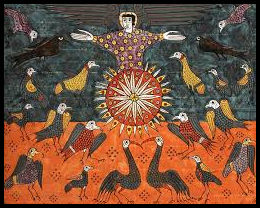
Zoroastrian sky burial
The Hermetic Philosophy is so radically compatible with neo-Platonism, Pythagoreanism, Gnosticism, mystical Judaism, Christianity, and Zoroastrianism, that it can come as no surprise that Marsilio Ficino put everything else aside to translate the Hermetica – this included putting some of the translations of Plato aside to focus on the translation of the new prize. This is highly significant because Ficino’s ultimate creation was his Theologia Platonica. He was fascinated by what was alleged to be Plato’s astrological chart. it would be exceedingly difficult to find anyone with a greater devotion, some would say obsession with all things Platonic.
Recently, I had the good chance to come upon a paper on the subject of the Hermetica. The author was clearly well versed in the many traditions that shadow or are informed by the tradition. I had only recently written a modest piece on Zoroastrian magic. Ficino is usually studied with an understanding of his fascination with the prisca theologia or “ancient theology,” the doctrine that asserts that a single, true theology exists, was drawn from a common divine source. The term appears to have been first used by Ficino. Nevertheless, I’m not sure that it is well understood how right Ficino really was!
There are essentially two sources of knowledge regarding the date of Zoroaster and the first revealed monotheistic religion. The first is Greek. It tells us he was born in about 6,000 b.c. The second is also Greek and places him at around 600 n.c. The latter appears to be a fairly arbitrary date prior to the invasion of Alexander the Great. There is no actual evidence for the latter date whatsoever. The earlier date was the one accepted by Plato, Pythagoras and others who clearly had contact with magi and Zoroastrians. What we lack in incontrovertible facts, we have in abundance the testimonies of ancients and the unmistakable similarities that point us to a single source. I admit that this requires a willing suspension of disbelief, but the usual alternatives are not available. If we consider the earlier date, then the earliest Hindu writings and the person of Abraham may be considered as deriving from Zoroastrianism. It has been said that Abraham and Sara are Ram and Saraswati. We may never know and that is part of the point.
Cristian Violatti provides an excellent and concise account of the arguments for an earlier date from classical; sources: “The dates of Zoroaster are also discussed by some classical authors. Herodotus, who we would expect to deal with this issue, does not mention Zoroaster. Plutarch estimated that Zoroaster lived 5,000 years before the Trojan War; the ancients believed that the date of the Trojan War was 1184 BCE (according to Eratosthenes’ estimations), which would make 6184 BCE a date consistent with Plutarch’s opinion. In the 3rd century CE, Diogenes Laertius, based on a claim of Xanthos of Lydia (a contemporary of Herodotus), places Zoroaster’s life 6,000 years before Xerxes’ military campaign against the Greeks, which took place in 480 BCE. Thus, according to Diogenes, 6480 BCE was the time when Zoroaster lived.” (Ancient History Encyclopedia).
One of Ficino’s most brilliant students was a young scholar named Pico della Mirandola. He is most famous for his Oration on the Dignity of Man In it, he addresses ‘the fathers’ – representative of the religious and moral establishment — with a fiery, eloquent and extraordinarily erudite oration. He was just 22 years of age, The flowering of the Italian Renaissance was in some respects more impressive that the Classical culture it wanted to emulate. It was like a precious bloom that fell as a result of its own weight.

Girolamo Savonarola
It is necessary here to make a mercifully short digression. The world that had meant to be a renaissance of the Platonic Academy and more was to fall by way of a very stupid, possibly psychotic priest named Girolamo Savonarola (Italian: [dʒiˈrɔːlamo savonaˈrɔːla]; 21 September 1452 – 23 May 1498). He was an Italian Dominican friar and preacher active in Renaissance Florence. He gained a reputation prophecy and was clearly strongly charismatic. He was obsessed with the destruction of secular art and culture. He managed to terrify Florence to such an extent that its citizens jettisoned books and magnificent works of art on the original bonfire of the vanities. He managed to get the population to turn on itself. Sexuality was demonized and creativity suspected of evil intentions. Whenever and wherever these thoughts become dominant, death of all kinds is at hand. Creativity and sexuality are part of a healthy life.
Not for the last time in history, reason, creativity, and passion were swapped for mortification of the flesh, morbid and delusional fears, mixed with paranoia and absurd accusations (read projections). A salivating lunatic, barking mad as he obviously was, convinced the mobs that he was a holy man. Eben Pico succumbed. Savonarola effectively snuffed one the greatest flourishings of art and culture. It seems particularly ironic that his central prophecy was that a second Darius would come from the North and restore Christianity. When the French king invaded, he saw that as proof that his prophecy had been genuine.

The Middle Persian word ʾhlmn’ (Ahreman) in Book Pahlavi script. The word is traditionally always written upside down as a sign of contempt..
The most tragic element here is that there was an early chance for Christianity to take its place as a cherished expression of the prisci theologia, confident enough to stand without wanting to see everyone else fail. The ensuing years saw the fracturing of the Church, a Reformation that for the most part only made things worse, while inadvertently creating the perfect soil for nutty extremists who saw witches behind every tree. The cult of accusation is always evil. It always seeks a guilty verdict no matter what. A decent Christian or Zoroastrian would see the evil for what it was. The witch hunts didn’t only target witches. It was an easy way to appropriate land and wealth while inflicting the most awful suffering. We see this same spirit at work today.
The ugly religion of Savonarola and his ilk would be considered symptomatic of dark forces and druje in Zoroastrianism.: Jayaram V points out that “Angra Mainyu is the architect of evil, the anti-God principle, who represents evil, untruth, arrogance and death and subjects people to torment once they come under his influence, Ahura Mazda created the twin spirits, the good Spenta Mainyu and the other named Angra Mainyu or Ahirman.” (Zoroastrianism, The Battle Between Good and Evil).
Some years ago, when Pakistan acquired the atomic bomb, I recall a young man in Islamabad stating “the Christians have the bomb, the Hindus have the bomb and now the Muslims have the bomb.’ The celebrations around this event were quite extraordinary, but my first thought was that this young man and many others. saw the world as being divided up by religions – not as a matter of choice, but as a matter of birth. Hindus were not like Muslims. This kind if thinking should have extinguished itself centuries ago, but in fact, it is strong and unlikely to reverse anytime soon. It’s obvious that the world is still reeling under the weight of massively scaled conflicts. These conflicts are migrating and attempts at multiculturalism on a grand scale fail largely due to religious intolerance.
The beginning of wisdom might be a revisiting of Ficino’s vision with both a mystical and a practical eye. Ficino was an ordained priest. He was the mentor of Botticelli, Raphael, a score of poets, scholars, and philosophers. He had part of his villa painted with astrological images. His medical knowledge was commendable. It isn’t easy to understand that before Ficino, all but a few, relatively unimportant works by Plato and none of the Corpus Hermeticum was available to the west His wealthy patrons arranged for the purchase of valuable greek texts that survived the fall of Constantinople. Intellectual and scholarly life before and after Ficino were entirely different. Italian scholars finally had what they needed to revive something of the Classical world.
[Raphael, School of Athens, fresco, 1509-1511 (Stanza della Segnatura, Papal Palace, Vatican) Speakers: Dr. Steven Zucker, Dr. Beth Harris. Created by Beth Harris and Steven Zucker.]
Nevertheless, the Judeo Christian heritage wasn’t something to be ignored and Pico had no qualms about Moses imbibing from the same source as Hermes. This was most easily done by reference to the Kabbalah. It is however surely noteworthy that Moses is not a central character in the co,[osition. Aristotle was no longer the last Classical word and the mystical quality of Plato became the preferred mode. The famous painting of The Academy shows Aristotle pointing toward the Earth while Plato points to the Heavens. This point in time was the first in which a prisci thelogia could have realistically been envisioned since antiquity.
In 1320 Dante Alighieri completed his Divina Commedia one year before he died. He was considered progressive insofar as he wrote literature in the vernacular. Beyond that, he lived in a Latin world, minimally touched by Greek thought. He had a degree of sympathy with only one Pagan and that was Virgil, a fellow poet and a Roman one at that. Most tellingly, Virgil plays an increasingly small role in
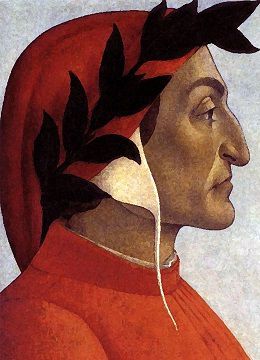
Dante Alighieri
the Comedia after leaving the Inferno. By the end of the people, he is given no voice at all. The Roman Catholic Church must have had the sense of perfect dominion in Europe, even it was threatened on other fronts. As in the works of Chaucer, there is a sense of Europe under a fairly comfortable siege. The notion os a Universal religion or a Prisci Theologia could not have found a footing during those times. A simple comparison of the two periods yields a great deal of insight into the massively expanded view of the late 15th Century.
Let’s take one more example. Dante had placed Guido Bonnati in the Inferno in Canto XX. He was to be eternally punished for seeking to see the future, in keeping with Dante’s ideas of Divine Retribution. Fortune Tellers and Diviners have their heads on backward and their eyes are full of tears. These are the souls who, on Earth, tried to see too far ahead of them, and thus will spend eternity forever looking behind with blurred vision. Following the teachings of the papacy, the theme of religion is broached, because the papacy did not approve of sorcery in any form.” This is the most perverse hatred and fear of vision. That such a punishment could be considered either wise or just is abundantly symptomatic of a religious view putrid to the core. .
Ficino, on the other hand, was an ordained priest who practised astrology and astrological medicine. He could hold to the Christian faith while being a mage and drawing inspiration from several Pagan sources. It needs to be said that Ficino didn’t need to mention the historical Jesus in his Theologia Platonica, which would rule him out as a Christian in the minds of some. Ficino was so well protected from attacks by extraordinarily wealthy and powerful patron, including ones in the church itself, that we can imagine that a blind eye might have been turned towards his eccentric life.
However, it was by no means that cut and dried. For the most part, the upper echelons of the Church were as enamored with Ficino’s circle of artists, philosophers, magi, statesmen and poets as the Medici themselves. It was a period of extraordinary learning. Latin scholars had been common since Rome itself, but greek ideas, texts, and the language enriched theology to the point that Marsilio Ficino could write The Theologia Platonica in the first place. Logos and Word were interchangeable, except that the word logos has both more specific and more general meanings. Consider this phrasing: “Grant us your favour, My Lord, show us this day your star, the one once you showed to the Magi. The star that led the Magi to Christ, may lead us to Christ’s mysteries.” – De Stella Magorum
The figure who embodies the greatest number of traits and qualities of this magical Prisci Thelogia was Zarathustra. But how could he be distinguished from Hermes Trismegistus? We know that what the Renaissance scholars were reading was probably a third-century work. However, reading the essence of the Hermetica, it takes no imagination to see Zoroastrian elements as well as Pythagorean and Platonic ones. At this point in history, this ought to come as no surprise. But one of the greatest pitfalls to knowledge has been the weird insistence of linear time and inevitable progress.
There are many interesting twists and turns on the theme of Prisca Theologia. A good example is to be found in Michelangelo’s Bacchus. The unnamed writer at Michelangelo.org writes:
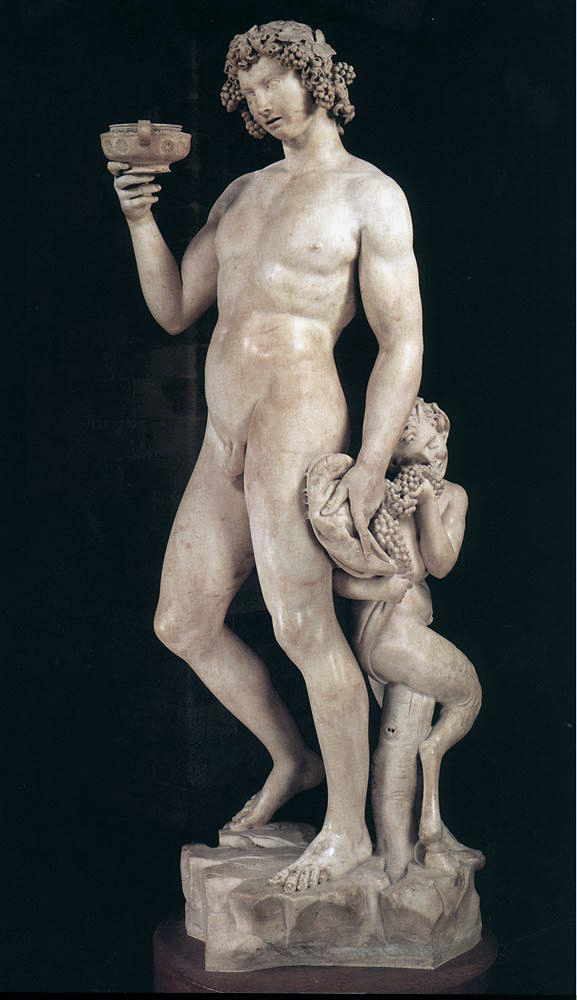
Mechelangelo – Baccus
“The statue of Bacchus was commissioned by the banker Jacopo Galli for his garden and he wanted it fashioned after the models of the ancients. The body of this drunken and staggering god gives an impression of both youthfulness and of femininity. Vasari says that this strange blending of effects is the characteristic of the Greek god Dionysus. But in Michelangelo’s experience, [the] sensuality of such a divine nature has a drawback for man: in his left hand the god holds with indifference a lionsksin, the symbol of death, and a bunch of grapes, the symbol of life, from which a Faun is feeding. Thus we are brought to realize, in a sudden way, what significance this miracle of pure sensuality has for man: living only for a short while he will find himself in the position of the faun, caught in the grasp of death, the lionskin. ”
What the patron had understood as an image of lewdness and inebriation, is subtly turned on its head, as it were. The creative process has brought into play to reveal that the Michelangelo of the Pieta and the Sistine Chapel are not so far removed from the theme of Dionysius or Baccus.
The traditions of Platonism, Hermetical, Qabala, Pythagoreanism and Zoroastrianism, all describe a universe in which humanity has the freedom to choose and create. All of these and other traditions integrate the reading of the heavens. In the next part of this article. I would like to address the consequences of a history of the western world that has mostly ignored the contribution made to augury and astrology itself by the cultures of Northern Europe – in particular, that of the Druids
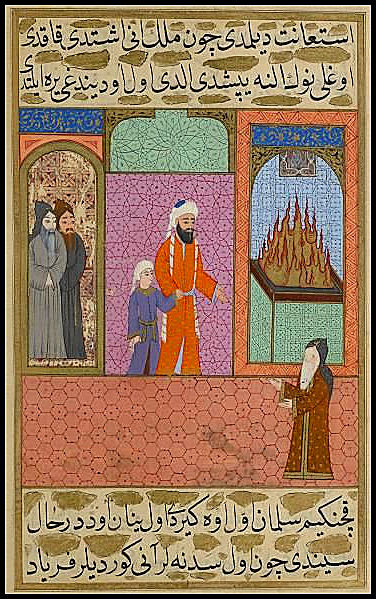
A Persian Zoroastrian King and his young son, Salmân al-Fârisî, enter a fire temple administered by three priests,
This is another of those topics which deserve a lengthy article, but for now a blog entry will have to suffice as an introduction to a highly complex topic. The video, shown below, was made available on YouTube by a Zoroastrian gentleman who has an extraordinary channel at Fereydoun Rasti Zoroastrianism & Iran If this material interests you, I heartily recommend looking through the extensive archives of videos.
I posted this rather lengthy video because it uses the Zoroastrian scriptures known as the Gathas. The similarity to the Vedic word Gita (song) is no accident: Maneckji Nusservanji Dhalla states that “It is an uncontested fact that there is a marked closeness between the grammar,metre, and style of the Rig Veda and the Gathas.” (History of Zoroastrianism p11).. The power of words is emphasized in both and the verses are meant to be sung, as the title suggests.
Zoroastrianism posits, quite sensibly in my estimation, that this world is in a battle between good and evil. There are no specific scriptural comments on astrology per se in the Gatha period at least, but astrology certainly became an important element of Persian beliefs. It was already ubiquitous. Zoroastrianism is not known as a superstitious religion. It is widely believed that Zoroaster was a priest and a prophet, associated with the Magi. He is considered a magician in the true sense.
The creator, Ahura Mazda, has always affected human reasoning and therefore actions. The aim is to reveal to humanity their innate connection to the source of light and consciousness. It should come as no surprise that Zoroastrianism was the impetus and source of Mahayana Buddhism.
There is also an angelology – the idea of celestial forces that could be called upon. Ahura Mazda is ineffable. The point for our immediate concerns are that the Gathas were sung for devotional reasons and also used to mitigate or cast out what were considered evil forces, including common illnesses. This cosmology lends itself very well to an astrological framework, but not one in which the planets or angels had a will of their own, as it were. We come back to the to the question as to whether the stars impel or compel us. The creed of Zoroastrianism comes down to “good thoughts, good speech, and good action..” With this thing in mind the practise of singing the Gathas, we find that this is more a practical application of divine principles than superstition.
The counterpart to Ahura Mazda is Angra Mainyu also known as the “evil spirit.” This dark manifestation is ultimately set to be destroyed according to Zoroastrian eschatology In the meantime, the kinds of practises described in the video presentation are regarded as wise and efficacious, much in the way a Hindu or Buddhist might consider a mantra. We don’t consider the practise of such things as being indicative of superstitious minds and certainly neither do those employing these remedies. This is the source of confusion for many when being introduced to the Good Religion, as it is frequently called. A Monotheistic faith that recognizes dual forces of light and darkness within that wholeness is actually a fair and apt description of life.
The study of ancient and classical astrology inevitably including spending a great deal of time on the history, culture and particularly the religion of ancient Persia. There are several reasons for this, but the primary one can be realized immediately by the strategic location of a land that once included most of what is now Afghanistan and beyond. She borders India and the Sik Road to China, promoting trade and the exchange of ideas. Moreover, she also bordered and later ruled Babylon, Assyria, and Sumeria.
The capturing of Babylon also include the liberation of the Jews by Darius, who went further and paid to gave the temple re-built. darius forbid the use of slaves. Later on, Persia was conquered by Alexander the Great, whose teacher was no less than Aristotle, Alexander’s conquest of Asia was a bloody affair and many scholars and written material were lost forever when he set the torch to Persepolis, burning the city to the ground amongst an orgy of violence, in spite of the fact that the inhabitants have surrendered. That was one of the best cases that have ever been made against the excessive abuse of alcohol in decision making in all of history.
Even the most unjustly founded empires do in fact has some advantages and this is very much the case in the transmission of knowledge. The Hellenistic world united Greece with Egypt and Persia with both. The School of Alexandria was among the greatest venues for shared knowledge, from Hindu astronomers and astrologers, Buddhists, Pythagorean, numerous Solar religions, Neo-Platonists, devotees of Isis, Christians, Jews, and Zoroastrians. This place of extraordinary learning was to meet its own demise under the Muslim invasions.
It’s a Persian, Indian and Greek alchemy that produced what we now call Hellenistic astrology. But that is only the beginning.

The Longest Night must pass before the waxing of the Light. A Blessed and Merry Yule to all my friends, family and associates. At the time of the Solstice, we have the image of the Centaur giving way to Capricorn with the Holly King, appropriately riding a Goat.

St. Nicholas magazine cover art by Canadian-born illustrator Norman Price, Christmas Number, December 1912
There are some variations on the theme of the Holly and the Oak Kings. First of all, they are two faces of the same life force, with strong natural, seasonal, agricultural and mythical significance. Form a traditional astrological point of view, the two signs of Saturn oppose both luminaries – Capricorn opposes the domicile of the Moon and Aquarius the domicile of the Sun. It is, after all, a dark time of year with the seeds of the waxing light.Beyond all other considerations, the celebrations taking place cross-culturally and around the world celebrate and exalt this seed of light.
The story of Pan and his contest with Apollo is an archetypal portrayal of Saturn vs the Sun. Pan is remembered for competing with his flute against Apollo’s lyre. Rhe contest was judged by Timolus to be inferior to Apollo’s lyre. Everyone present agreed with the judgment except for King Midas, who considered it unjust. For his insolence, Midas acquired, by the will of Apollo, the ears of an ass, which he tried, unsuccessfully, to conceal under a turban.
I’m also reminded of the passage by C.S. Lewis wherein Mr. and Mrs. Beaver tell the children that Narnia is under the spell of a malevolent despot. There is neither joy nor peace. Narnia has become a land where hope is little more than an act of folly and oppression is the order of the night, Every day is as if it is “always winter but never Christmas.” Not long after, there is the sound of sleigh bells and it becomes apparent that the dark force is losing its strength.
Lewis is drawing from ancient sources and a theme that is ubiquitous. Christmas is, of course, a Christian festival, but The Oak King and the Holly King each rule for half the year. The evergreen holly and the sacred oak symbolically vanquish each other every six months, to rule for half the year. In reality, they are two sides of the same force. Indeed, the etymology of the word Holly in Latin means the holm-oak or evergreen oak (Quercus ilex).
These battles are usually considered to take place at the Solstices, but this seems to be the result of a misunderstanding regarding the nature of the seasons.
The battles take place at the Equinoxes – Samhain, and Beltane so that the Oak King is at his strongest during Midsummer or Litha, and the Holly King is dominant during Yule. In the Celtic tradition, Samhain is the end of Summer and the beginning of a new year. Beltane is a time of new life – a celebration of mating and regeneration. The association of Pan with Capricorn shouldn’t be missed. At his peak, the Holly King is very much like the Lord of Misrule, thriving as he does under two consecutive Saturnine signs.
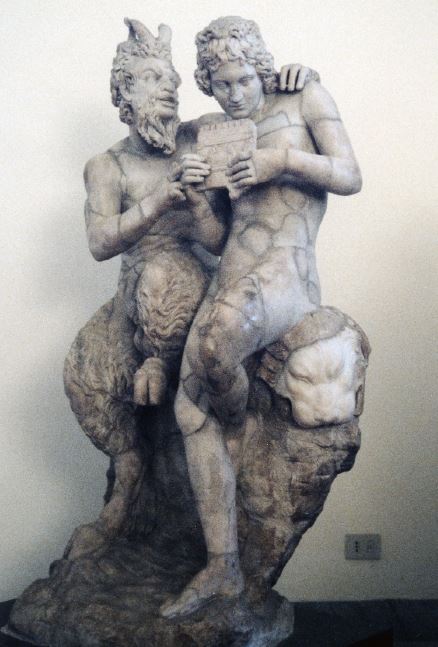
Pan and Daphnis 4, the inventor of the bucolic poem. 7222: Gruppo marmoreo di Pan e Dafni. Collezione Farnese. Forse da un prototipo dello scultore rodio Eliodoro. National Archaeological Museum, Naples.
I think Lewis is also pointing to a parallel tradition in which a faun might be interpreted as a child of Pan. In the engraving above, Father Christmas or the Holly King has an unmistakably lecherous grin and he appears to be well- stocked up with wine. The goat is synonymous with lust and of course, Pan himself is half goat. We have a mischievous Father Christmas who could also be seen as the Lord of Misrule, found at the center of Saturnalia. The Holly Kings is also merry. The mythic elements are also decidedly chthonic and celebratory of nourishment found in barren places. Goats thrive in the most hostile environments due to their extraordinary sure-footedness and ability to find food even in the most remote places, including high elevations and extreme temperatures.

This 1835 drawing depicts “Father Christmas” being ferried by a goat.
Wikimedia Commons / University of St Andrews Library
It would be naive to interpret the Holly King as a Santa Claus, but the fact is they will forever be associated with most of the same themes that we associate with Christmas and Yule and the dozens of other festival occurring at the same time. Pan is the Piper at the Gates of Dawn. Syd Barret, a Capricorn, chose this title for Pink Floyd’s first studio lp. No doubt, he got the namer and the inspiration from ‘The Wind in the Willows’ by Kenneth Grahame; illustrated by Nancy Barnhart and Published 1913. The Piper goes back much further, however, and he was the subject of Pre-raphaelite artists.
Pan’s is a primal music and his nature is the origin of the word ‘panic.’ But authentic music is not merely cerebral. It evokes other states of consciousness – some sweet and some dark
The Season is a celebration of Peace and Good-Will as much as it is a recognition of our most primal nature and the transmutation required to embrace both. We are all the Piper at the Gates.

Winter Solstice – Capricorn Ingress of the Sun – Dec 21 2017, 4:27:52 PM GMT
I believe that the pivotal charts for the two Equinoxes and Solstices are not so much a time for analysis as they are of seasonal observation. They are times of celebration. I will make just a few brief observations on the chart for the time of the Solstice. Before we do that, I’d like to take some time to recognize the nature and symbolism of the Winter Solstice.
This is a particularly auspicious day for people of widely diverse cultures, ranging from the St Lucia Day celebrations in Scandinavia, Saturnalia and its modern variants, Chanukah, Christmas and many Pagan celebrations that go back to the dawn of time. Less well known perhaps is the Persian festival Yalda, or Shab-e Yalda . It’s a celebration of the Winter Solstice in Persia that began in ancient times. It marks the end of the month of Azar. Yalda is symbolic of the victory of light over dark ar the time of the longest night. It is the birthday assigned to the Sun god, Mithra. There are family celebrations with traditional foods like nuts and pomegranates. The intent is to stay awake all night long in order to welcome the rising Sun.
In my indigenous Celtic tradition, we bring the symbolism of Father Christmas, holly, the Yule Log, Mistletoe, the Christmas Tree and almost everything else we think of at this time of year in European cultures and increasingly in Asian ones as well. Yule is a Pagan holiday that celebrates the Winter Solstice. Every detail has significance. While it is true that Santa Claus and the Christmas tree also originate in part from different, but parallel traditions, the core symbolism of the point of greatest darkness is the seed for the renewal of the light – the waning of the light gives way to the waxing of the light force.

The Celtic Wheel of the Year
The symbolism is shown in the wheel of the year, constantly turning, waxing and waning throughout the year. On this spoke of the wheel, the Oak King, representative of the light half of the year, changes places with the Holly King, representing the dark half of the year. This ensures that the light and warmth of the Sun will begin to wax each day until the cycles begin again. The universality of celebrations with similar themes are evidence of our deep connection to the cycles of Earth and Heaven.
On this particular Winter Solstice, of particular note is that Saturn enters his own domicile of Capricorn on the day of the Solstice. This is a very good thing. Saturn is relatively miserable in Sagittarius and when Saturn is in a sign that is not congenial, it augurs for more difficulties. You might think of this as something of a homecoming, with Saturn stepping into Capricorn with the Sun.
The warm expressiveness of the Sun is contrasted with the cold, dry astringency of Saturn. Still, I see this as more of a congenial meeting, particularly because Saturn is in Cazimi. This is a very rare occurrence for the Sun and Saturn to be in this relationship right at the moment of the Winter Solstice. Saturn ends up with the highest score when accidental dignities are considered. It’s an auspicious event to see Saturn enter into his own domicile in this way.
To better understand Cazimi, it’s important to note that traditional astrologers maintain that the proximity of Saturn to the Sun, within approximately 10 degrees, is combust. Combustion is a term of Medieval origin that indicates that a planet is, as it were, swallowed by the beams or fire of the Sun. When a planet is combust, it won’t be visible. Because light is an essential element in traditional astrology, this further points towards the poor condition of the planet. However, the ancient astrological tradition also recognizes an important exception. This exception is named Cazimi, a transliteration of the Arabic term kaṣmīmī. This empowers the planet greatly. Saturn, as William Lilly stated “will be ’wonderous strong.’
The Almuten or Guardian Spirit of the moment is Jupiter. He is the Face ruler of the Sun but has none of the essential Dignity rulers of the Sun. Jupiter then collects light from both luminaries. This makes him a more powerful participant than may be obvious at first glance. Mars has greater dignity and is in his domicile. These two in the Fifth House under Mars can be a boisterous combination. The more difficult elements are not so easily obvious either. For example, the Moon is in the Eighth House. This is the House of death and the place of Aquarius in the Thema Mundi and she is the ruler of the Ascendant. This augurs caution, particularly in London at this time. This a wonderful time to celebrate at home with family and loved ones.

Feat on Yalda Night
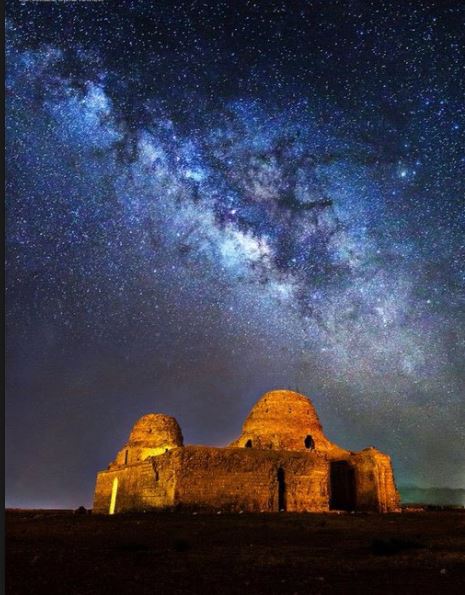
The Sassanid Palace at Sarvestan Shiraz Iran – Persian: kakh-eh Sassani-ye Sarvestan – Photo- Javad Jowkar
Before we begin, I would like to make it abundantly clear that it is not my intention to replace the chart we have for the foundation of Baghdad The data, but not the chart, came down to us from a venerable source What I would like to do, however, is to explore what happens when we decide not to take the best of intentions as the only possible motivation and that, further, the shifting of one element in the charts’ construction can change the meaning dramatically and with often unexpected results. I do this with the full recognition that the perfect chart exists only in the Mind of God.
At the centre of my argument is the simple fact that this chart has been read with the unsupported assumption that Māshā’allāh used an exclusively Tropical zodiac. There is no evidence for this.
Scientists and other researchers understand the necessity of ridding ourselves, as much as is humanly possible, of preconceptions. I think it only fair to read Māshā’allāh using the Sassanian Ayansama to see what might be found. I will add that this study makes me uncomfortable for all the right reasons and I most certainly mean no disrespect to Māshā’allāh.
Māshā’allāh (from mā shā’ Allāh, i.e. “that which God intends”) was a Jewish astrologer from Basra. Ibn al-Nadīm says in his Fihrist that his name was Mīshā, meaning Yithro (Jethro). Māshā’allāh was one of the leading astrologers in the eighth- and early ninth-century Baghdad under the caliphates from the time of al-Manṣūr to Ma’mūn, and together with al-Nawbakht worked on the horoscope for the foundation of Baghdad in 762. (See Māshā’allāh ibn Atharī (or Sāriya) [Messahala]
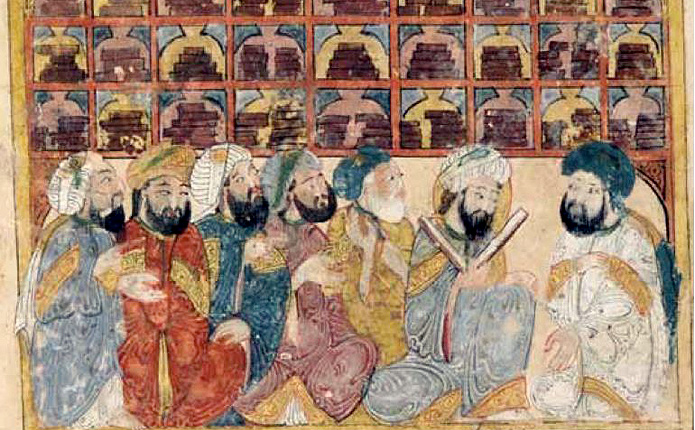
13-th century manuscript, drawn by Al-Wasiti of the celebrated book “The Assemblies”. Written by Hariri, shows a library in Baghdad
The chart that he was commissioned for the construction of Baghdad comes down to us from Al Biruni, a fellow Persian from modern-day Uzbekistan / Turkmenistan, in his monumental work The Chronology of Nations. He is less commonly known by his full name of Abū Rayḥān Muḥammad ibn Aḥmad Al-Bīrūnī (4/5 September 973 – 13 December 1048). Biruni gives us the time, place and date, but makes no mention of the House System or Ayanamsa used for the chart. It’s reasonably considered that Māshā’allāh used Whole Signs and we know his most famous student did also. This still leaves the thorny question of which Ayanamsa he used.
If he used the Sassanian Ayanamsa along with material available to him in the Greater Bundahishn, this would change a great many things and certainly challenge some of our more cherished notions, such as the Chart for Baghdad being done in good faith in the hope of the greatest possible benevolence.
Before proceeding any further, it needs to be said that this chart has been subjected to all kinds of tortuous logic by several astrologers, including my initial article on this chart more than a decade ago. It has always seemed to have been discussed with a touch of reticence.
This is no more than a ‘what if’ because we cannot absolutely prove it either way. As a Persian Jew, Māshā’allāh had good reasons to dislike and resent the Arab Islamic invasion of Persia and the slaughter of Jewish tribes in the Arabian peninsula and elsewhere. Jews had enjoyed a good life in Persia for millennia, as they do to this day. It would be extraordinary if he had no reservations whatsoever.
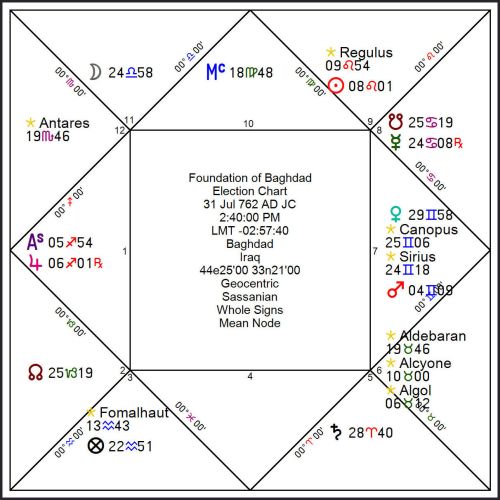
Here we have the chart with all the information passed on to us by Al Biruni, using Whole Sign houses, calculated using the Sassanian Ayanamsa. This strikes me as a struggling chart with little to commend it if continued good fortune was intended when all is said and done. But the chart has never been unequivocally beneficent in any of its forms, using other house systems and the sidereal zodiac, for example. This has been part of the confusion. Baghdad was indeed a great centre of learning with widespread influence, both through space and time. However, it has also suffered excessive calamities and violence over the centuries and still suffers to this day. We see all this in the chart presented here.
The chart is not without considerable merit, but this is undercut by the very real and existential threats that are also illustrated. It is likely that only a seasoned astrologer may detect these in short order, but they cannot be unseen once they have been discovered.
The Sun in the Royal sign if Leo and magnificently placed with Regulus, one of the Royal Stars of Persia, known as the Watchers of the Directions,. Regulus is the Heart of Leo, Watcher of the North and associated with the Archangel Raphael

Isrāfīl.-” Angel with Fish.” Mughal 1590 – Hossein Naqqash
The significance of this star is that it leads to immense good fortune, provided that revenge is avoided. The Fixed Stars are stronger when well connected to a better planet. That is established. But reversals of fortune are part of the bargain if revenge is enacted.
In the ninth house, the Sun with Regulus is a powerful testament to the higher ideals of the proposed purposes and is placed in a near-perfect relation to Jupiter and the Ascendant. This is also ideal when considering the meeting of foreign cultures and of course, religion provided that they don’t come in war. The Sun is in his Joy and in Hayz.
We find Mercury Retrograde and conjunct the South Node in the house of Death. This is most unfortunate. It also brings us back to the Moon. Cancer is her only domicile. The chart would do well to support a strong clerical and other positions falling under the influence of Mercury. At this level, always a crucial one in any system. They will be the keepers of the record and the ones who disseminate information of all kinds to keep the Caliphate strong.
Jupiter is in his own domicile and strong, in fine relationship to the Caliph and supportive of the goals desired This reads like a great blessing and is very likely what Māshā’allāh would emphasise when presenting his election.
However, the fatal signatures of the chart should give us pause.
A brief history of the city shows us that Baghdad’s early meteoric growth was stifled due to problems within the Caliphate itself, including a relocation of the capital to Samarra (during 808–819 and 836–892), the loss of the western and easternmost provinces, and periods of political domination by the Iranian Buwayhids (945–1055) and Seljuk Turks (1055–1135).
Nevertheless, Baghdad held her place and continued as a major cultural and commercial centre in the Islamic world. Then tragedy struck on a massive scale. On February 10, 1258, the city was sacked by the Mongols under the command of Hulagu Khan. The Mongols killed most of the inhabitants, including the Abbasid Caliph Al-Musta’sim. They also destroyed large sections of the city. Even the canals and dykes forming the city’s irrigation system were destroyed. The attack ended the Abbasid Caliphate. It has often been noted that Islamic civilization never completely recovered.
In 1401, Baghdad was again vanquished by Timur. So it continued, until the incursion of the Ottoman Turks. It’s difficult to make the case that Bagdad has not had far more than its share of sorrows and reversals of fortune. It is equally difficult not to recognize the measure of success and abundance during its golden age.
We are used to thinking of the Royal Stars of Persia – the Watchers of the Directions – as Regulus, Aldebaran, Fomalhaut, and Antares, representing the four Fixed Signs as the primary consideration in Persian astronomy. However, the Sassanian model clearly puts the emphasis on Sirius.
Canopus is used in Islam for the orientation of places of worship. For those reasons, I have included it here. It is crucial to consider the Horoscope of the World which we examined in a previous article. In that schema, the House of Life (the Ascendant) was at the nineteenth degree of Cancer, the asterism Azara too was disposed in the star Sirius, which in the chart we have falls in the seventh house at 24°18. I cannot see how he could have missed this detail. He was certainly aware of the Horoscope and the extraordinary power of Sirius.
In the Great Bundahishn
in Chapter 2, sections 3 & 4, in the translation by Behramgore Tehmuras Anklesariawe, we find:
“3. Over these constellations, He appointed four chieftains, in four directions; He appointed a chieftain over these chieftains; He appointed many innumerable stars that are recognized by name, in various directions and various places, as givers of vigour, by cooperation, to these Constellations.
4. As one says: “Sirius [Tishtar] is the chieftain of the East, Sataves the chieftain of the South, Antares [Vanand] the chieftain of the West, the Seven Bears [Haptoring] the chieftain of the North; the Lord of the throne, Capricornus, whom they call the Lord of Mid- Heaven, [is the chieftain of chieftains; Parand, Mazd-tat, and others of this list are also chiefs of the directions.”
Ibn al-Nadīm lists some twenty-one titles of works attributed to Māshā’allāh; these are mostly astrological, but some deal with astronomical topics and provide us with the information (directly or indirectly) about sources used which included Persian, Syriac, and Greek) He was a learned, brilliant and extremely talented man. We wouldn’t expect him to simply make a mistake.
We should not ignore the fact that the chart was drawn up for the Day of Saturn – the Jewish Sabbath. No work is to be done on this day.
We find the Moon in Venusian Libra in the house of the Good Spirit. The Moon can refer to the common people in a Mundane chart and is feminine in any chart. Most interesting, however, is that she is disposited by a Mercurial Venus in the Anorectic degree in the house of open enemies. She is spent. The benefits we might anticipate with Venus in this placement are such that Mars dominates in the sign of the N. Node’s exaltation. Mars is doubly dangerous because he is also the Lord of the 12th house in Scorpio – this house is hidden enemies and self-undoing among other designations. Saturn is in his Fall and in a productive house.
I see no useful purpose to further elaborate on this. It is after all entirely speculative, even if plausible. I realize this turns the old enigma on its head, but sometimes an entirely new way of looking at something can be useful. At the very least, it ought to raise awareness of just how different a chart can appear when the astrologer is using an Ayanamsa that may not have occurred to a modern reader. It also asks the astrologer to consider the cultural differences between practitioners that may very well, on the source be in agreement on virtually everything. This demands that we read far beyond the astrology itself, to the very ground of being which informs us all.
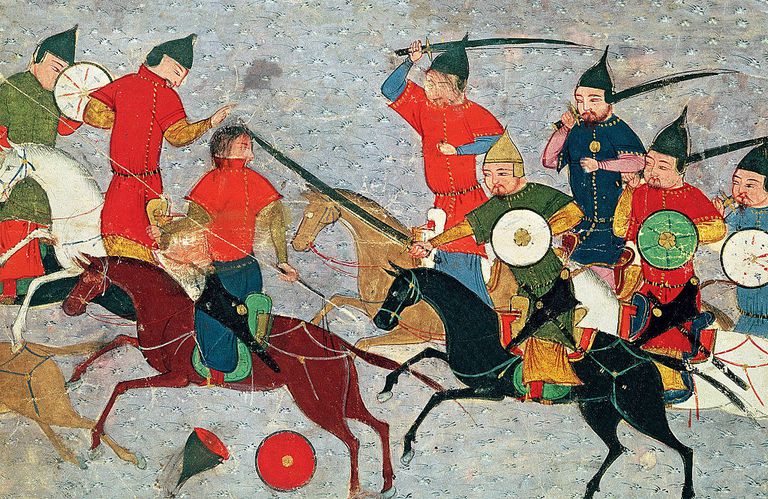
Beginning in 1211, Genghis Khan and his nomadic armies burst from Mongolia and swiftly conquered most of Eurasia. The Great Khan died in 1227, but his sons and grandsons continued the expansion of the Mongol Empire across Central Asia, China, the Middle East, and into Europe.
______________________________________________________
Note: shortly after publishing this brief article, I became aware of another, written in 2003: The Horoscope of Baghdad: historical, astronomical, and astrological notes by Juan Antonio Revilla. The topic is not identical, but Revilla does well in describing context, methodologies and sensibilities involved in deriving the chart. He has a familiarity with Sassanian astrology and discusses many things, such as the Tables of al-Kwarizm, which go beyond the limitations of a single blog post.
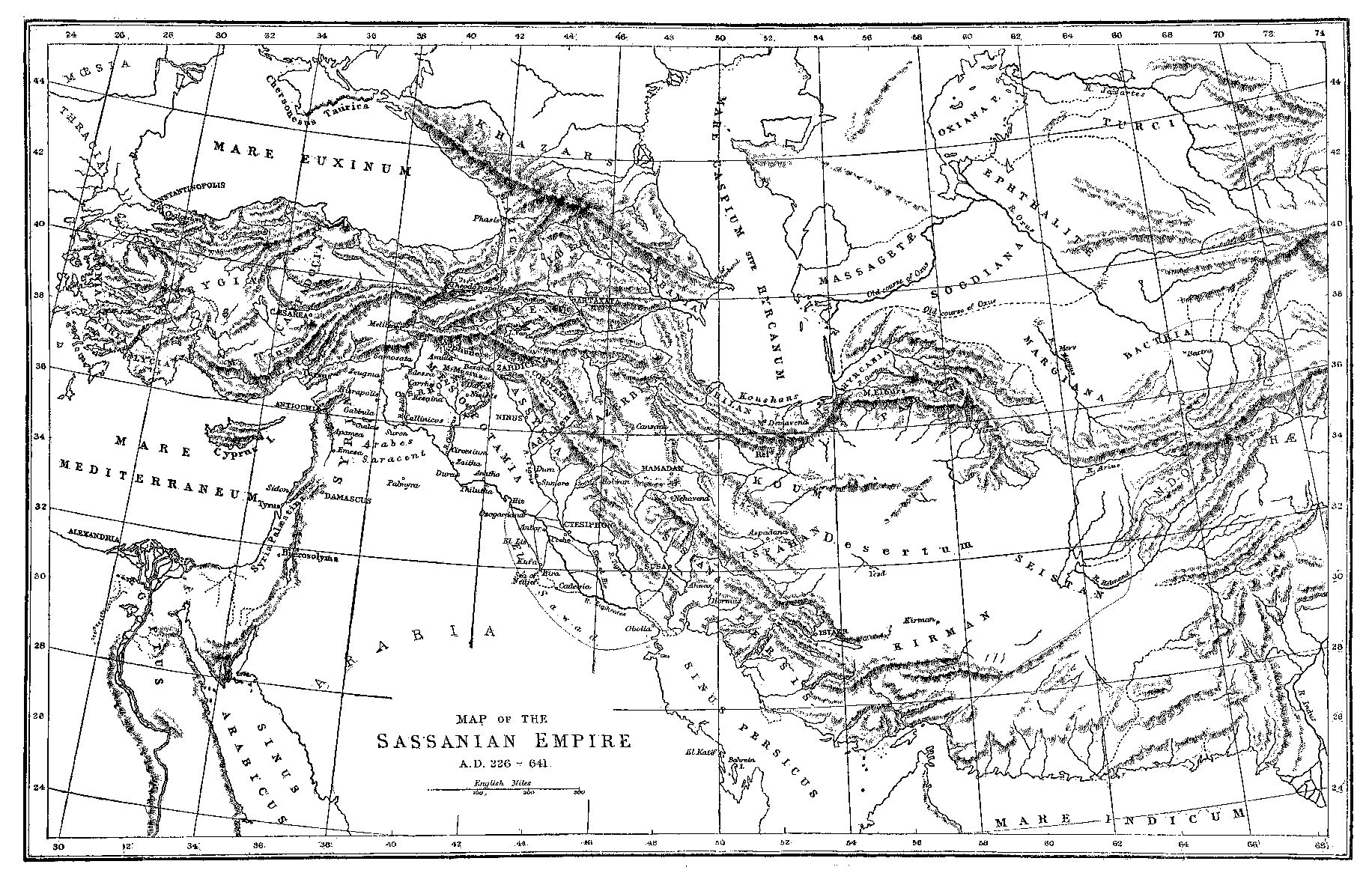
Sassanian Empire
This article barely touches on a very important issue in the history and transmission of ideas, and in particular to those that are related to the celestial arts and related cosmologies. This should be read as one might read the newly exposed contents of a roll-top desk. The topic is potentially so extensive, that a small library would be required to cover even the main points. It should, however, serve as a decent introduction and I have referenced some particularly useful sources for those who wish to delve further. My hope is that this and the articles which follow will ignite interest in this topic by cultivating informed reflection and discussion.
By way of extending this discussion, I’ve decided that it will best be done by a reasonably detailed account of the part played by three Persian astrologers and polymaths: Māšāʾallāh b. Aṯarī, a Persian Jew from Baṣra, was one of the leading astrologers in the ʿAbbasid caliphate from the founding of Baghdad in 145/762, Biruni, Abu Rayhan (362/973- after 442/1050), scholar and polymath of the period of the late Samanids and early Ghaznavids and one of the two greatest intellectual figures of his time in the eastern lands of the Muslim world, the other being Ebn Sīnā (Avicenna) and Abū Ḥafṣ ʿOmar b. Farroḵān Ṭabarī was an astrologer from Ṭabarestān who translated Pahlavi works into Arabic (for example, the five books on astrology by Dorotheus of Sidon) and paraphrased Ptolemy’s Apotelesmatica Tetrabiblos in 812. The few astronomical theories with which his name is associated are Indian; he presumably derived them from Pahlavi books. Biographical details courtesy of Encyclopedia Iranica.
There is a great volume of scholarly editions and studies of the Greek Hermes Trismegistus. Although the origins remained murky in the early European Rennaissance, that did nothing to quell the enthusiasm of Marsilio Ficino and those 0f ensuing generations of scholars, philosophers, and demagogues. However, when we look to the Hermes of the Persians and Arabs, there are precious few studies. One exception to this otherwise bleak outlook is the work of Kevin Van Bladel The Arabic Hermes. The title of this article is the name of a pivotal chapter in that work. In the 2010 edition of the Classical Review, Bryn Mawr provides an admirable summary of the work:

Modern Iran
“Kevin van Bladel has produced an admirable study of the Arabic Hermetic tradition, fleshing out in considerable detail the evolution of Hermes’ image, his identification with Qur’anic prophet Idris as well as the forces driving this transformation, and his connections, real, imagined, and still controversial, with the Harranians, the last organized group of astrolators to continue functioning within Islamic civilization.” .
The most direct source of the reception of Hermetic knowledge in the oriental tradition was Sassanian Persia, the last period of the Persian Empire before the Islamic invasion. The empire took its name from the House of Sasan who governed from 224 to 651 AD. The Sassanians succeeded the Parthian Empire and was a leading regional and ‘world’ power, alongside the Roman-Byzantine Empire. Iy held this position for four centuries. This empire was perfectly situated to be a cultural conduit between India, Greece, Rome and the Middle East and this had been the case for a very long time. Even to this day, the strategic geography of Iran is extraordinary, sharing borders with Turkey, Iraq, Pakistan,, Afghanistan, Armenia, Azerbaijan, Russia and beyond. The US military currently has Iran surrounded in ten countries to make sure she is contained. Persia had long had relations with Asia, including China long before the onslaught of Alexander the Great and the subsequent Hellenizing of much of the known world.
In Alexandria, Priests of Isis mixed with Hindus and Buddhists as well as Jews, Christians, a wide array of Greek philosophers, Gnostics, and Pythagoreans. Ideas, traditions, and wisdom were not merely shared but in many cases, syncretized. It has been said of the Parsis in India that they are like sugar in milk. This is true of many traditions. It is difficult, for example, to read Plotinus without being reminded of Hindu metaphysics or to read St, John’s Gospel without being reminded of Philo, a brilliant Hellenized Jew. It is not always an easy task to see where one tradition ends and another begins.
Until the Islamic conquests, which began in the lifetime of Muhammad and spread from Spain to India within 60 yrs of his death, the desert-dwelling Arabs had a primitive, but fascinating desert culture. It mostly consisted of an oral tradition and the level of literacy was not high. Written language had no great utility beyond that used in trade. Indeed the Prophet himself was known to be illiterate. The Arab tribes were frequently at war with each other, which further impeded a scholarly tradition, As a trading people, they did, of course, come into contact with other cultures. However, there were no centres of learning and those who were identified as learned were most often the Christians, Jews and to some extent the Chaldeans. The work of transposing the spoken word of the Prophet into the written Quran would have mostly fallen to Jewish scribes.
Massive invasions are usually violent and demonstrate little or no interest in the culture being conquered unless it can be readily turned into profit, either of monetary or propagandistic. The second form takes places when places of indigenous worship are destroyed and replaced with the religious symbols of the invading force. This has been the key to the creation of hegemony since the earliest times. Typically, indigenous languages are also replaced by the language of the conqueror. This was certainly the case with Arabic. The Persians had not taken the threat of an Arab invasion seriously. That was a fatal mistake and one that proved that a sufficiently riled up group of illiterate desert dwellers could do hitherto unimaginable damage to a greatly advanced society. The Armies of Islam would prove the same point, time and time again. Temples were razed. Religions outlawed and Mosques built where previously sacred places were celebrated by the vanquished indigenous culture. Conversely, invading forces are exposed to cultural ideas, including ones seen as scientific, that serve to edify the culture of the invader.
Van Bladel writes: “Middle Persian, the language of the Sasanian court and administration of government, as well as their Magian (Zoroastrian) religion, was displaced by Arabic after the Arab conquest and colonization of Iran in the seventh and eighth centuries.3 Arabic, the prestigious language of the new rulers and of their new religion, Islam, superseded written Iranian languages almost entirely. Education and literacy in Middle Persian and other Iranian languages became practically obsolete for Iranians who converted to
Islam. The children of converts learned Arabic, the language of their scripture, as their own literary medium.” (p.21)
However, Persia had already suffered a much earlier blow at the hands of Alexander and beyond the savagery and brutal destruction, Persian culture was to attain the advantage of being part of the Hellenized world which, ironically perhaps, helped preserve core texts, even if many were lost forever. Alexander must have seemed a complete monster to the Persian and to this day he is known in Iran as “the horned one.” It is an irony that beggars belief that Alexander would be included in the line of the Prophets of Islam.
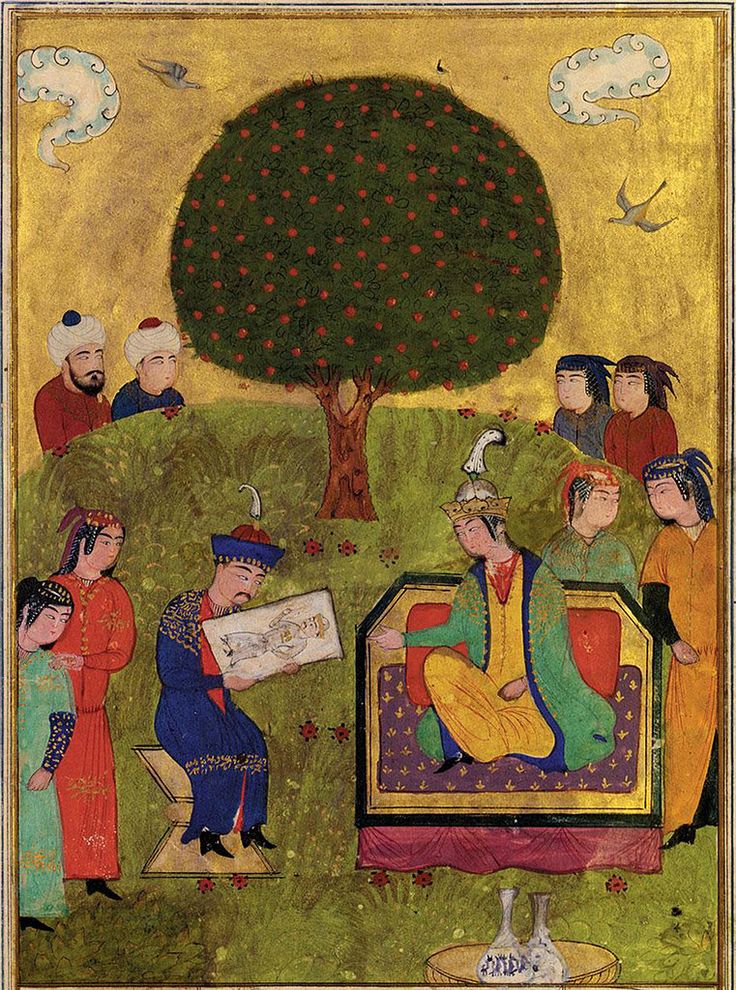
An illustrated leaf from the Sharafnama of the Khamsa of Nizami: Queen Nushaba recognizes Iskandar [Alexander the Great] by his portrait, Persia, circa 1490-1500 miniature 15.5 by 11.2cm.
“although it was known that they were from three different countries, Persia, India, and Babylonia. But their activities seemed interchangeable, at least from the first century CE onward. Therefore, the ‘wise men’ mentioned in the Gospel of Matthew are called Magians, although the correct term for people observing celestial omens would have been Chaldaeans, mathematicians or astrologers (Chaldaioi, mathematikoi or astrologoi).” (Magians after Alexander.)
This is usually interpreted as a diminished occidental view of the orient and it may very well be that. Nevertheless, it may also be a case of general recognition and familiarity, since European groups such as the Druids were also similar in almost all respects. It may be a case of “a rose by any other name.” Certainly, all these came together in Ficino’s prisca theologia This is the doctrine that asserts “that a single, true theology exists, which threads through all religions, and which was anciently given by God to man.” (Yates, F., Giordano Bruno and the Hermetic Tradition, Routledge., London, 1964, pp 14–18 and pp 433–434)
In light of the many considerations, it may very well have happened that the ‘un Islamic’ Persian Hermetica would have been lost to history. As it happens, much of it not only survived but made its way into the Islamic world and the Arabic language.
Van Bladel tells us: “The name Hermes was invoked in Sassanian Mesopotamia as a source of occult power. A few surviving texts of Syro-Mesopotamian origin provide the attestations: two Babylonian Aramaic incantation bowls containing the same formula, found at Nippur (modern Niffar) in Iraq, once part of the Sasanian Empire, and a magical amulet written in Syriac on parchment dating to Sasanian times.11 Incantation bowls are a type of popular magical apparatus inscribed with texts in different Eastern varieties of Aramaic made from about the fourth to the seventh century, that is, under the Persian Sasanid dynasty, in Mesopotamia.
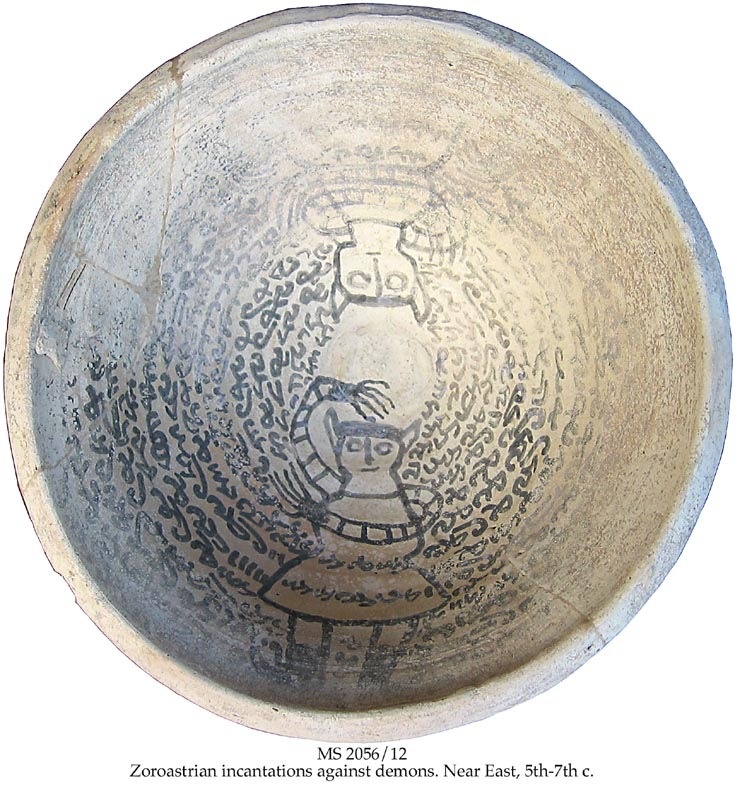
Unfortunately little is known about exactly how they were used.12 The two bowls mentioning Hermes invoke him as a magical power, so that the protective operation is performed not only in the name of four angels but also in the name of “Hermes the Great Lord.” One of these bowls was made for the benefit of “Yazīdād, son of Yazdāndukh(t),” both Middle Persian names indicating a Persian, perhaps aristocratic, recipient. As for the parchment amulet, although it was written in Syriac, it was made for the protection of a certain ¢warrawehzād, called Yazdānzādag, daughter of De¯nag, whose name is also clearly Middle Persian” pp.25-6).
These types of bowls were not uncommon: “Across the ancient world, demons and other forces of evil were treated as genuine threats to reckon with. In Sasanian Mesopotamia from the fifth to the seventh centuries CE, clay Aramaic incantation bowls, commonly known as magic bowls were widely used to expel demons and protect houses.” See the work of Avigail Manekin Bamberger, a doctoral candidate in the department of Hebrew Culture Studies at Tel Aviv University. It needs to be said that these bowls were used for the same purposes by Jews and Christians.

Al Kindi
One could fairly ask, why the Islamic and Arabian world couldn’t have simply taken the Hermetic teachings from the Greeks. particularly during this time period, when there was no dearth of excellent translators and as had been mentioned, various cultures had been blending for a very long time. It was not a Persian, but Al Kindi who was largely responsible for the transmission:
Abu Yūsuf Yaʻqūb ibn ʼIsḥāq aṣ-Ṣabbāḥ al-Kindī, known as “the Philosopher of the Islamic empire.” He was an Arab Muslim philosopher, polymath, mathematician, physician, and musician. :
“A description of Hermes and his teachings is preserved in the collection of wise sayings made by al-Mubaššir ibn Fātik in Fātịmid Egypt, Kitāb Muxtār al-ḥikam. These passages are treated extensively in sections 5.2 and 5.3 in this volume, but a brief summary here will help to make this survey of testimony about Ḥarrānian Hermetica complete. Al-Mubaššir’s source describes Hermes:
“as a prophet teaching pious commandments in the form of maxims, as well as an outline of rules for Hermes’ religion and his wise advice. Although al-Mubaššir’s treatment of Hermes and his instructions include no direct references to Ḥarrānians or to Ṣābians in general, the religion taught by Hermes in this account is similar to as-Saraxsı’s description of the Ḥarrānian Ṣābian religion: it included feasts at astrological conjunctions and at the sun’s entry into a new zodiacal sign, as well as sacrificial offerings to the planets at the appropriate times. Hermes is also said to have commanded them “to perform prayers that he stated for them in ways that he described.” On the other hand, the religious laws of Hermes given here bear close resemblance to Islamic law: they require ritual purity, abstinence from intoxication, gˇihād against the enemies of the religion, alms (az-zakāt), and prescribe most of the punishments called ḥadd punishments in Islamic law. All this leads me to conclude that the “religion of Hermes” described here was developed and described well after the establishment of Islam and Islamic law.” (pp 94-5).
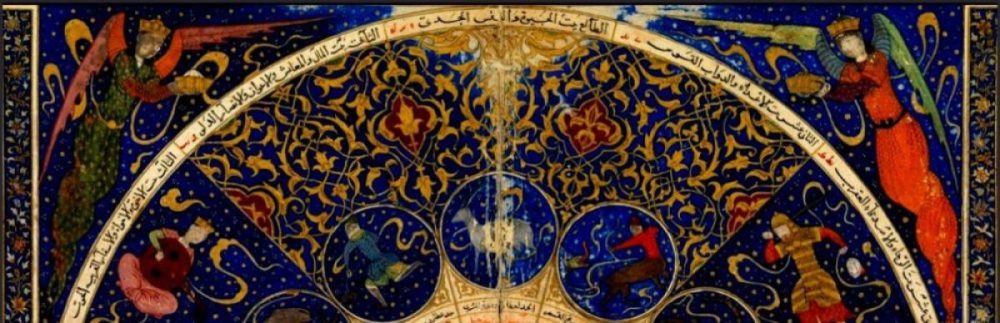
This was a clever manoeuvre but certainly not unprecedented. Most importantly, it ensured that something of the indigenous religion of Iran would prevail and with this many other elements entered the Islamic world. This was also the case with the Angelology of Zoroastrianism. It not survived but was exalted by Islamic Persian artists in some of the most exquisite miniatures. Core beliefs of the Persians were passed on. It may well be surmised that without this transmission the Golden Age of Islam would have been far less likely to have occurred.
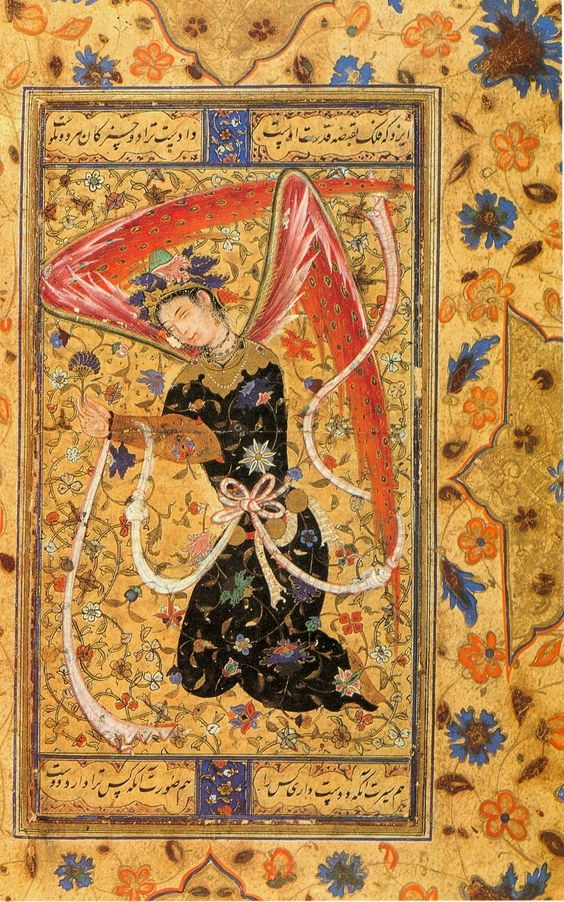
Persian miniature (1555)
With regard to the import of the book, we began by discussing is brilliantly summarized by “Bryn Mawr in the same classical review article. I leave the closing words of this first part of the study to him:
“Hermes the prophet of science is a combination of “ancient Judaean lore” concerning the biblical Enoch with Hellenistic astrology, including stories of heavenly ascents in order to receive science from the angels. ….. With Hermes as its prophet, science becomes revelation and as such is superior to the musings of the philosophers.” (Classical Review 2010.02.63).
In articles to follow, we will look at a variety of other Persian and Indian sources.

Gemini – Horoscope from ‘The book of the birth of Iskandar” Credit: Wellcome Library, London.
This article is little more than a footnote that concerns an intriguing passage I had the good fortune to read while perusing a publication of The Metropolitan Museum of Art (1997) : Following the Stars: Images of the Zodiac in Islamic Art by Stefano Carboni. The book is out of print, but you can find a digital version @ Google books.
Mercury is known as many, many things, from the Trickster to the Psychopomp, the Magician & the Physician. His very nature is protean and either gender may be applied, depending on the relative position of the Sun. He is also known as Quicksilver and the Patron of Scribes. Mercury is by nature duplicitous. The glyph for Mercury suggests he is a messenger of the Sun and Moon  But the term ‘hypocritical’ has further implications, specifically professing a virtue that not only one does not possess while impugning a lack of the same virtue in others. The term ‘two-faced’ applies and that may be one of Mercury’s greatest possessions.
The word munafiqun (‘hypocrites’, Arabic: منافقون, singular munāfiq) was a group decried in the Quran as those who professed to be Muslims but were secretly holding antipathy to the Islamic cause and sought to defeat the Muslim community. For example, sura ‘Al-Munafiqun’, Quran 4:61, Quran 9:67, Quran 8:49, Quran 4:140, Quran 9:64, Quran 4:145. Hypocrisy itself is called nifāq (Arabic: نفاق).
The Islamic context exceeds the negative connotations of the English word hypocrite. The Munafiq is considered worse than an unbeliever, with the tribal connotations of a traitor.
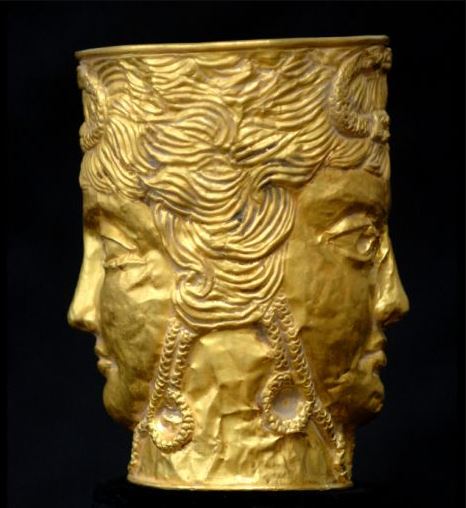
Ancient Persian gold cup featuring two faces gazing in opposite directions, with entwined serpents. 4th century B.C.E.
When he is represented as one of the seven planets and luminaries, the traditional iconography is maintained. However, when the same planet is read in actual astrology, “he “hypocritical” association is operative. Carboni explains that Mercury was considered a munafiq because it “did not have positive or negative influences (in conjunction with a lucky planet, he brought good fortune, and with an unlucky one, ill fortune.) His neutral and ultimately weak nature was reflected in his image as conveyed by the representatives of the two Zodiac signs he presides over, Gemini and Virgo… that Mercury not only did not maintain his attributes of the pen and scroll but also was superseded by the more powerful image of the Head and Tail of the Dragon.” (p.13)
.This particular twist would seem to be in accordance with the Sassanian schema I discussed in the previous article. The horoscope of the World is based on Exaltations, rather than the Domicile basis of the Greek Thema Mundi. It is probably the case that the Sassanian model sought one that placed the Sun not only in Dirunal charts but one that places the Sun in his Exaltation in Aries the Tenth House The Exaltation of the Head of the Dragon is Gemini.
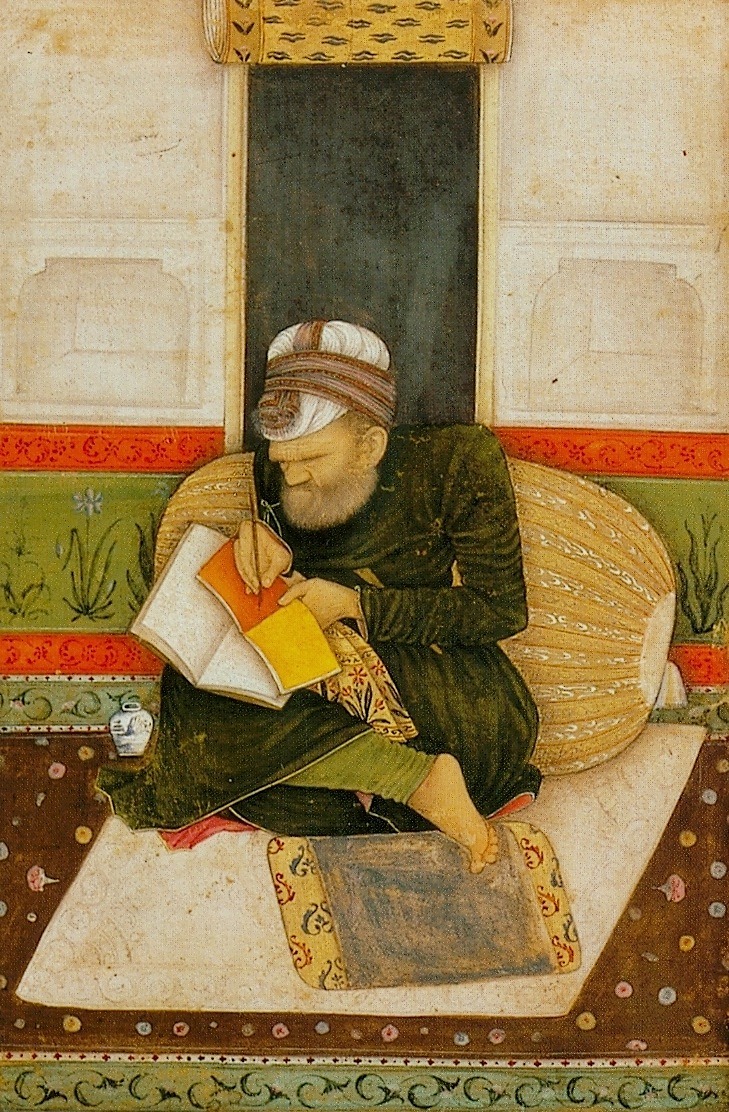
Bichitr, A Scribe, ca. 1625.
We know the Persian influence on Arabian astrology was enormous and we also have the Persian Al Biruni’s view, albeit indirectly expressed. In this regard, we can look to the talismanic assignments given by Biruni who places a Serpent in the right hand of Mercury. Carboni touches on this briefly in the same article.
>This ought to show that although a great deal of imagery and meaning is shared from one culture to another, that in some cases the meaning can seem virtually alien. This should always be borne in mind when taking concepts from foreign cultures, even when they seem to have a great deal in common. On the other hand, the cognitive jolt one might experience from such interactions can force one to see connections that would otherwise have been missed.
.”
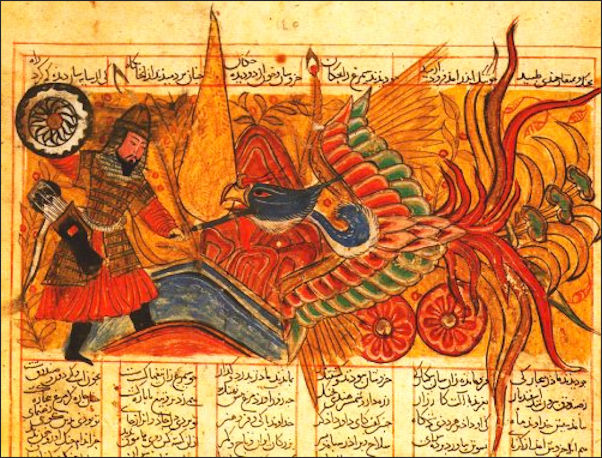
This is but a cursory introduction to the Greater Bundahishn which will be followed by articles with a sharper focus. The work contains a concise narrative of the Zoroastrian creation myth, including the first conflicts between Ahura Mazda and Angra Mainyu for the hegemony of the world. In the process, the Bundahishn recites an exhaustive compendium on the nature of things, including the properties of the elements and significant astrological material. For those interested, there is a pdf version of the work here.
The Bundahishn exists in two forms, the Greater, and the Lesser. The first is the longer Persian version and the shorter or lesser is an Indian version. Here we will be discussing the former only. The title of the work translates as ‘primal creation” The work concerns itself with every imaginable question that might be raised about the Creation, including the origin and nature of the dark force and it’s antagonism to the light force, ultimately for a greater good. Compared to comparable works, such as Genesis, it is concise, to the point and quintessentially Persian in its optimistic point of view, even in the face of cosmic adversity. Although the work is late, almost certainly the ninth century, it harks back to the ancient religion of Zarathustra.
As stated by the author at Encyclopedia Iranica, “it’s a major Pahlavi work of compilation, mainly a detailed cosmogony and cosmography based on the Zoroastrian scriptures but also containing a short history of the legendary Kayanids and Ērānšahr in their days. There is also a Ṣad dar-e Bondaheš, a considerably later (ca. 8th-9th/14th-15th century) work in Persian of a hundred miscellaneous chapters on the Zoroastrian religion, morals, legends, and liturgy.” (Encyclopedia Iranica)
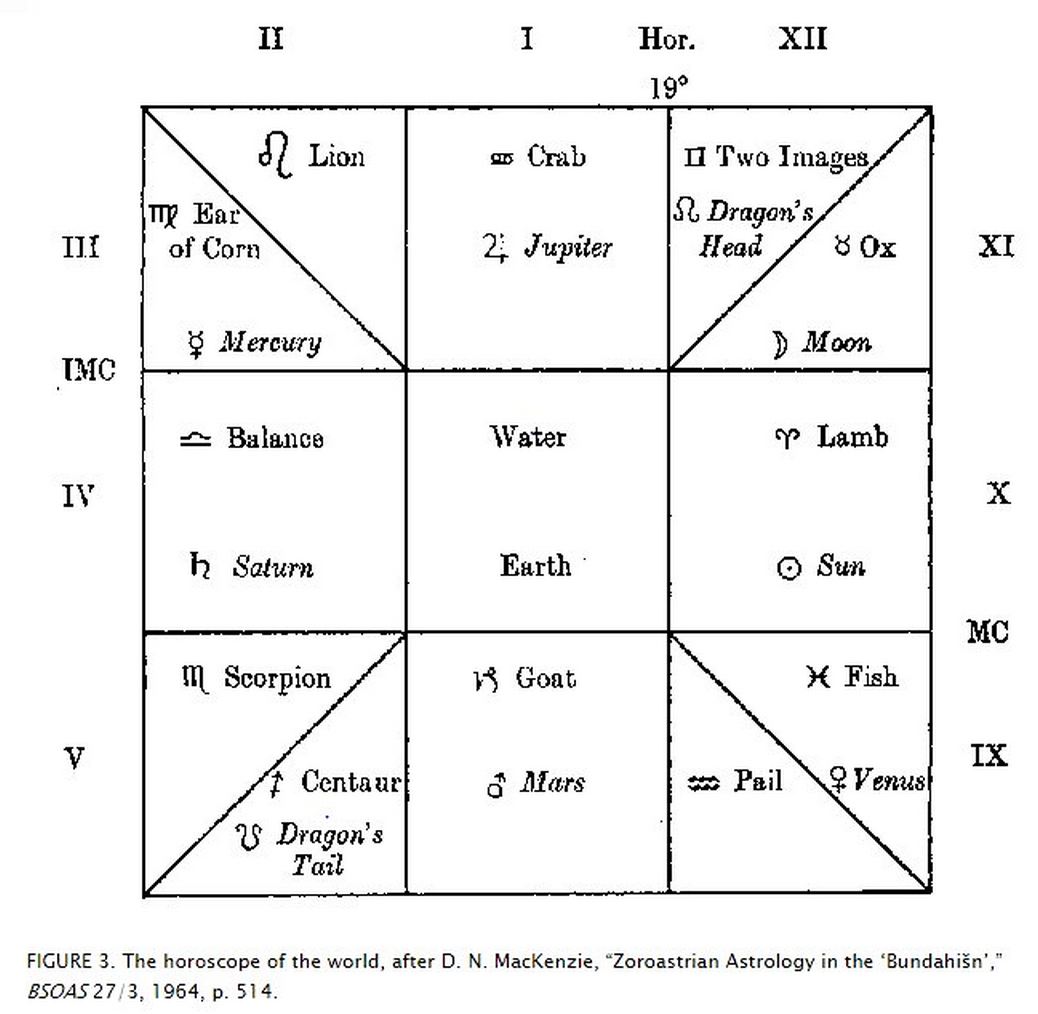
As David Pingree has observed, “the Sassanian horoscope is quite different from the normal Greek Thema Mundi. with which it has been compared.” (Masha’allah: some Sasanian and Syriac sources. pp. 5) The most immediately noticeable feature of the Sassanian horoscope is that it is diurnal, with Aries, the exaltation of the Sun occupying the tenth house, rather than the Sun with Leo in the second house in the diurnal Thema Mundi. Instead of the planets and luminaries being placed in their respective domiciles, they take the place of their exhalations. However, there are some interesting anomalies. The Ninth House is occupied by the sign Pisces with Venus and Mercury, the first is exalted in Pisces, but Mercury falls in the sign of the Fishes.
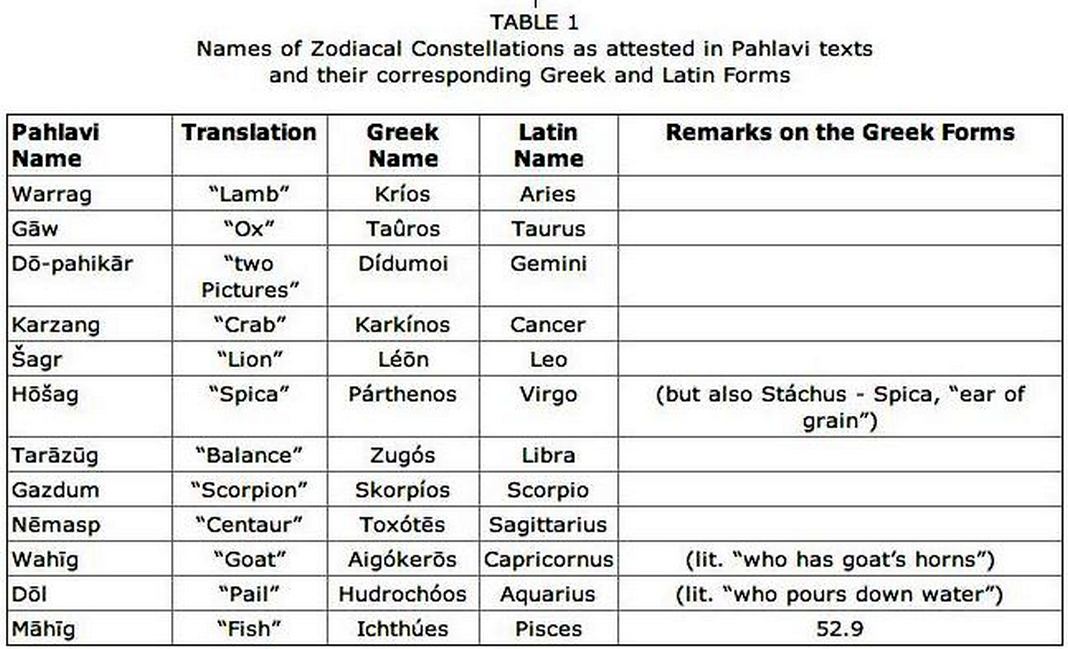

The degrees assigned to the signs and planets is crucial to the overall meaning. We know that Persians translated Greek astrological material. Less often mentioned is the influence of Indian astrology.
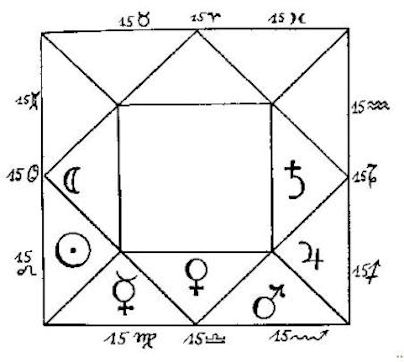
Thema Mundi
The Ascendant is in Cancer at the same degree as Sirius, “know as Tishtar in the Khurta (Lunar constellation) Azrarag, which corresponds to the Indian naksatra, Aslesa [9th of the 27 nakshatras in Hindu astrology.] (Cancer 16;40° – 30°)” Pingree p. 5-6.
The other most striking difference is in relation to the nodes, in the exaltation but occupying the unfortunate houses. The house of the Evil Spirit is given to the North Node (Rahu) and Gemini. The S. Node (Ketu) is given to Sagittarius.
However, the exaltation of the Sun in Aries is shown at 19° which concords with the Greek assignment. The Indian degree of exaltation is 9°. The Persian sources appear to be troubled by the Sun being in a nocturnal chart of creation. This makes perfect sense considering the importance and symbolism of the Sun in indigenous Persian religion. The Lunar Mansions and Fixed Stars clearly play a role in the placement of the planets and luminaries but beyond that, we need to refer to the Persian accounts of Creation.
The Hermetic Thema Mundi is an astrological teaching tool and it is also decidedly Platonic in its expression of a perfect world of the Forms to be referred to for those who practise astrological divination. It may very well be more than that, but the Sassanian version is something quite different. It appears, after all, in a text describing every element of creation, according to ancient Persian and specifically Zoroastrianism cosmology:
“According to the spherical model assumed in Sasanian Iran under the impact of Greek and Indian astral sciences, the inferior sphere was called the spihr ī gumēzišnīg “sphere of mixture;” it comprised the twelve constellations (Pahl. 12-axtarān) which were subjected to the “mixture” with the demoniac and evil forces (planets, falling stars, comets, etc.); this sphere, of course, included the Zodiacal belt (see Ir. Bd., II, 8-9; cf. Henning, 1942, pp. 232-33, 240; Belardi, 1977, pp. 125-26) with its 12 constellations (Gignoux, 1988); here a most important battle between astral demons and divine star beings takes place, according to the Pahlavi sources. In the framework of the fight between stars and planetary demons, the Zodiacal constellation were considered as bayān, in its early meaning of “givers” of a good lot in opposition to the planets, who are “bandits” (gēg) and robbers of the human fortune.” (Encyclopedia Iranica)
The Greater Bundahishn is a compendium of ideas that are believed to pre-date Zoroastrianism, but the core is true to the cosmology of that religion. There are also some elements that would indicate knowledge relatively contemporary to its ninth century appearance. It appears to be putting preserved knowledge in one place after the horrific destruction in the wake of the Islamic invasion.

‘Buddha offers fruit to the devil’ from 14th-century Persian manuscript ‘The Jāmi
 The Classical Astrologer